Why Nations Fail: Daron Acemoglu interview | The Economist
29 Sep 2018 Leave a comment
in comparative institutional analysis, constitutional political economy, development economics, economic history, economics of bureaucracy, economics of regulation, entrepreneurship, growth disasters, growth miracles, income redistribution, international economics, law and economics, property rights, Public Choice, rentseeking Tags: Daron Acemoglu
Instrumental Variables estimation – colonial origins of economic development
17 Jun 2018 Leave a comment
in comparative institutional analysis, constitutional political economy, development economics, econometerics, growth disasters, growth miracles, health economics, law and economics, property rights, Public Choice Tags: Daron Acemoglu, economics of colonialism
Do the European welfare states free ride off American entrepreneurship and innovation?
12 Nov 2015 1 Comment
in applied price theory, applied welfare economics, comparative institutional analysis, constitutional political economy, economic history, economics of regulation, entrepreneurship, industrial organisation, politics - USA, public economics, survivor principle, taxation, technological progress Tags: creative destruction, Daron Acemoglu, Denmark, entrepreneurial alertness, Eurosclerosis, international technology diffusion, taxation and entrepreneurship, taxation and innovation, taxation and investment, taxation and labour supply, technology followers, welfare state
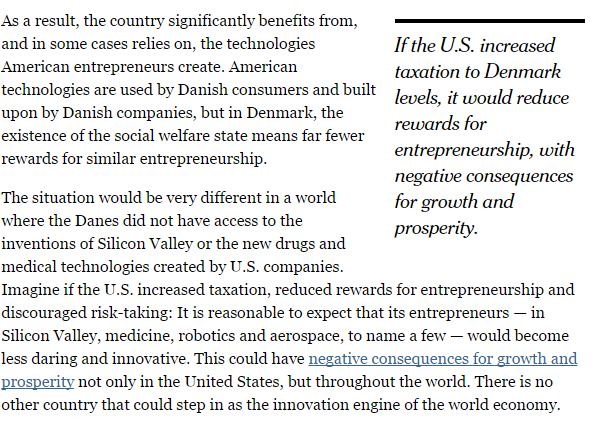
Source: Daron Acemoglu A Scandinavian U.S. Would Be a Problem for the Global Economy – NYTimes.com.
Piketty on inequality: views of the IGM economic experts
16 Oct 2014 Leave a comment
in applied price theory, applied welfare economics, comparative institutional analysis, constitutional political economy, discrimination, economic growth, entrepreneurship, gender, human capital, income redistribution, industrial organisation, labour economics, Marxist economics, Rawls and Nozick Tags: Daron Acemoglu, James Robinson, Piketty, poverty and inequality, The Great Enrichment
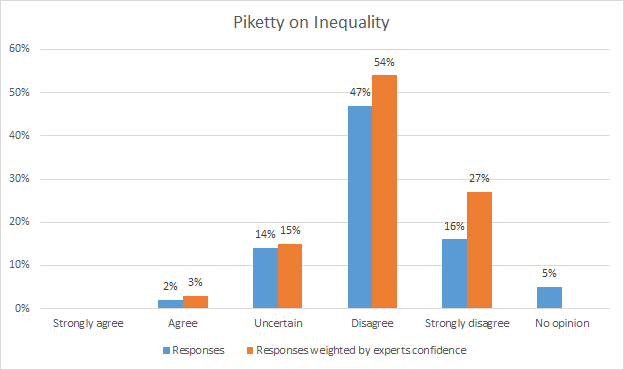
Question: The most powerful force pushing towards greater wealth inequality in the US since the 1970s is the gap between the after-tax return on capital and the economic growth rate?
Daron Acemoglu and James Robinson have a simple explanation for why Piketty is wrong:
But like Marx, Piketty goes wrong for a very simple reason. The quest for general laws of capitalism or any economic system is misguided because it is a-institutional.
It ignores that it is the institutions and the political equilibrium of a society that determine how technology evolves, how markets function, and how the gains from various different economic arrangements are distributed.
Despite his erudition, ambition, and creativity, Marx was ultimately led astray because of his disregard of institutions and politics. The same is true of Piketty.
Hayek’s spotty record as a prophet in the Road to Serfdom – part 2: what about the post-colonial Third World?
13 Apr 2014 Leave a comment
in constitutional political economy, development economics, economics, F.A. Hayek, politics, Public Choice Tags: Daron Acemoglu, Hayek, Road to Serfdom
Gordon Tullock used Sweden to argue that the problem with The Road to Serfdom was:
“that it offered predictions which turned out to be false. The steady advance of government in places such as Sweden did not lead to any loss of non-economic freedoms.”
But was socialism good for democratic consolidations in the post-colonial third world? Was that not a better hunting ground for Hayek’s fears?

The people and parties, very often with a socialist hew, who won the election after the colonial government left town are not always all that keen to give up the reins of power.
Remember Huntington’s Two Turnover Test: when a nation moves from an emergent to a stable democracy, it must undergo two democratic and peaceful turnovers of ruling parties.
After an emerging democracy’s first turnover, the new administration often reverts to authoritarian rule. Russia under Yeltsin and Putin are examples.
Would Singapore be an example of central planning and state ownership leading to serfdom and a one-party state?
The state controls and owns firms that comprise at least 60% of the GDP through government entities. The vast majority (more than 80%) of Singaporeans live in public housing;
Although initially styling itself an anti-Communist and Social Democratic, the People Action Party (PAP) was expelled from the Socialist International in 1976 because it suppressed dissent and jailed opposition leaders. Hayek would be vindicated?!
The Index of Economic Freedom says that Singapore is a nominally democratic state ruled by the PAP since the country became independent in 1965, and that certain rights, such as freedom of assembly and freedom of speech, remain restricted
The Freedom House 2010 country report notes that Singapore is not an electoral democracy despite elections free of irregularities and mentions that all domestic newspapers, radio stations, and television channels are owned by government-linked companies, which limits free speech. The PAP has used the Government’s extensive powers to place formidable obstacles in the path of political opponents.
Daron Acemoglu has written on the role of institutions on post-colonial development in his why nations fail research agenda.
- In Africa, Central America, the Caribbean and South Asia, European powers set up extractive states. These institutions did not introduce much protection for private property nor did they provide checks and balances against government expropriation. The explicit goal of the Europeans, in one form or another, was the extraction of resources from these colonies.
- This colonization strategy contrasts with the institutions that the Europeans set up in colonies in which they settled in large numbers, e.g., the United States, Canada, Australia and New Zealand. In these colonies, life was modelled after that in the home country; the emphasis was on the enforcement of property rights for a broad cross-section of society, especially smallholders, merchants and entrepreneurs.
The same British colonists established different institutions in very different parts of the world:
- If Europeans settled in a colony, institutions were developed for their own future benefits.
- If Europeans did not settle in a colony, they set up a highly centralized state apparatus and other similar institutions to oppress the native population and to facilitate the extraction of resources in the short run
Acemoglu has written on Singapore as a stable non-democracy that can persist without significant repression.
Singapore was able through industrialization in the post-colonial period to ease social tensions and thus eliminate the need for democratic consolidation and also the need for repression. China’s ruling elite has the same current goal.
Why has Singapore not democratized? Acemoglu suggests is it is because Singapore is a very equal society. There is no traditional wealthy landed elite and the economy relies on external capital and businesses.
Most people appear to be relatively happy with the status-quo, at least not so unhappy that they want to engage in serious, and potentially costly, collective action to induce a major change in political institutions.
All and all, political economy has come on in leaps and bounds since 1944. Hayek should be judged against the other predictions of his times. Few socialist countries in the post-colonial Third World stayed democratic for long.
 Utopia, you are standing in it!
Recent Comments