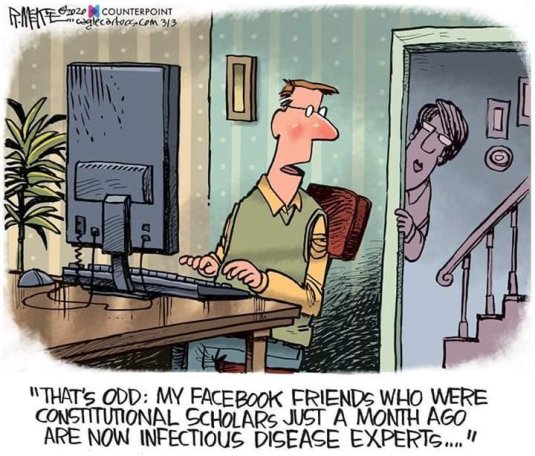
https://www.facebook.com/groups/sciencehumor/permalink/3136897759706592/?sfnsn=mo
Celebrating humanity's flourishing through the spread of capitalism and the rule of law
05 Mar 2020 Leave a comment
in economics of education, health economics, politics - Australia, politics - New Zealand, politics - USA Tags: Dunning-Kruger effect, rational ignorance, rational irrationality
26 Apr 2018 Leave a comment
in health economics Tags: Dunning-Kruger effect
17 Sep 2015 Leave a comment
in managerial economics, organisational economics Tags: cognitive psychology, conjecture and refutation, Dunning-Kruger effect
Avoid Mount Stupid http://t.co/PrtPoRX3xJ—
Steve Case (@SteveCase) September 15, 2015
10 Aug 2015 Leave a comment
in applied price theory, economics of education, economics of media and culture, gender, human capital, labour economics, personnel economics Tags: cognitive psychology, Dunning-Kruger effect, economics of personality traits, reversing gender gap
Great scientists know what they don't know. 1st step to learning. Female economists winning. blogs.lse.ac.uk/impactofsocial… http://t.co/xcfCvMNU3U—
S Dynarski (@dynarski) July 03, 2015
21 May 2015 Leave a comment
Where are you on this graph @AlanKohler ? 😉 http://t.co/L89lQXGKHN—
Tim Mackay (@timqfadvice) May 16, 2015
14 May 2015 Leave a comment
in economics of education, human capital, labour economics, labour supply, occupational choice Tags: cognitive psychology, Dunning-Kruger effect, economics of personality traits, educational psychology

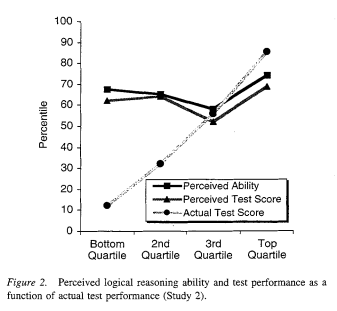
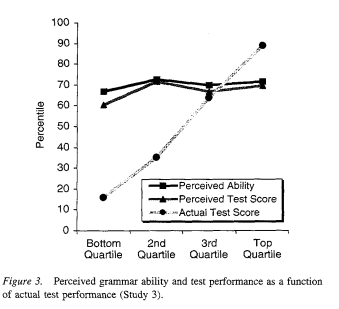

The grammar test is the easiest explanation of the Dunning-Kruger effect. The only way to know you have bad grammar is to have good ground but as you don’t have good grammar you think you have good grammar because you don’t know you have bad grammar because you have no way of self-assessing your bad grammar because you don’t have good grammar.
28 Mar 2015 Leave a comment
in liberalism Tags: Dunning-Kruger effect
12 Mar 2015 3 Comments
in economics of education, human capital, managerial economics, organisational economics, personnel economics Tags: coaching, cognitive psychology, Dunning-Kruger effect, John Cleese, psychology of learning, Socratic questions
This seems to be a tension between the Dunning-Kruger effect on the principles of coaching as encompassed by its modern manifestation, non-directional coaching.
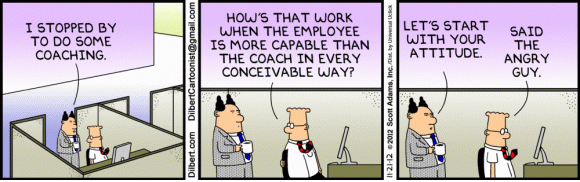
Under the modern fad of non-directional coaching, the coach asks open-ended questions which will elicit from the coached his or her own breakthroughs. Questions like what happened, what did you do then, is there another way will lead the student of the coach to reveal their knowledge within?

Psychologists David Dunning and Justin Kruger published a paper in which they described cognitive trait that quickly became known as the Dunning-Kruger effect. In a recent article, Dunning summarizes the effect as:
…incompetent people do not recognize—scratch that, cannot recognize—just how incompetent they are
He further explains:
What’s curious is that, in many cases, incompetence does not leave people disoriented, perplexed, or cautious.
Instead, the incompetent are often blessed with an inappropriate confidence, buoyed by something that feels to them like knowledge.

People who lack the skill to do something also lack the skill to recognise that they don’t know how to do it and to develop the skill how to do it. Dunning also points out:
An ignorant mind is precisely not a spotless, empty vessel, but one that’s filled with the clutter of irrelevant or misleading life experiences, theories, facts, intuitions, strategies, algorithms, heuristics, metaphors, and hunches that regrettably have the look and feel of useful and accurate knowledge.
I’m bad at spelling, grammar and proofreading my own work. To know how skilled or unskilled I am at using the rules of grammar, I must have a good working knowledge of those rules to start with the self-assessed myself as not been good at grammar. This is impossible for me to find out for myself because I don’t know the rules of grammar to tell me that I don’t know the rules of grammar and to what extent I don’t know the rules of grammar. I have succumbed to the Dunning-Kruger Effect
“The Dunning–Kruger effect is a cognitive bias in which unskilled people make poor decisions and reach erroneous conclusions, but their incompetence denies them the metacognitive ability to recognize their mistakes.
The unskilled therefore suffer from illusory superiority, rating their ability as above average, much higher than it actually is, while the highly skilled underrate their own abilities, suffering from illusory inferiority.
Actual competence may weaken self-confidence, as competent individuals may falsely assume that others have an equivalent understanding.
As Kruger and Dunning conclude, ‘the miscalibration of the incompetent stems from an error about the self, whereas the miscalibration of the highly competent stems from an error about others’. The effect is about paradoxical defects in cognitive ability, both in oneself and as one compares oneself to others.”
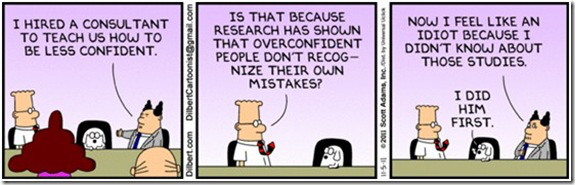
Poor performers fails to see the flaws in their thinking or the answers they lack. As Dunning explains:
A whole battery of studies conducted by myself and others have confirmed that people who don’t know much about a given set of cognitive, technical, or social skills tend to grossly overestimate their prowess and performance, whether it’s grammar, emotional intelligence, logical reasoning, firearm care and safety, debating, or financial knowledge.
College students who hand in exams that will earn them Ds and Fs tend to think their efforts will be worthy of far higher grades; low-performing chess players, bridge players, and medical students, and elderly people applying for a renewed driver’s license, similarly overestimate their competence by a long shot
Dunning and Kruger proposed that, for a given skill, incompetent people will:
Going back to my point about the modern trend in coaching of asking non-directive questions and open-ended questions and expecting the student to make their own breakthroughs, this contradicts the Dunning Kruger effect and the requirement that it be fixed through training. Coaching is not training; they are separate activities.
I was taught this non-directive coaching and went round the workplace asking questions of colleagues who are not economists using these open-ended questions of a coach. None of them made breakthroughs as a result of questions such as what happened, what happened then and other Socratic questions such as those below:
Conceptual clarification questions
Get them to think more about what exactly they are asking or thinking about. Prove the concepts behind their argument. Use basic ‘tell me more’ questions that get them to go deeper.
· Why are you saying that?
· What exactly does this mean?
· How does this relate to what we have been talking about?
· What is the nature of …?
· What do we already know about this?
· Can you give me an example?
· Are you saying … or … ?
· Can you rephrase that, please?
Probing their assumptions makes them think about the presuppositions and unquestioned beliefs on which they are founding their argument. This is shaking the bedrock and should get them really going!
· What else could we assume?
· You seem to be assuming … ?
· How did you choose those assumptions?
· Please explain why/how … ?
· How can you verify or disprove that assumption?
· What would happen if … ?
· Do you agree or disagree with … ?
Probing rationale, reasons and evidence
When they give a rationale for their arguments, dig into that reasoning rather than assuming it is a given. People often use un-thought-through or weakly-understood supports for their arguments.
· Why is that happening?
· How do you know this?
· Show me … ?
· Can you give me an example of that?
· What do you think causes … ?
· What is the nature of this?
· Are these reasons good enough?
· Would it stand up in court?
· How might it be refuted?
· How can I be sure of what you are saying?
· Why is … happening?
· Why? (keep asking it — you’ll never get past a few times)
· What evidence is there to support what you are saying?
· On what authority are you basing your argument?
Questioning viewpoints and perspectives
Most arguments are given from a particular position. So attack the position. Show that there are other, equally valid, viewpoints.
· Another way of looking at this is …, does this seem reasonable?
· What alternative ways of looking at this are there?
· Why it is … necessary?
· Who benefits from this?
· What is the difference between… and…?
· Why is it better than …?
· What are the strengths and weaknesses of…?
· How are … and … similar?
· What would … say about it?
· What if you compared … and … ?
· How could you look another way at this?
Probe implications and consequences
The argument that they give may have logical implications that can be forecast. Do these make sense? Are they desirable?
· Then what would happen?
· What are the consequences of that assumption?
· How could … be used to … ?
· What are the implications of … ?
· How does … affect … ?
· How does … fit with what we learned before?
· Why is … important?
· What is the best … ? Why?
And you can also get reflexive about the whole thing, turning the question in on itself. Use their attack against themselves. Bounce the ball back into their court, etc.
· What was the point of asking that question?
· Why do you think I asked this question?
· Am I making sense? Why not?
· What else might I ask?
· What does that mean?
Celebrating humanity's flourishing through the spread of capitalism and the rule of law
Scholarly commentary on law, economics, and more
Beatrice Cherrier's blog
Celebrating humanity's flourishing through the spread of capitalism and the rule of law
Celebrating humanity's flourishing through the spread of capitalism and the rule of law
Celebrating humanity's flourishing through the spread of capitalism and the rule of law
Why Evolution is True is a blog written by Jerry Coyne, centered on evolution and biology but also dealing with diverse topics like politics, culture, and cats.
Celebrating humanity's flourishing through the spread of capitalism and the rule of law
Celebrating humanity's flourishing through the spread of capitalism and the rule of law
A rural perspective with a blue tint by Ele Ludemann
DPF's Kiwiblog - Fomenting Happy Mischief since 2003
Celebrating humanity's flourishing through the spread of capitalism and the rule of law
The world's most viewed site on global warming and climate change
Tim Harding's writings on rationality, informal logic and skepticism
A window into Doc Freiberger's library
Let's examine hard decisions!
Commentary on monetary policy in the spirit of R. G. Hawtrey
Thoughts on public policy and the media
Celebrating humanity's flourishing through the spread of capitalism and the rule of law
Politics and the economy
A blog (primarily) on Canadian and Commonwealth political history and institutions
Reading between the lines, and underneath the hype.
Economics, and such stuff as dreams are made on
"The British constitution has always been puzzling, and always will be." --Queen Elizabeth II
Celebrating humanity's flourishing through the spread of capitalism and the rule of law
Celebrating humanity's flourishing through the spread of capitalism and the rule of law
WORLD WAR II, MUSIC, HISTORY, HOLOCAUST
Undisciplined scholar, recovering academic
Celebrating humanity's flourishing through the spread of capitalism and the rule of law
Res ipsa loquitur - The thing itself speaks
Celebrating humanity's flourishing through the spread of capitalism and the rule of law
Researching the House of Commons, 1832-1868
Articles and research from the History of Parliament Trust
Reflections on books and art
Posts on the History of Law, Crime, and Justice
Celebrating humanity's flourishing through the spread of capitalism and the rule of law
Exploring the Monarchs of Europe
Cutting edge science you can dice with
Small Steps Toward A Much Better World
“We do not believe any group of men adequate enough or wise enough to operate without scrutiny or without criticism. We know that the only way to avoid error is to detect it, that the only way to detect it is to be free to inquire. We know that in secrecy error undetected will flourish and subvert”. - J Robert Oppenheimer.
The truth about the great wind power fraud - we're not here to debate the wind industry, we're here to destroy it.
Celebrating humanity's flourishing through the spread of capitalism and the rule of law
Celebrating humanity's flourishing through the spread of capitalism and the rule of law
Economics, public policy, monetary policy, financial regulation, with a New Zealand perspective
Celebrating humanity's flourishing through the spread of capitalism and the rule of law
Restraining Government in America and Around the World
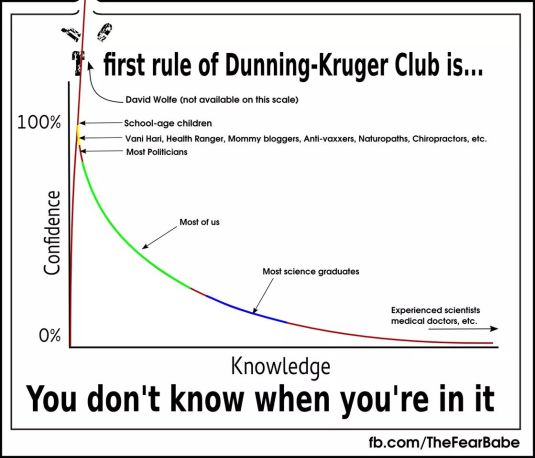
 Utopia, you are standing in it!
Recent Comments