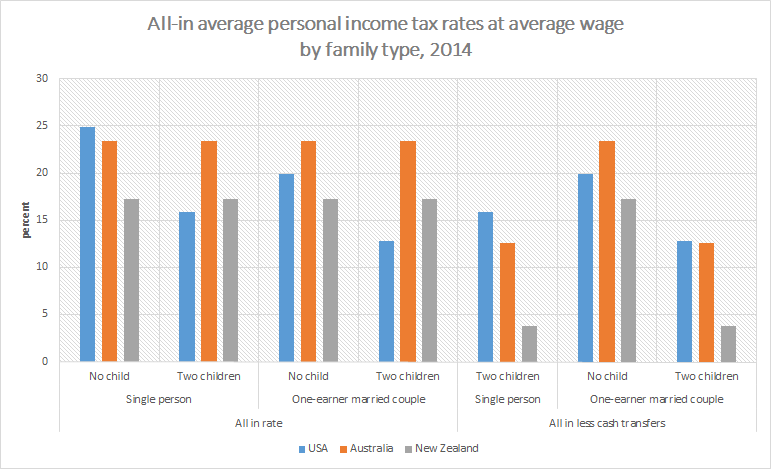
Data extracted on 25 Jan 2016 01:07 UTC (GMT) from OECD.Stat.
Celebrating humanity's flourishing through the spread of capitalism and the rule of law
26 Jan 2016 Leave a comment
in politics - Australia, politics - New Zealand, politics - USA, public economics Tags: Australia, earned income tax credit, family tax credits, family taxation, in-work tax credits, working for families
30 Jun 2015 Leave a comment
in labour economics, minimum wage, poverty and inequality, public economics Tags: earned income tax credit, family tax benefits, working for families
What are alternatives to the minimum wage, and how do they effect workers and taxpayers? buff.ly/1c4BYhd http://t.co/hf67ujjvOK—
MRUniversity (@MRevUniversity) May 20, 2015
23 Jun 2015 Leave a comment
in economics of love and marriage, labour economics, politics - USA, public economics Tags: earned income tax credit, economics of families, family tax credits
19 Jun 2015 Leave a comment
in politics - USA, public economics Tags: earned income tax credit, family tax credits, progressive income taxes, tax incidence, top 1%, welfare state
07 Jun 2015 1 Comment
in labour economics, minimum wage, politics - Australia, politics - New Zealand, politics - USA, population economics, poverty and inequality, welfare reform Tags: earned income tax credit, poverty traps, single parents, taxation and the labour supply, welfare state
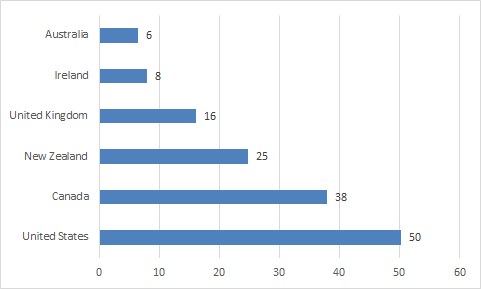
Figure 1: Weekly working hours needed at minimum-wage to move above a 50% relative poverty line after taxes, mandatory social or private contributions payable by workers, and family benefits for lone parent with two children, Anglo-Saxon countries, 2013
15 Dec 2014 Leave a comment
in applied welfare economics, labour economics, liberalism, minimum wage, poverty and inequality Tags: earned income tax credit, family tax credits, in-work tax credits, minimum wage, negative income tax, poverty and inequality
20 Jul 2014 1 Comment
in labour economics, Milton Friedman, welfare reform Tags: capitalism and freedom, earned income tax credit, family tax credits, guaranteed minimum income, negative income tax
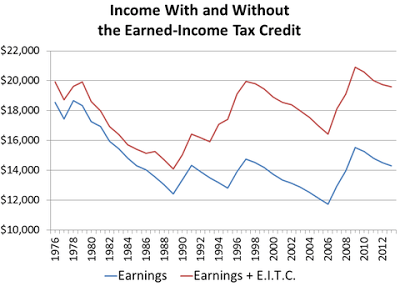
Curiously, a family tax credit or earned income tax credit is the most successful anti-poverty tool in the late 20th century. Furthermore, those on the Left are relatively convinced that the sole cause of poverty is a lack of money, and the solution is to give the poor more money.
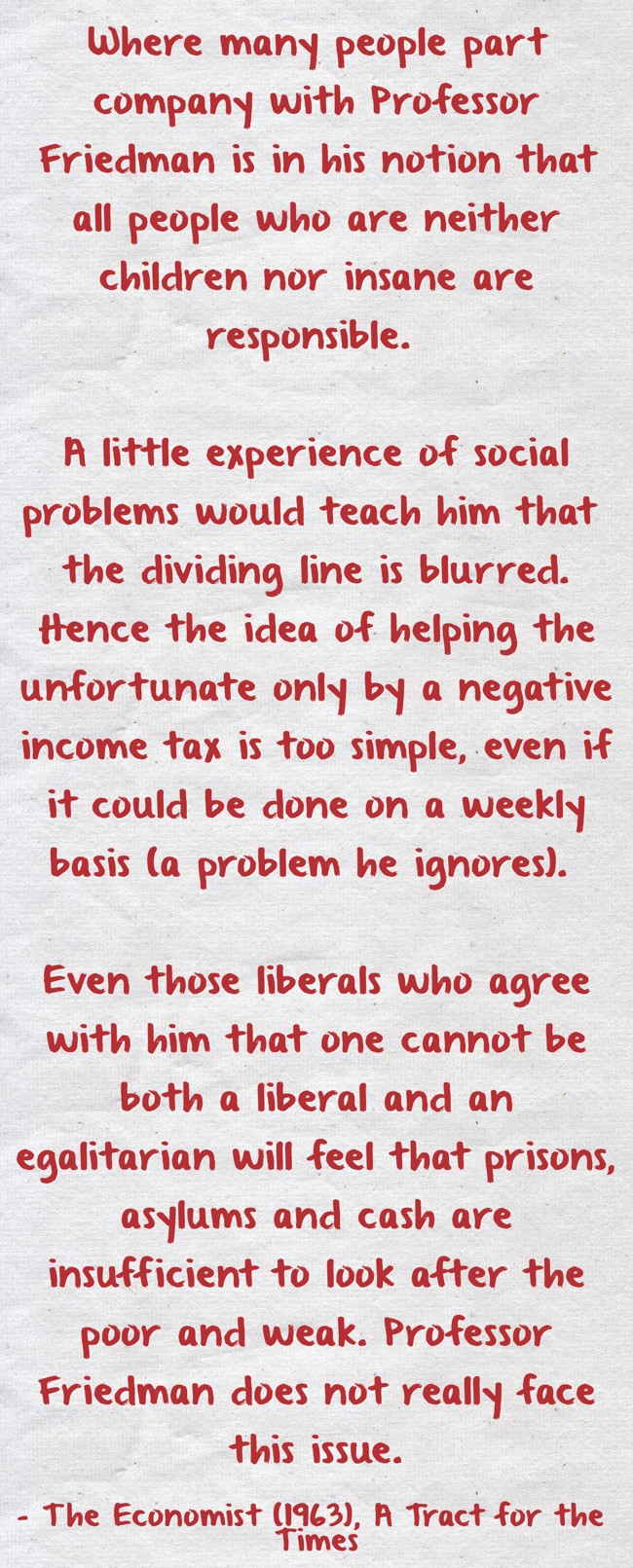
Friedman, Hayek in the Constitution of Liberty, and George Stigler in his great paper on the minimum wage in 1946 all supported a guaranteed minimum income.
Celebrating humanity's flourishing through the spread of capitalism and the rule of law
Scholarly commentary on law, economics, and more
Beatrice Cherrier's blog
Celebrating humanity's flourishing through the spread of capitalism and the rule of law
Celebrating humanity's flourishing through the spread of capitalism and the rule of law
Celebrating humanity's flourishing through the spread of capitalism and the rule of law
Why Evolution is True is a blog written by Jerry Coyne, centered on evolution and biology but also dealing with diverse topics like politics, culture, and cats.
Celebrating humanity's flourishing through the spread of capitalism and the rule of law
Celebrating humanity's flourishing through the spread of capitalism and the rule of law
A rural perspective with a blue tint by Ele Ludemann
DPF's Kiwiblog - Fomenting Happy Mischief since 2003
Celebrating humanity's flourishing through the spread of capitalism and the rule of law
The world's most viewed site on global warming and climate change
Tim Harding's writings on rationality, informal logic and skepticism
A window into Doc Freiberger's library
Let's examine hard decisions!
Commentary on monetary policy in the spirit of R. G. Hawtrey
Thoughts on public policy and the media
Celebrating humanity's flourishing through the spread of capitalism and the rule of law
Politics and the economy
A blog (primarily) on Canadian and Commonwealth political history and institutions
Reading between the lines, and underneath the hype.
Economics, and such stuff as dreams are made on
"The British constitution has always been puzzling, and always will be." --Queen Elizabeth II
Celebrating humanity's flourishing through the spread of capitalism and the rule of law
Celebrating humanity's flourishing through the spread of capitalism and the rule of law
WORLD WAR II, MUSIC, HISTORY, HOLOCAUST
Undisciplined scholar, recovering academic
Celebrating humanity's flourishing through the spread of capitalism and the rule of law
Res ipsa loquitur - The thing itself speaks
Celebrating humanity's flourishing through the spread of capitalism and the rule of law
Researching the House of Commons, 1832-1868
Articles and research from the History of Parliament Trust
Reflections on books and art
Posts on the History of Law, Crime, and Justice
Celebrating humanity's flourishing through the spread of capitalism and the rule of law
Exploring the Monarchs of Europe
Cutting edge science you can dice with
Small Steps Toward A Much Better World
“We do not believe any group of men adequate enough or wise enough to operate without scrutiny or without criticism. We know that the only way to avoid error is to detect it, that the only way to detect it is to be free to inquire. We know that in secrecy error undetected will flourish and subvert”. - J Robert Oppenheimer.
The truth about the great wind power fraud - we're not here to debate the wind industry, we're here to destroy it.
Celebrating humanity's flourishing through the spread of capitalism and the rule of law
Celebrating humanity's flourishing through the spread of capitalism and the rule of law
Economics, public policy, monetary policy, financial regulation, with a New Zealand perspective
Celebrating humanity's flourishing through the spread of capitalism and the rule of law
Restraining Government in America and Around the World
 Utopia, you are standing in it!
Recent Comments