The explosion in health workers supply
28 Sep 2015 Leave a comment
in economics of education, health economics, human capital, labour supply Tags: College premium, economics of healthcare, education premium, graduate premium
Higher education is a dog of an investment in #NewZealand
14 Sep 2015 Leave a comment
in economics of education, human capital, labour economics, labour supply, occupational choice, politics - New Zealand Tags: College premium, education premium, graduate premium
How much more will you earn by going to university? It depends hugely on which country you're from http://t.co/7RMnUTM8nj—
paulkirby (@paul1kirby) September 11, 2015
Long-term evidence of the college premium
12 Sep 2015 Leave a comment
in economics of education Tags: College premium, education premium, graduate premium
Always exceptions but BA+ earn more on average than everyone else. seii.mit.edu/wp-content/upl… @anamfores http://t.co/gtO69MetqB—
S Dynarski (@dynarski) September 09, 2015
Does the minimum wage increase unemployment?
20 Aug 2015 Leave a comment
in labour economics, minimum wage, unemployment Tags: College premium, compensating differentials, education premium, evidence-based policy, offsetting behaviour, The fatal conceit, The pretence to knowledge, unintended consequences
https://twitter.com/MiltonFriedmanS/status/630956276554444800/photo/1
#Australia:highest minimum wage in OECD relative to purchasing power. Increases #youthunemployment #auspol #jobsearch http://t.co/HML9l2rD7R—
Bob Day (@senatorbobday) August 11, 2015
The gender wage gap by educational attainment
28 Jul 2015 Leave a comment
in discrimination, economics of education, gender, human capital, labour economics, occupational choice Tags: College premium, education premium, gender wage gap
Men's and Women's Earnings by Education (Ph'Ds are the most equal) bit.ly/153m9jZ http://t.co/IPfT15Qwiz—
Catherine Mulbrandon (@VisualEcon) September 03, 2013
Unemployment rates by education in the USA
21 Jul 2015 Leave a comment
in business cycles, economics of education, global financial crisis (GFC), great recession, human capital, job search and matching, labour economics, labour supply, macroeconomics, unemployment Tags: education premium, labour market demographics
June jobless rate for people 25+ with
B.A. or more 2.5%
High school diploma 5.4%
No H.S. 8.2%
on.wsj.com/1LG1B6z http://t.co/luUUuw9h1V—
Sudeep Reddy (@Reddy) July 02, 2015
The graduate premium for New Zealand is at the bottom of the OECD ladder
05 Jul 2015 Leave a comment
in economics of education, human capital, labour economics, occupational choice, politics - New Zealand Tags: College premium, education premium, graduate premium
More on the college premium and economic mobility
22 Jun 2015 Leave a comment
in economics of education, human capital, labour economics, labour supply, occupational choice Tags: College premium, economic mobility, education premium, graduate premium
"…most powerful instrument of economic mobility for low-income ppl is 4 yr college degree." nyti.ms/1ji4fTl http://t.co/94xbbJW4Ny—
Equitable Growth (@equitablegrowth) May 15, 2014
The education premium has immediate effects
17 Jun 2015 Leave a comment
in economics of education, human capital, labour economics, labour supply, occupational choice, poverty and inequality Tags: College premium, education premium, graduate premium, high school dropouts
http://t.co/t1Pym23Wgv—
EPI Chart Bot (@epichartbot) May 27, 2015
The reverse gender tertiary education gap for ages 25–34, Anglo-Saxon countries
14 Jun 2015 Leave a comment
in discrimination, economics of education, gender, human capital, labour economics, labour supply, occupational choice, politics - Australia, politics - New Zealand, politics - USA Tags: Australia, British economy, Canada, College premium, education premium, gender wage gap, Ireland
Figure 1: % population who have attained at least tertiary education, age 25 – 34 by gender (2012)
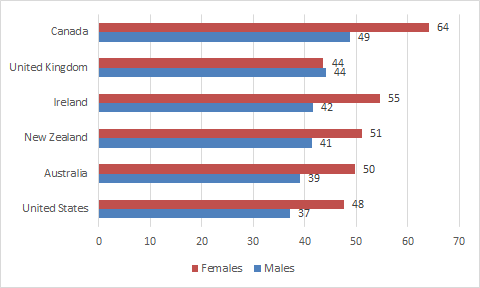
Source: OECD family database.
Figure 2 shows that the stark reversing of the gender gap in educational attainment shown in figure 1 was somewhat more recent in the US, UK and to a lesser extent in Ireland and Australia. In the UK and USA, educational attainment by gender was pretty equal for the earlier generation of graduates as compared to today’s 25 to 34-year-olds. The reversing of the gender gap in educational attainment dates back several decades in Canada and New Zealand.
Figure 2: % population who have attained at least tertiary education, age 45 – 54 by gender (2012)
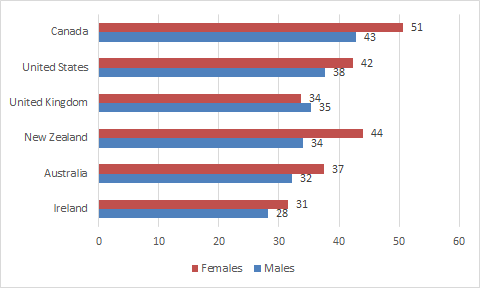
Source: OECD family database.
Another rather stunning illustration of the size of the graduate premium in the USA
14 Jun 2015 Leave a comment
in economics of education, human capital, labour economics, occupational choice, politics - USA Tags: College premium, education premium, graduate premium
Unemployment by educational level and degree level
02 Jun 2015 Leave a comment
in business cycles, economics of education, human capital, job search and matching, labour economics, labour supply, macroeconomics, occupational choice, unemployment Tags: education premium, graduate premium
Don't listen to naysayers. College is worth it, even for so-so students. nyti.ms/1JC1ZiN http://t.co/Wnr5BnwumM—
The Upshot (@UpshotNYT) April 24, 2015
Pay is always net of human capital accumulation
31 May 2015 Leave a comment
in economics of education, human capital, labour economics, labour supply, minimum wage, occupational choice, poverty and inequality Tags: College premium, education premium, internships, on-the-job human capital
The education premium illustrated
22 May 2015 1 Comment
in economics of education, human capital, labour economics, labour supply, occupational choice Tags: education premium
What are the rejection rates at the Ivy League Universities?
16 May 2015 Leave a comment
in economics of education Tags: college wage premium, economics of universities, education premium, graduate premium
How many applied and how many were accepted to the Ivy League universities – @peterajacobs read.bi/1GIFFW3 http://t.co/1zRGTO0WWL—
Business Insider (@businessinsider) March 31, 2015
 Utopia, you are standing in it!

Recent Comments