The curse of knowledge is a cognitive bias that occurs when someone, possessing knowledge or expertise on a particular topic, struggles to imagine or communicate with others who lack the same understanding or information. Essentially, once we know something, it’s very hard to imagine what it’s like not to know it. How it manifests: Why it happens: […]
The curse of knowledge
The curse of knowledge
25 Mar 2025 1 Comment
in economics of education, health and safety, human capital, occupational choice Tags: cognitive psychology, educational psychology
Puzzle box (Thorndike)
02 Aug 2018 Leave a comment
in economics of education Tags: educational psychology
The myth of studying to build mental muscles – Bryan Caplan
02 Aug 2018 Leave a comment
in applied price theory, economics of education, economics of information, human capital Tags: educational psychology, signalling
More on who is winning the battle of the sexes
09 Feb 2017 Leave a comment
in discrimination, economics of education, gender, human capital, labour economics Tags: behavioural genetics, educational psychology, gender gap, gender wage gap, reversing gender gap

Speaking of the equality of the sexes
06 Feb 2017 Leave a comment
in discrimination, economics of education, gender, labour economics, labour supply, occupational choice Tags: behavioural genetics, compensating differentials, educational psychology, gender gap, reversing gender gap
Low performers in maths by gender, USA, UK, Japan, Canada, Australia and New Zealand
17 Jul 2015 Leave a comment
in discrimination, economics of education, gender, human capital, labour economics Tags: cognitive psychology, educational psychology, lost boys, PISA, Psychology, reversing gender gap
Figure 1: % of students achieving a proficiency level below 2 in maths by gender, USA, UK, New Zealand, Japan, Canada and Australia, 2012
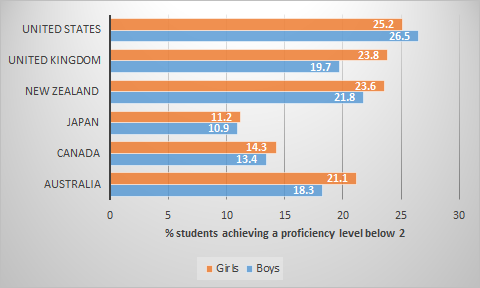
Source: OECD StatExtract.
Low performers in science by gender, USA, UK, Japan, Canada, Australia and New Zealand
16 Jul 2015 Leave a comment
in discrimination, economics of education, gender, labour economics, labour supply Tags: cognitive psychology, educational psychology, lost boys, PISA, Psychology, reversing gender gap
Figure 1: % of students achieving a proficiency level below 2 in science by gender, USA, UK, New Zealand, Japan, Canada and Australia, 2012

Source: OECD StatExtract.
Unskilled but Unaware of It
14 May 2015 Leave a comment
in economics of education, human capital, labour economics, labour supply, occupational choice Tags: cognitive psychology, Dunning-Kruger effect, economics of personality traits, educational psychology

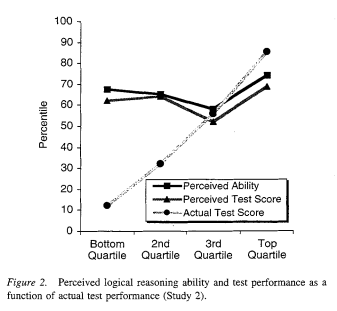
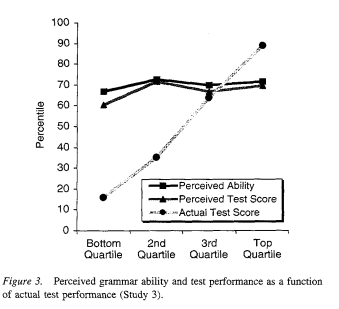

The grammar test is the easiest explanation of the Dunning-Kruger effect. The only way to know you have bad grammar is to have good ground but as you don’t have good grammar you think you have good grammar because you don’t know you have bad grammar because you have no way of self-assessing your bad grammar because you don’t have good grammar.
 Utopia, you are standing in it!
Recent Comments