Digital music sales have exceeded those from CDs for the first time: on.wsj.com/1yp37FW http://t.co/LDOdrgGap9—
Wall Street Journal (@WSJ) April 15, 2015
Creative destruction in CD sales
17 Apr 2015 Leave a comment
in applied price theory, economic history, economics of media and culture, entrepreneurship, industrial organisation, Music, survivor principle Tags: creative destruction, entrepreneurial alertness
The sharing economy in a nutshell
15 Apr 2015 Leave a comment
in economics of information, economics of media and culture, entrepreneurship Tags: entrepreneurial alertness, Facebook, sharing economy, Uber
@FlipChartRick spotted this earlier http://t.co/q6FoyIGJFL—
(@MervynDinnen) March 20, 2015
Uber is bringing a new meaning to creative destruction
14 Apr 2015 Leave a comment
in economics of regulation, entrepreneurship, industrial organisation, survivor principle Tags: creative destruction, entrepreneurial alertness, Uber
Uber's astounding rise: onforb.es/1yiZFNp http://t.co/VocIl3EogE—
Forbes Tech News (@ForbesTech) April 10, 2015
Do vice funds out-perform the share market?
13 Apr 2015 Leave a comment
in entrepreneurship, financial economics, market efficiency, TV shows Tags: active investing, efficient markets hypothesis, entrepreneurial alertness, ethical investing, passive investing, Sopranos, vice funds

The Vice Fund has outperformed the S&P 500 since 2004. They invest in sinful stocks as its managers describe it:
Designed with the goal of delivering better risk-adjusted returns than the S&P 500 Index. It invests primarily in stocks in the tobacco, alcohol, gaming and defence industries. Vice Funds believe these industries tend to thrive regardless of the economy as a whole.
The Vice Fund was founded in 2002 to specialise in socially irresponsible stocks such as gambling, alcohol , tobacco and defence contracting. The Vice Fund is not recession proof, but did do better in the 2009 market crash.
The Vice fund also has high management fees of 2%. Americans can buy Vanguard’s or Fidelity’s index funds and pay only 0.1% in expenses. The Vice Fund may have buckled under the heat because it has rebranded:
The Vice Fund is now called the Barrier Fund. The investment strategy and the portfolio manager have not changed… The Barrier Fund invests in companies, both domestic and foreign, within industries that have significant barriers to entry.
All is not lost, the Ave Maria Catholic Values Fund beat the market almost as handily as Vice.

To confuse further, the Catholic Values Fund revealed that it shared investments in defence contractors with the Vice Fund. The Vice Fund invested in staid Berkshire Hathaway and Microsoft.
HT: Investing in Vice.
Facebook makes most of its money from mobile ads
12 Apr 2015 Leave a comment
in economics of media and culture, entrepreneurship, industrial organisation, survivor principle Tags: advertising, creative destruction, entrepreneurial alertness, Facebook, mobile phones
Creative destruction in Internet desktop browsers
07 Apr 2015 Leave a comment
in economics of media and culture, entrepreneurship, industrial organisation, survivor principle Tags: creative destruction, entrepreneurial alertness, innovation, markets selection, The meaning of competition
This is why @Microsoft is killing off the Internet Explorer brand: dadaviz.com/i/3622 #dataviz http://t.co/EikfbZFe2N—
Randy Olson (@randal_olson) March 17, 2015
Creative destruction from the first iPhone to the latest Apple Watch
04 Apr 2015 Leave a comment
in entrepreneurship, technological progress Tags: Apple watch, creative destruction, entrepreneurial alertness, Iphone
Comparing first-gen iPhone (2007) to Apple Watch shows the march of technology, and yet slow progress in battery tech http://t.co/4MI2gG4kk5—
Darshan Shankar (@DShankar) April 03, 2015
The first cell phone call was made 42 years ago today
04 Apr 2015 Leave a comment
in entrepreneurship, industrial organisation, technological progress Tags: cellphones, creative destruction, entrepreneurial alertness, innovation
"42 Years Ago today, Martin Cooper Made First Call Via A Cellular Phone In Public" prsm.tc/353dq7 @pmarca http://t.co/PnaeFT3WEr—
Evan Kirstel (@evankirstel) April 03, 2015
Creative destruction in the US technology sector since 1980
04 Apr 2015 Leave a comment
in entrepreneurship, industrial organisation, survivor principle Tags: creative destruction, entrepreneurial alertness, Joseph Schumpeter
People really forget how awesomely powerful IBM was in the 1980s: @evankirstel http://t.co/TkpuU5sAXg—
Marc Andreessen (@pmarca) April 04, 2015
More evidence of mass kidnappings of activists
01 Apr 2015 Leave a comment
in development economics, entrepreneurship, growth disasters, growth miracles, liberalism Tags: Africa, anticapitalist mentality, capitalism and freedom, do gooders, entrepreneurial alertness, foreign direct investment, Left-wing hypocrisy, ODA
Why aren’t overseas development activists dancing in the streets to celebrate this turnaround in the economic climate of Africa through capitalism and the freedom to invest. The only possible explanation is mass kidnappings.
Customer service was always a priority in Japan
01 Apr 2015 Leave a comment
in entrepreneurship, transport economics Tags: entrepreneurial alertness, Japan, Tokyo
Japan Railway's app has live data, sure… including the crowdedness and inside temperature of EACH TRAIN CAR. 😍/😭 http://t.co/ySz1oTuIbF—
Cabel Sasser (@cabel) March 27, 2015

The North–South theory of product life cycles
23 Mar 2015 Leave a comment
in comparative institutional analysis, entrepreneurship, industrial organisation, law and economics, managerial economics, organisational economics, property rights, survivor principle, theory of the firm Tags: entrepreneurial alertness, foreign direct investment, incomplete contracts, incomplete property rights, North-South product life cycle, product life cycles
Forecasts of the offshoring of service jobs, as an example, can be constituted into a theory of North-South product cycles. The North-South theory of the life cycle of products starts with their research and development and refinement by entrepreneurs in the advanced countries (the North) with some exporting (Grossman and Helpmann 1991a, 1991b). These innovations require resources to be invested with uncertain prospects of success. Entrepreneurs in the North compete to discover new technology-intensive products using the ample supply of R&D workers and human capital-rich workers in the industrialised countries (Grossman and Helpmann 1991a, 1991b).

As a new product matures and its production becomes more standardised, the bulk of its production can migrate to the less developed countries (the South) to take advantage of lower production costs, and these countries will become net exporters. In the South, entrepreneurs focus more on imitation. They invest resources in importing and learning the production processes developed and proven to be a success in the North (Grossman and Helpmann 1991a, 1991b).
The shifting of production of standardised products to lower-wage foreign locations will frequently be within the originating company via a foreign affiliate, because of uncertainties about property rights and contract enforcement institutions in the host countries, and only later to independent foreign firms (Antràs 2005). Within corporate hierarchies, the high-skilled managers in the developed countries will specialise in problem-solving and non-routine tasks. They will interact with middle managers and production workers in developing countries who perform the routine tasks (Antràs et al. 2006, 2008).
Contracts are typically incomplete either because they are difficult to write and/or because the court cannot enforce them. The World Trade Organization (2005, 2008) concluded that, for example, the location of offshored services depends on:
- labour costs,
- trade costs,
- the quality of institutions, particularly the legal framework,
- the tax and investment regime,
- the quality of infrastructure, particularly telecommunications, and
- skills, particularly language and computer skills.
Risks in contract negotiation and enforcement will influence which types of production is outsourced. Roughly one-third of world trade is infra-firm, and this intra-firm trade is concentrated in the capital-intensive industries because of the costs and risks of investing in contracting with arm’s-length suppliers (Antràs 2003). Considerations about R&D incentives, the availability of human capital and the quality of contract enforcement institutions weigh heavily on the development of new products and their initial and later locations of different stages of production.
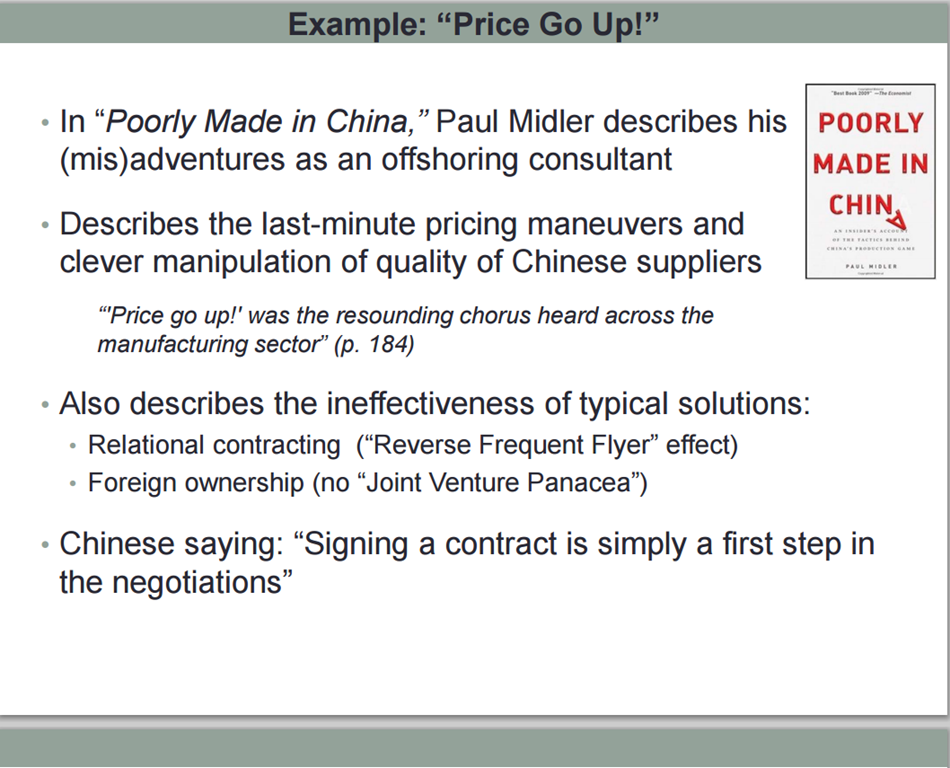
Products are initially developed in the highly industrialised countries because their sophisticated legal systems allow contracts to be enforced. Even then, in industrialised countries, the difficulties of writing and enforcing complicated contracts over the quality of new products early in the product life cycle encourages firms to make those products internally within the firm. Early in the product life cycle, if sub-contractors were used for key imports, there would have to be continual renegotiation of contracts contracts to incorporate new innovations and learning by doing. As Antras says:
Global production networks necessarily entail intensive contracting between parties located in different countries and thus subject to distinct legal systems0
As the new product standardises, and product quality in consequence becomes easier to measure and contract over, initially the innovating firm will sub-contract within the industrialised country but in time will import from developing countries. In the first instance, these imports may be from affiliates established in the developing country to ensure greater control of product quality through direct ownership of the factory. As Antras says:
Firms contemplating doing business in a country with weak contracting institutions might decide to do so within firm boundaries to have more control.
The size and shape of the firm is a direct response to mitigate the costs of contracting over quality that is hard to measure and which is constantly changing early in the product cycle. By assigning ownership rights to the party undertaking the more important investment in quality early in the product life cycle, entrepreneurs and innovators can minimise the losses caused by lack of enforceable contracts over quality when quality is changing rapidly as the firm moves through the product life cycle.

Boeing blamed the delays on the delivery of the Dreamliner on an unwillingness of sub-contractors to stand by their contractual obligations. In response, Boeing acquired some of the key sub-contractors to ensure that they delivered as promised. This is a classic operation of the theory of the firm where the entrepreneur brings within the firm what is too expensive to transact on the market because of difficulties in measuring quality and defining and enforcing property rights over what has been contracted.

 Utopia, you are standing in it!
Recent Comments