
via 57 Percent of Americans Say Only Kids Who Win Should Get Trophies – Reason-Rupe Surveys : Reason.com.
Celebrating humanity's flourishing through the spread of capitalism and the rule of law
21 Aug 2014 Leave a comment
in comparative institutional analysis, entrepreneurship, liberalism Tags: distributive justice, entitlement theory of justice, expressive voting, just deserts, The mirage of social justice
via 57 Percent of Americans Say Only Kids Who Win Should Get Trophies – Reason-Rupe Surveys : Reason.com.
02 Aug 2014 Leave a comment
02 Aug 2014 Leave a comment
in environmental economics, environmentalism Tags: expressive voting, recycling

It is a crime in New York to steal garbage put out for recycling.
31 Jul 2014 Leave a comment
in economics of regulation, environmental economics, environmentalism Tags: expressive voting, plastic bags, recycling

My local supermarket tried to charge for plastic bags then backed down because of customer protests.
In the UK, a compulsory 5p charge on plastic bags first resulted in a sharp drop consumption then a rise in in the use of plastic bags last year. It seems the immediate change in behaviour reaped by the new charges is short-lived and it doesn’t take long for old habits to re-emerge.
Attaching a cost to something that was free certainly reduces frivolous consumption, but if that cost that is too low can merely act to pay off one’s conscience.
Beware of putting a price on guilt and letting people down.
A classic paper from 2000, Gneezy and Rustichini studied what happened when day-care centres in Israel tried to reduce late parental pick-ups by introducing fines.
Before long, late pick-ups had not reduced, they had doubled. Why? Because parents felt that the fine was a price worth paying and the guilt which had previously controlled their behaviour was assuaged.

19 Jul 2014 Leave a comment
in environmental economics, global warming, politics - Australia Tags: carbon tax, expressive voting
08 Jul 2014 Leave a comment
in labour supply, liberalism, Public Choice, Rawls and Nozick, taxation Tags: envy, expressive voting, top tax rate

via Labour supporters admit it: taxes are to punish the rich, not to raise revenue – Telegraph Blogs and http://danieljmitchell.wordpress.com/2014/02/04/what-motivates-the-left-envy-or-greed/
06 Jul 2014 Leave a comment
in Public Choice Tags: expressive voting

Expressive voting is the voting where people express themselves in support of things they approve of, and in opposition of what they disapprove of and make statements about themselves and what they belong to.
If hundreds of thousands or millions vote on the same election, how you vote simply does not matter, so you can use it to feel good about yourself and a developer self-identity of this caring person. Voting becomes rather like cheering at a football match – the more noise the better but how loud you cheer as an individual doesn’t matter that much so you can cheer from whether you like.
The trouble is in expressive voting theory, voters know that feel-good policies are ineffective. Expressive voters do not necessarily embrace dubious or absurd beliefs about the world. The expressive voting is not a product of ignorance, it’s a product of the fact that your vote is one among so many and will not change the result of the election.
Expressive voting not only explains why a lot of people vote, it also explains the higher voter turnout of the more educated. It also explains why people are more likely to vote in national elections than in local elections even though their vote is more likely to be decisive in local elections.
Expressive voting also explains why people often vote against their personal interests. The fact is that voting against your interests cost you almost nothing when there are countless others voting too. Voting against your interest seems to have some hair-shirt benefit.
That said, expressive voting is like any other good in demand, demand for a expressive voting declines with as the cost of it goes up. There is less expressive voting when elections are close and as the cost of policies supported by the expressive voter go up.
Under the preferential voting system in Australia , instead of voting for the Australian Labor Party, a swinging voter can vote Green as a protest vote and then vote liberal
If there were no greens to vote for, some of the protest vote will stay with Labour because the voter cannot cop-out and split their vote while still feeling good about themselves but still be able to vote for their wallets and vote for right-wing party.
29 May 2014 Leave a comment
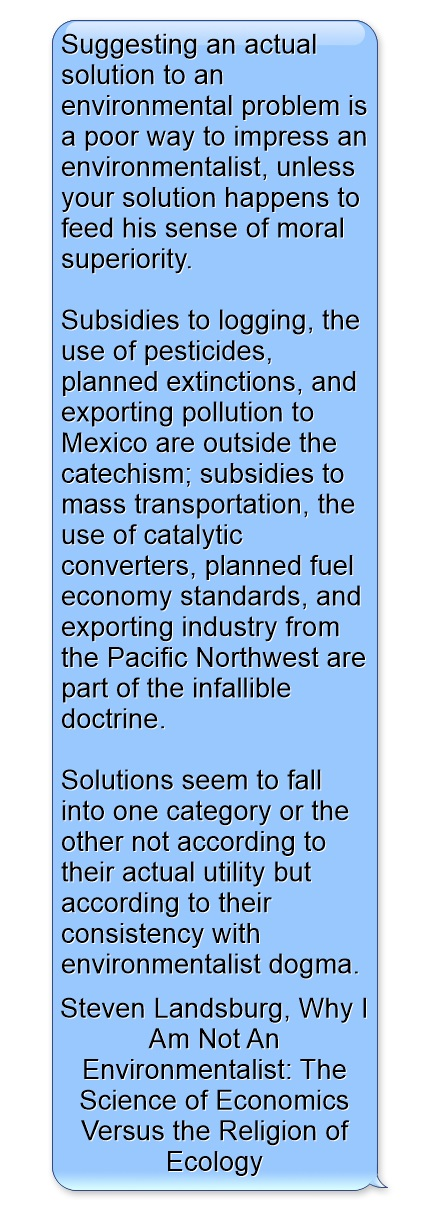
in environmental economics, environmentalism Tags: expressive voting, Steven Landsburg
21 May 2014 Leave a comment
in applied price theory, David Friedman, development economics, Public Choice Tags: bootleggers and baptists, expressive voting, foreign investment, imperialism, marxist fallacies
Much more commonly, [economic imperialism] is used by Marxists to describe–and attack–foreign investment in “developing” (i.e., poor) nations.
The implication of the term is that such investment is only a subtler equivalent of military imperialism–a way by which capitalists in rich and powerful countries control and exploit the inhabitants of poor and weak countries.
There is one interesting feature of such “economic imperialism” that seems to have escaped the notice of most of those who use the term.
Developing countries are generally labour rich and capital poor; developed countries are, relatively, capital rich and labour poor. One result is that in developing countries, the return on labour is low and the return on capital is high–wages are low and profits high. That is why they are attractive to foreign investors.
To the extent that foreign investment occurs, it raises the amount of capital in the country, driving wages up and profits down.
The effect is exactly analogous to the effect of free migration. If people move from labour-rich countries to labour-poor ones, they drive wages down and rents and profits up in the countries they go to, while having the opposite effect in the countries they come from.
If capital moves from capital-rich countries to capital-poor ones, it drives profits down and wages up in the countries it goes to and has the opposite effect in the countries it comes from.
The people who attack “economic imperialism” generally regard themselves as champions of the poor and oppressed.
To the extent that they succeed in preventing foreign investment in poor countries, they are benefiting the capitalists of those countries by holding up profits and injuring the workers by holding down wages.
It would be interesting to know how much of the clamour against foreign investment in such countries is due to Marxist ideologues who do not understand this and how much is financed by local capitalists who do.
David D. Friedman
Opposition to immigration might protect the wages of local workers. Opposition to foreign investment might increase the profits of local capitalists.
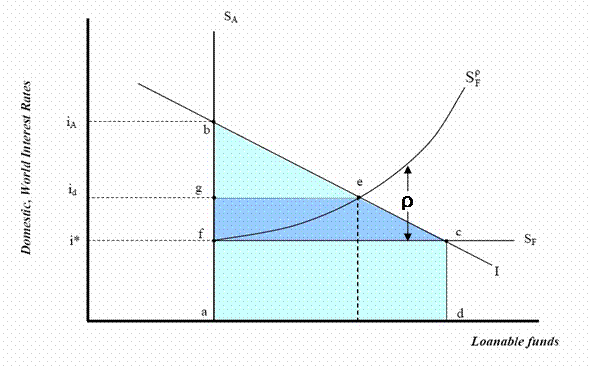
How does more competition help the local capitalists? The foreign investment is in response to the high returns in the local market and that inflow of foreign capital will continue until local rates of return match those in other countries.
Equalisation of risk-adjusted rate of returns is central to the operation of capital markets.
Stopping this process of equalisation through regulation only benefits the capitalists inside the country. It reduces the wages of workers because they have less capital and fewer modern technologies to work with.
27 Apr 2014 1 Comment
in environmental economics, politics - New Zealand, transport economics Tags: expressive voting, killer green technologies, Wellington buses
The extra costs associated with the wire network and the difficulty of changing the buses’ routes were the main factors in this great decision.
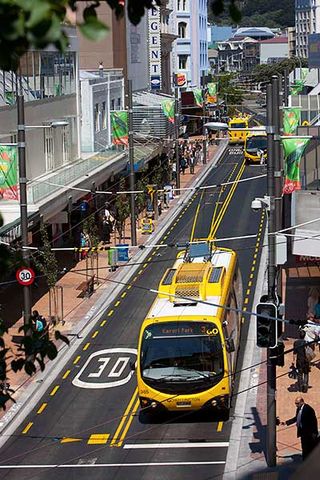
Trolley buses cause backlogs when they brake down because they cannot overtake a broken-down bus. The trolley buses just stake-up behind the broken-down bus because they cannot overtake.
I have been trapped on a diesel express bus this way commuting to work many times. Central Wellington grinds to halt when one trolley bus breaks-down.
The 50-year-old power system would need upgrading soon costing “tens of millions of dollars,” and maintaining the 160 kilometres of wires and 15 substations costs $6m a year. The one-off cost of dismantling this network is cheaper than this!
Trolley bases are a killer green technology: drivers have been killed while standing on the road behind the bus reconnected the arms on the top of the bus to the overhead wires. These arms disconnect frequently, and have even hit people on the side of the road.
Wellington is earthquake prone. Having public transport run off a single electric power source connected to overhead wires is fool hardy.
I grew up in a small country town. I have none of the obsessions that big-city folk and the inner-city green voters, in particular, have with buses.
29 Mar 2014 1 Comment
in politics - USA, Public Choice Tags: expressive voting, liberal Jews, Obama and the Jewish vote
Obama won nearly 80% of the Jewish vote. He and the Democratic Party are rather divided on support for Israel. The Republicans are more in favour of Israel.
Now see Expressive voting and identity: evidence from a case study of a group of U.S. voters, A review of Norman Podhoretz, Why are Jews Liberals? by Arye L. Hillman, Public Choice (2011).
Podhoretz describes behaviour that backs up the hypothesis that people vote expressively to affirm their identity. Podhoretz was concerned that liberal Jews vote against their self-interest.
Jewish approval of #Obama now 54%, 8 points above national average… on.gallup.com/1avbZ1T #GallupDaily http://t.co/1z4LN6wRFP—
(@GallupNews) April 10, 2015
Most of the Jews who voted for Obama did care about Israel but downplayed his anti-Israel associations; they voted for him anyway. The expressive behaviour hypothesis explains why many Jews do this. As a single vote is not decisive in most elections, the main benefit from voting is its expressive value:
Liberal Jews support liberal principles through the low-cost actions of voting and rhetoric, so as to place themselves at the centre of society despite their higher-than-average incomes.
People also vote for parties that will never win elections for expressive reasons. Since maybe 1945, up to a quarter of UK voters knowingly vote for the Liberals and now the LDP knowing that it is usually a wasted vote. But is it?
To win this LDP vote, the major parties must change their policies or these voters will park their vote somewhere else while still signalling their vote is up for grabs to both sides. These voters affirm themselves as sensible middle-of-the-road voters without voting for either Labour or the Tory party.
The same happens for third-party candidates in America. They are protest votes. The major parties spend a lot of time wooing back these voters at the next election. A protest vote is very affirming to an expressive voter.
Expressive voting also offers much insight into why some democratically elected governments continued to pursue terrible wars of attrition. The unwillingness to discuss peace terms in World War I is an example. A voter might prefer peace to war but showing patriotism might outweigh this. One candidate offers a policy of appeasement, recognising the enormous cost in lives that further fighting might involve. The other candidate stands for national pride, not surrendering to bullies, and avenging past losses. A careful reflection on the costs and benefits of war or peace is what the voter does not do. What is relevant is showing patriotism and strength of purpose.
The main point is that expressive voters are not disciplined by outcomes, and that democratic choice is suspect for this reason even on the biggest of issues.
21 Mar 2014 Leave a comment
in climate change, environmental economics, Public Choice Tags: Al Gore, Copenhagen Summit, expressive voting, Kyoto Protocol
The US Senate voted 95-0 in July 1997 that the Kyoto Protocol would not be ratified because it excluded certain developing countries, including India and China, from having to comply with new emissions standards.
Disregarding the Senate Resolution, Vice President Al Gore symbolically signed the Protocol on November 12, 1998.

Knowing that the Kyoto Protocol would not be passed without the inclusion of developing countries in some way, Clinton did not even send the Protocol to the U.S. Senate for ratification. Clinton had 801 days in office to submit it, but did not. As it was going to be rejected, it cost him nothing to sign it and he won the support of expressive voters. Bush was criticised for not doing what Clinton also failed to do.
The EU made demands that the USA would not accept so that the treaty would not include the USA. This allowed EU ministers to look good to expressive voters back home by standing staunch and not compromising.
US non-participation made participation cheaper for the EU because the USA would not be competing for carbon credits, so the price of carbon would be much less.
There was an emergency night time meeting to save the Copenhagen Summit called by Gordon Brown. He was joined by Obama, Sarkozy, Merkel and PM Hatoyama of Japan. To make a point, China sent a rather out-spoken vice foreign minister of foreign affairs. He was the smartest guy in the room.
Celebrating humanity's flourishing through the spread of capitalism and the rule of law
Scholarly commentary on law, economics, and more
Beatrice Cherrier's blog
Celebrating humanity's flourishing through the spread of capitalism and the rule of law
Celebrating humanity's flourishing through the spread of capitalism and the rule of law
Celebrating humanity's flourishing through the spread of capitalism and the rule of law
Why Evolution is True is a blog written by Jerry Coyne, centered on evolution and biology but also dealing with diverse topics like politics, culture, and cats.
Celebrating humanity's flourishing through the spread of capitalism and the rule of law
Celebrating humanity's flourishing through the spread of capitalism and the rule of law
A rural perspective with a blue tint by Ele Ludemann
DPF's Kiwiblog - Fomenting Happy Mischief since 2003
Celebrating humanity's flourishing through the spread of capitalism and the rule of law
The world's most viewed site on global warming and climate change
Tim Harding's writings on rationality, informal logic and skepticism
A window into Doc Freiberger's library
Let's examine hard decisions!
Commentary on monetary policy in the spirit of R. G. Hawtrey
Thoughts on public policy and the media
Celebrating humanity's flourishing through the spread of capitalism and the rule of law
Politics and the economy
A blog (primarily) on Canadian and Commonwealth political history and institutions
Reading between the lines, and underneath the hype.
Economics, and such stuff as dreams are made on
"The British constitution has always been puzzling, and always will be." --Queen Elizabeth II
Celebrating humanity's flourishing through the spread of capitalism and the rule of law
Celebrating humanity's flourishing through the spread of capitalism and the rule of law
WORLD WAR II, MUSIC, HISTORY, HOLOCAUST
Undisciplined scholar, recovering academic
Celebrating humanity's flourishing through the spread of capitalism and the rule of law
Res ipsa loquitur - The thing itself speaks
Celebrating humanity's flourishing through the spread of capitalism and the rule of law
Researching the House of Commons, 1832-1868
Articles and research from the History of Parliament Trust
Reflections on books and art
Posts on the History of Law, Crime, and Justice
Celebrating humanity's flourishing through the spread of capitalism and the rule of law
Exploring the Monarchs of Europe
Cutting edge science you can dice with
Small Steps Toward A Much Better World
“We do not believe any group of men adequate enough or wise enough to operate without scrutiny or without criticism. We know that the only way to avoid error is to detect it, that the only way to detect it is to be free to inquire. We know that in secrecy error undetected will flourish and subvert”. - J Robert Oppenheimer.
The truth about the great wind power fraud - we're not here to debate the wind industry, we're here to destroy it.
Celebrating humanity's flourishing through the spread of capitalism and the rule of law
Celebrating humanity's flourishing through the spread of capitalism and the rule of law
Economics, public policy, monetary policy, financial regulation, with a New Zealand perspective
Celebrating humanity's flourishing through the spread of capitalism and the rule of law
Restraining Government in America and Around the World


 Utopia, you are standing in it!
Recent Comments