More young adults in poverty as rate drops to record low for pensioners bit.ly/1qZiPnZ http://t.co/3QhofXekWP—
Guardian Data (@GuardianData) November 24, 2014
Poverty in the UK
07 Jul 2015 Leave a comment
in poverty and inequality Tags: British economy, child poverty, family poverty
Child poverty across Europe
28 Jun 2015 Leave a comment
in Euro crisis, poverty and inequality Tags: child poverty, EU, Eurosclerosis, family poverty
Spain's lost decade: one in three Spanish kids live in poverty or at risk of social exclusion: gu.com/p/42yx7/tw http://t.co/qg8PDla19z—
Guardian Data (@GuardianData) October 28, 2014
Food is now much smaller share of the average family’s budget than in the 60s
28 Jun 2015 Leave a comment
in applied welfare economics, labour economics, population economics, welfare reform Tags: child poverty, family poverty, poverty line, poverty measurement, statistics
Child poverty rates in single parent and couple families, Anglo-Saxon countries
22 Jun 2015 Leave a comment
in labour economics, politics - Australia, politics - New Zealand, politics - USA, population economics, poverty and inequality, welfare reform Tags: Australia, British economy, Canada, child poverty, economics of the family, family poverty, Ireland, single mothers, single parents
Figure 1: Child poverty rates by family type, Anglo-Saxon countries, 2010
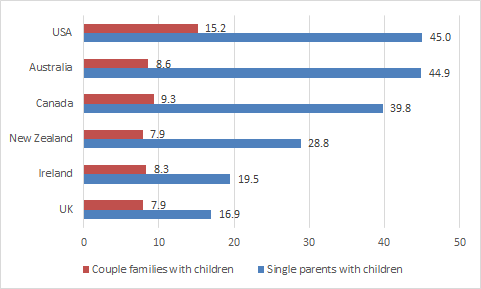
Source: OECD Family Database; Poverty thresholds are set at 50% of the median income of the entire population.
What happened to black family formation in the 1970s?
22 Jun 2015 Leave a comment
in economics of love and marriage, labour economics, labour supply, law and economics, occupational choice Tags: child poverty, economics of the family, family poverty, single mothers, single parents
The War On Poverty has been a disaster for black kids. 2x kids living with unmarried mom. bit.ly/1alPWKB http://t.co/Cwi4C5NtHz—
Old Whig (@aClassicLiberal) April 12, 2015
The impact of parental employment on child poverty in couple families, Anglo-Saxon countries
21 Jun 2015 Leave a comment
in economics of love and marriage, labour economics, labour supply, law and economics, politics - Australia, politics - New Zealand, politics - USA, population economics, poverty and inequality, welfare reform Tags: Australia, British economy, Canada, child poverty, economics of families, family poverty, Ireland, labour force participation, single parents
Figure 1: child poverty rates in couple families by employment status, Anglo-Saxon countries, 2010
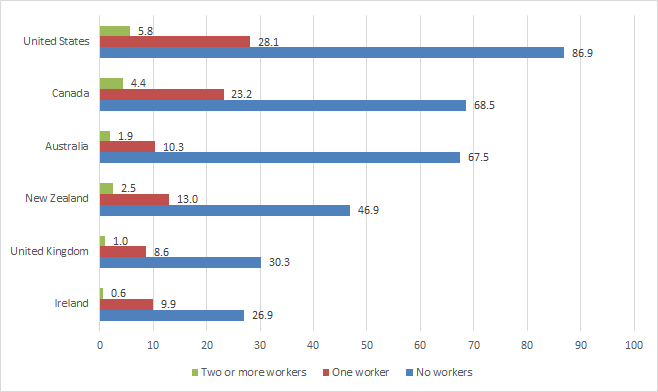
Source: OECD Family Database; Poverty thresholds are set at 50% of the median income of the entire population.
The impact of single parent employment on child poverty rates, Anglo-Saxon countries
20 Jun 2015 Leave a comment
in labour economics, politics - Australia, politics - New Zealand, politics - USA, poverty and inequality, welfare reform Tags: Australia, British economy, Canada, child poverty, economics of the family, family poverty, female labour force participation rates, Ireland, maternal labour supply, single mothers, single parents
Figure 1: Child poverty rate by employment status of single parent, Anglo-Saxon countries, 2010
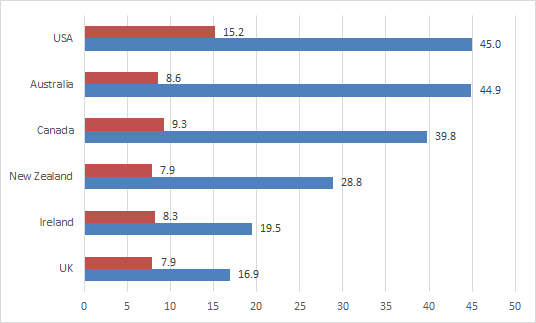
Source: OECD Family Database; Poverty thresholds are set at 50% of the median income of the entire population.
The average American woman now weighs as much as the average 1960s man
14 Jun 2015 Leave a comment
in economic history, politics - USA, poverty and inequality Tags: economics of physiology, family poverty, obesity, The Great Escape

Trends in what drives single motherhood
11 Jun 2015 Leave a comment
Divorce used to be biggest engine of single parenthood in America. No more. It's nonmarital childbearing cc@davidfrum http://t.co/J5yZtUukNW—
W Bradford Wilcox (@WilcoxNMP) June 10, 2015
Household energy price inflation in New Zealand
09 Jun 2015 Leave a comment
in energy economics, politics - New Zealand Tags: child poverty, consumer price index, CPI inflation, energy prices, family poverty, fuel poverty, power prices
Energy prices seem to have been roaring ahead of consumer prices since the first quarter of 2001. Maybe that is a major contributor to fuel poverty in New Zealand and material deprivation among more poor households in the winter. What gives?
Figure 1: ratio of household energy price index to consumer price index – all groups, March quarter 1995 – March quarter 2015, base = 1995

Source: Statistics New Zealand Infoshare.
Figure 2: Household energy price index and consumer price index – all groups, March quarter 1975 – March quarter 2015, base = 1995
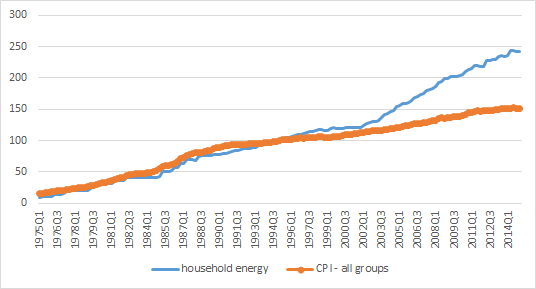
Source: Statistics New Zealand Infoshare.
New Zealand does rather well on many measures of poverty and inequality
05 Jun 2015 Leave a comment
in labour economics, minimum wage, poverty and inequality, welfare reform Tags: child poverty, family poverty, living wage, welfare state
Tough times? On #MayDay, compare % of low-paid #workers in yr country bit.ly/1EFrrV7 #LabourDay http://t.co/jNBrmjcom9—
(@OECD) May 01, 2015
Working for minimum wage? See how your country compares, then read oe.cd/mw2015 ( PDF) #wages http://t.co/DJsLYawtfw—
(@OECD) May 06, 2015
The three S’s in family policy
18 May 2015 Leave a comment
in economics of education, gender, human capital, labour economics, labour supply, occupational choice, poverty and inequality, welfare reform Tags: child poverty, economics of marriage, family poverty, female labour force participation, labour force participation, male labour force participation, marriage and divorce, single parents, welfare reform
Helpful distinctions for family thinking: structure, stability & strength (&.. how related) @inclusionist @mboteach http://t.co/zMi92WYUhi—
Richard V. Reeves (@RichardvReeves) January 13, 2015
The War on Poverty at 50
16 May 2015 Leave a comment
in economic history, labour economics, labour supply, poverty and inequality, welfare reform Tags: 1996 US welfare reforms, child poverty, family poverty, war on poverty

The big drop .in both child poverty and poverty in general was after the 1996 welfare reforms.


via Chart Book: The War on Poverty at 50, Section 1 | Center on Budget and Policy Priorities.
The main drivers of child poverty
15 May 2015 Leave a comment
in applied welfare economics, economics of love and marriage, gender, labour economics, labour supply, occupational choice, politics - Australia, politics - New Zealand, politics - USA, population economics, welfare reform Tags: child poverty, economics of the family, family poverty, marriage and divorce, single mothers, single parents
CHART: Black Illegitimacy Rate Went from < 20% in 1950 to 75.2% in 2010. Has Obama ever mentioned that? http://t.co/1UBUQ5aLRi—
Mark J. Perry (@Mark_J_Perry) May 12, 2015
Quotation of the Day from Charles Murray http://t.co/Y8W6xGjRPO—
Mark J. Perry (@Mark_J_Perry) May 12, 2015
 Utopia, you are standing in it!
Recent Comments