HL Mencken on the Harmful Digital Communication Bill
26 Jun 2015 Leave a comment
in applied price theory, applied welfare economics, comparative institutional analysis, constitutional political economy, economics of crime, economics of media and culture, economics of regulation, law and economics, liberalism, politics - New Zealand, Public Choice Tags: chilling effect, disorderly conduct, free speech, infotopia, Internet trolls, meddlesome preferences, nanny state, offsetting behaviour, The fatal conceit, The pretence to knowledge, unintended consequences
How fainting couch feminism threatens freedom
24 Jun 2015 Leave a comment
in liberalism, politics - Australia, politics - New Zealand, politics - USA Tags: feminism, free speech, meddlesome preferences, nanny state, political correctness
In College and Hiding From Scary Ideas
07 Jun 2015 Leave a comment
in economics of education, liberalism Tags: free speech, Left-wing hypocrisy, political correctness, speech codes, Twitter left

John Stuart Mill on trigger warnings
07 Jun 2015 Leave a comment
in liberalism Tags: free speech, political correctness, trigger warnings
There is nothing new under the sun – trigger warnings
27 May 2015 Leave a comment
in liberalism Tags: free speech, political correctness, trigger warnings

To punish the discussion of public affairs through libel judgments is to shut off discussion of the very kind most needed
29 Mar 2015 Leave a comment

George Mason Law School’s position on the “Sodomite Suppression Act” proposal – The Washington Post
27 Mar 2015 Leave a comment
in liberalism Tags: free speech

Emails to various members of the Mason community have informed us that Matthew McLaughlin, a 1998 graduate of this law school, has filed a ballot initiative in California where he has apparently lived for the past seventeen years. The effect of this initiative, if it were enacted by voters, would be to amend the state’s Constitution by enacting a bill of attainder (the “Sodomite Suppression Act”). Among other things, this act would impose the condition of outlawry on gay and lesbian people in California, thus withdrawing from them the protection of law and allowing them to be killed out of hand, by anyone at any time, with legal impunity.
Some correspondents have called upon the law school to repudiate this initiative – and Mr. McLaughlin. With respect, we must decline, as it is not the function of schools or other institutions to denounce things with which they have nothing to do. Law schools are not guarantors of the views or acts of their former students. No one ever suggested that Harvard Law School should repudiate the treason of Alger Hiss, or that the University of Puget Sound law school should disclaim murders committed by Ted Bundy. Responsibility for those crimes belongs to the criminals, not to the schools they attended. The same principle applies here. Mr. McLaughlin must answer for himself, and not we answer for him, concerning what he says or does. Of course individuals, speaking for themselves, remain free to express their own opinions if they so choose.
Another consideration contributes to the conclusion that we should stand to one side. Mr. McLaughlin’s filing suggests views that undeniably are out of keeping with the normal civilities of life. But so far as appears, they are also lawful and constitutionally protected expressions. Mr. McLaughlin has a right to say what he wants and to petition the government for redress of his grievances – and it is up to him to determine what aggrieves him. Other people have the same rights and are free to use them in a different way – including to criticize Mr. McLaughlin. And still others are free, for a variety of possible reasons, to refuse to be conscripted into a contretemps that has nothing to do with them. There is real advantage, apart from the principles of constitutional law, in limiting how much one should discourage people from expressing even very revolting ideas if that is what is on their mind. Tolerance of this kind facilitates self-disclosure by those whose hearts are septic with senseless rage. So disclosed, respectable people can see who they are and simply avoid them. But if suppressed, they may nurture their loathing in afflicted silence, even as they continue to mingle freely in the world with less-stricken and unsuspecting souls.
via George Mason Law School’s position on the “Sodomite Suppression Act” proposal – The Washington Post.
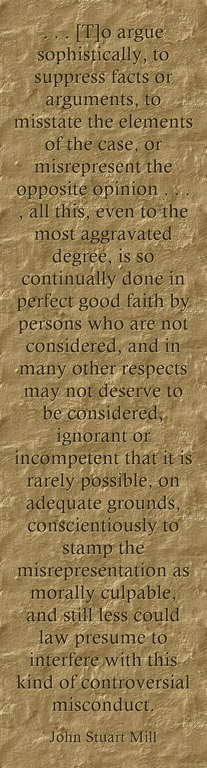
The best test of truth is the power of the thought to get itself accepted in the competition of the market
14 Mar 2015 Leave a comment
in liberalism Tags: anti-vaccination movement, Disneyland, free speech, marketplace for ideas, vaccinations


Rowan Atkinson on the right to offend
09 Feb 2015 Leave a comment
in law and economics, liberalism Tags: Blasphemy, free speech, Rowen Atkinson
Link to share: Blasphemous artwork removed from Paris exhibition (due to Islamist threats)
30 Jan 2015 Leave a comment
in economics of religion, liberalism, politics - Australia, politics - New Zealand, politics - USA Tags: Blasphemy, Censorship, free speech, freedom from religion, Freedom of religion, religious bigotry, religious tolerance, terrorism, The Age of Enlightenment
 Utopia, you are standing in it!
Recent Comments