How New Zealand’s rich-poor divide killed its egalitarian paradise | Max Rashbrooke | The Guardian – a boy’s own fact check

What is claimed to have gone wrong by the op-ed in The Guardian overnight?

A stark rich-poor divide, the OECD argued, had taken over a third off the country’s economic growth rate in the last 20 years. But how could this be?

The simple answer is that in the two decades from 1985 onwards, New Zealand had the biggest increase in income gaps of any developed country.

Incomes for the richest Kiwis doubled, while those of the poorest stagnated. Middle income earners didn’t do too well, either.

Are these claims true? That is, in the two decades from 1985 onwards, have the incomes of the richest Kiwis doubled, while those of the poorest stagnated and have a middle income earners not done too well either?

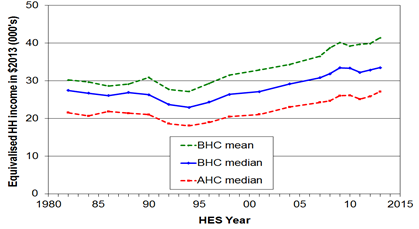
Figure 1 shows that prior to the recent recession starting in 2009, there were 15 years of steady growth in median household incomes. As will be shown, most of the period covered both by the op-ed in the Guardian, and by the OECD paper was an economic boom.

Figure 1: Real household income trends before housing costs (BHC) and after housing costs (AHC), 1982 to 2013 ($2013)
clip_image002

Source: Bryan Perry, Household incomes in New Zealand: Trends in indicators of inequality and hardship 1982 to 2013. Ministry of Social Development (July 2014).

Perry (2104) found that net income gains from the mid-1990s to 2013 were similar for all income groups, so income inequality in 2013 was also similar to the mid-1990s – see Figure 2.

Figure 2: Real household incomes (BHC), changes for top of income deciles, 1994 to 2013

clip_image002[7]

Source: (Perry 2014).

Importantly,  in the OECD analysis, much was made of what was happening  to the 40% income decile. As can be seen from figure 2, this decile gained as much as any other group in New Zealand from the income growth  between  1994 and 2013.

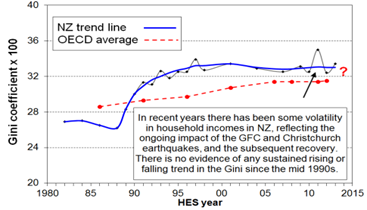
The Gini coefficient in figure 3 , which years the most common measure of inequality, shows no evidence of a rise in income inequality since the mid-1990s. The trend-line of the genie coefficient in figure 3 is almost flat since the early 1990s .

Figure 3: Gini coefficient New Zealand 1980-2015
clip_image004

Source: (Perry 2014).

To make things more awkward,  the large increase in income inequality in New Zealand in the late 1980s and early 1990s shown in figure 3 was followed by a 15 year economic boom after 20 years of economic stagnation  – next to no income growth  – as is shown in figure 4.

Figure 4: Real GDP per New Zealander and Australian aged 15-64, converted to 2013 price level with updated 2005 EKS purchasing power parities, 1956-2013

Source: Computed from OECD Stat Extract and The Conference Board, Total Database, January 2014, http://www.conference-board.org/economics

The lost decades of the growth in the 1970s and 1980s were  replaced with a long boom. Trend growth of 2% per year returned after this increase in inequality – see figure 4.

The gains since the economic boom since the early 1990s has been broadly based both up and down the income distribution  and by ethnicity. As shown in figure 5, between 1994 and 2010, real equivalised median household income rose 47% from 1994 to 2010; for Māori, this rise was 68%; for Pasifika, the rise was 77%.

Figure 5: Real equivalised median household income (before housing costs) by ethnicity, 1988 to 2013 ($2013).

clip_image002[9]

Source: (Perry 2014).

These improvements in Māori incomes since 1992 were based on rising Māori employment rates, fewer Māori on benefits, more Māori moving into higher paying jobs, and greater Māori educational attainment should be celebrated and consolidated. Māori unemployment reached a 20-year low of 8 per cent from 2005 to 2008.

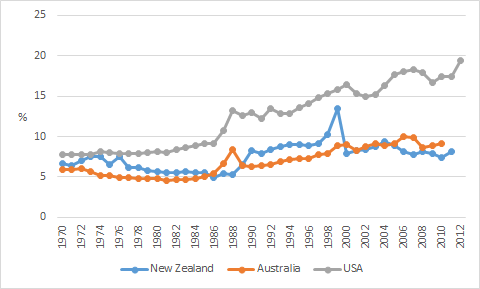
As for the top 1%,  as shown by Figure 6, their income share has been steady at 8-9% since the mid-1990s. It was only in the USA the top 1% share continued to rise strongly, from 13% to 19%.

Figure 6:  income shares of the top 1% of earners,  New Zealand, Australia and USA
image

source: Top incomes database

Over the last more than two decades in New Zealand, there has been sustained income growth spread across all of society. Perry (2014) concluded that:

Overall, there is no evidence of any sustained rise or fall in inequality in the last two decades.

The level of household disposable income inequality in New Zealand is a little above the OECD median.

The share of total income received by the top 1% of individuals is at the low end of the OECD rankings.

What is claimed as the causes of this growing rich-poor divide that is also slowing growth by a third?

Tracing the causes of a growing income gap is like trying to map earthquake fault lines – never a precise science – but it is hard to ignore the correlation between the timing of the increase and the country’s post-1984 political revolution.

Embracing reforms known elsewhere as Thatchernomics and Reaganomics with unprecedented enthusiasm, New Zealand halved its top tax rate, cut benefits by up to a quarter of their value, and dramatically reduced the bargaining power – and therefore the share of national income – of ordinary workers.

Thousands of people lost their jobs as manufacturing work went overseas, and there was no significant response with increased trade training or skills programmes, a policy failure that is on-going.

At the same time, New Zealand stopped building affordable houses in any serious quantity, forcing poorer households to spend ever-increasing amounts on rent and mortgages.

As will be recalled from Figure 4, the economic reforms in New Zealand were followed by a long economic  boom starting in 1992 that only came to an end with the onset of the global financial crisis.

Figure 7  shows that from 1994, the proportion of the lowest income households spending more than 30% of their income on housing fell steadily, reaching 34% by 204.

Figure 7: Proportion of households spending more than 30% of their income on housing costs by income quintile, New Zealand 1988–2013 HES years

Source: Perry (2014)

Housing affordability was improving for much of the period in which the op-ed in the Guardian was claiming it was getting worse. The increase in housing unaffordability in the late 1980s and early 1990s coincided with a deep recession and a cut in welfare benefits.

Housing affordability has become an issue in New Zealand because of rising prices. Supply is not keeping up with demand.

There were considerable increases in prices throughout the house price distribution between 2004 and 2008. Median house price increasing by over 50% between 2004 and 2008; the price rises were largest among the lower price houses.

It was not a case of a decline in demand under the hypothesis that is put forward in the op-ed in the Guardian. For that hypothesis to hold, housing prices would somehow have to fall in the price range of ordinary workers. That is not the case.

Furthermore,  the large increase in housing prices and decline in housing affordability  occurred a decade and more after the increase in inequality in the late 1980s and early 1990s. The timing is out.

Another inconvenience for the rich poor divide hypothesis is during the housing  price boom after 2004 rent to disposable income for all income quintiles remained relatively constant. Rents were stable.

Poorer households are more likely to rent, and therefore much less likely to be affected by the housing affordability crisis in New Zealand as that was mostly about home ownership.

Gender analysis! Gender analysis? Where is the gender analysis? Over the last 20 to 30 years, the gender gap has closed substantially in terms of wages and employment. Young women now outnumber young men two to one at university.

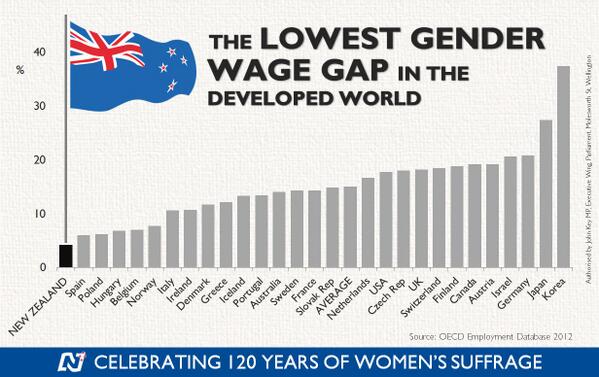
New Zealand has the smallest gender wage gap in the Western world. That is inconsistent with the notion in New Zealand has a rich poor divide. Instead New Zealand appears to be an egalitarian paradise as long as you are not a boy!
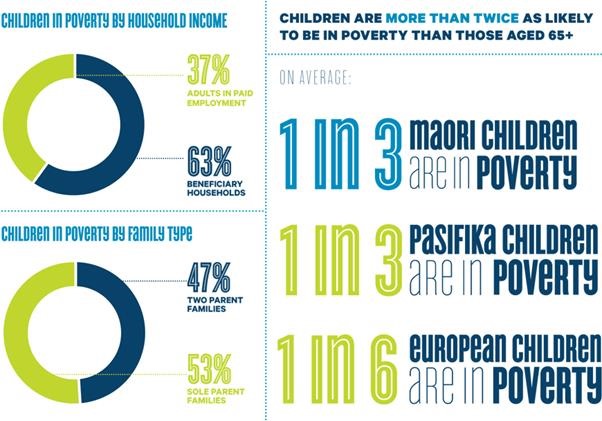
The major driver of inequality in New Zealand and overseas is the rising number of two-income households made up of two well-educated parents and one or two children and many more single parent households on low pay or no one in paid employment in the house. Well-educated couples form into high income households;  fewer of the less educated marry and too many end up a single mothers.
clip_image002

Source: closertogether.org.nz

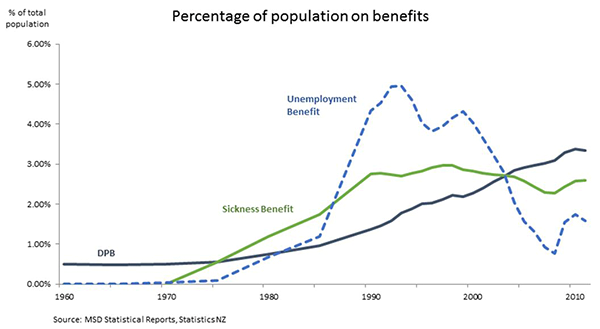
The main cause of poverty in New Zealand is dependency on welfare benefits and in particular the number of single parents. Child poverty in beneficiary families is 75% to 80%, much higher than in families with at least one adult in full-time employment (11% in 2012 and 2013). The payment of welfare benefits to families who do not work guarantees an income to people not in a job, but it creates incentives not to work.
image

The economic and sociological literatures overseas increasingly suggesting that skill disparities resulting from a lower quality education and less access to good parenting, peer and neighbourhood environments produce most of the income gaps of racial and ethnic minorities rather than factors such as labour market discrimination.

via How New Zealand’s rich-poor divide killed its egalitarian paradise | Max Rashbrooke | Comment is free | The Guardian.

Gender wage gap or asymmetric marriage premium?

Image

Some economics of the marriage bars (and mandatory retirement ages)

Up until 1966, women had to quit from the Australian Public Service when they married! The bar was repealed in 1966 with a private members bill by Bill Hayden.

Some hid their marriages for years, hiding their rings before they got to work.

One woman remained unmarried and bore four children. She managed this by timing her annual leave to cover the births.

While her personnel area was co-operative, they forced her to resign her middle management position when she decided to make an honest man of her de facto husband by marrying the father of their children.

Claudia Goldin found that marriage bars were policies adopted by firms and local school boards, from about the early 1900’s to 1950. They fired single women when they married and would not not to hire married women.

The marriage bar, which had at its height affected 751 of all local school boards in the USA and more than 50% of all office workers, was virtually abandoned in the 1950’s when the cost of limiting labour supply greatly increased.

When marriage bars disappeared, Goldin found that older female workers in the mid-1950’s were suddenly praised for their “maturity, reliability, neat appearance, and less chatty nature”.

In retail trades, and especially in suburban retail shops, Goldin found that older married women with absolutely no previous training were now the “ideal employee”; the middle-class woman were “naturally courteous” and “well-bred,” and who did not have to work became the preferred recruits of the major department stores. the best female employee was, in the words of a Sears, Roebuck, and Co. officer

a married woman with a mortgage on her house and her children partially raised

These sudden changes in the attitude of employers towards the recruitment of women of different ages and marital status suggests that the previous personnel policies were disciplined by competition.

Marriage bars, in the private sector, were instituted by large firms with centralised hiring promotion and salary schedules that were often fixed and based on tenure with the firm, and other modern employment practices.

This evidence suggested to Claudia Goldin that firms may have wanted to encourage turnover when earnings rose more rapidly with tenure than productivity. These  employers in firms with rigid wage systems, tied to their workers’ seniority, desired a young, inexperienced work force. Goldin hypothesise that the marriage bar was a socially acceptable way of terminating the employment of young women whose wages would eventually rise to exceed their addition revenue to the firm.

Goldin suggested that the marriage bar had some relationship to seniority pay, as discussed by Edward Lazear.

Under seniority pay, and employees paid less than their productivity in their early years of employment but more in their later years of employment up to say a retirement date.

By back loading salary, the employer could economise on the cost of monitoring the employee’s performance and especially so in jobs where it was hard to evaluate performance. Because of the prize at the end of the road: a large salary paid towards the end of a career, an employee had more reasons to be honest and not to underperform and risk dismissal.

Not all workers may be compensated under long-term seniority pay contracts. Routine office workers, support staff, sales agents, and so on appear to be compensated on a spot basis rather than under long-term incentive contracts.

Workers in these more routine occupations have lower monitoring costs. Their productivity can be more easily and cheaply  measure directly.

There is no need for sophisticated incentive contracts as is the case more often with managerial Employees and workers who hold positions of trust. In both cases , the back loading a salary operates as a bond against poor performance and dishonesty.

Most women entered the workforce by the age of 18 in the mid to early 20th century. They married in their early to mid-20s. This meant that the maximum length of their career with the firm would be 5 to 7, maybe 10 years.

Because these women are often assigned to low skilled clerical duties where there are a few promotion prospects, the productivity of these women did not increase much with time in the job.

To make sure that some women didn’t stay on to receive the seniority based salary increases by not marrying, Goldin found that some firms offered a substantial dowry is to women when they married if that already been with the firm for six years.

These dowries were buying women out of jobs where their wages were rising, but their productivity was stable.

Another advantage of buying women out of their jobs when they married was that the male co-workers didn’t have to be paid a wage premium for less job security can as they themselves could be dismissed on similar grounds.

Marriage bars were found by Goldin to be associated with fixed salary scales, internal promotion, and other personnel practices and they are not associated with piece-rate work.

Subsequent work on mandatory retirement ages in the public private sector found a similar link to both seniority pay and organisational architecture and the the limits of individual managerial discretion over firing.

The organisational architecture of a firm encompasses the assignment of decision rights within the firm, the methods of rewarding individual employees, and the structure of the systems that evaluate the performance of individual employees and business units.

Some larger firms may struggle to administer internal corporate governance structures which permit more local managerial discretion over employment relationship matters and still properly control the costs of a more diverse workforce.

A price of growth in the size of a firm is often the standardisation of products, workforce compositions and terms of employment.

When mandatory retirement was lawful, large firms with centralised personnel structures are more often to be found to have mandatory retirement ages.

The nub of the problem is large firms have several layers of management with fairly strict limits on what each individual line manager can do (Williamson 1975, 1985; Fama and Jensen 1983b).

There must be limits on local managerial discretion because the owners and senior managers set the strategic direction of the firm, the products it sells, and how many workers are employed and on what wages.

Larger firms may struggle with striking the most profitable balance between greater local managerial discretion and effective corporate governance of a large diverse organisation with professional managers and diffuse ownership structures. It will be shown that very large firms promulgate rigid personnel policies while smaller firms are much more flexible in their deals with individual employees.

This balance between local managerial discretion and central control must extend to wages and hours because labour costs make up much of the costs of many firms. Changes in policies on wages and conditions are subject to ratification and monitoring by head office and the corporate board in managerial firms.

This increasing rigid separation of decision management rights from decision control rights as a managerial firm grows will restrict flexibility in terms of employment, including phased retirements. Top level managers and board members both have limited amount of time to allocate, limited spans of control, and will have less and less detailed knowledge of their firm as it grows.

Limits on the degree of local managerial discretion over employment relations in large managerial firms can arise from restrictions on managerial delegations, divided decision making rights, hierarchical approval procedures, and the breath and content of wage and personnel policies. This can include not having a personnel policy on the availability of phased retirements. This gap can be through choice, inertia or attention to other concerns currently of a higher priority.

The discretion of supervisors in large firms over the terms and conditions of employment of individual members of their team may be limited to individual performance ratings (Gibbs and Hendricks 2004).

Smaller firms have more more discretion over retirement ages was is less of a separation of ownership and control, and owners are much more able to be on-site and of balance risks and rewards from innovations.

Good evidence to illustrate the proposition that larger firms prefer rigid rules over discretion in personnel policies comes from the days of mandatory retirement. Mandatory retirements can be viewed as the wholesale substitution of local managerial discretion with a single company-wide rule because larger firms find idiosyncratic decisions to be more costly (Parsons 1997).

Back when they were legal, mandatory retirements are near universal in very large workplaces, but in small to medium size firms, there were flexible retirement polices. Few very large firms reported flexible retirement polices. The smaller firms provided for policies that allowed for exceptions to mandatory retirement rules while most of largest firm reported a policy of zero exceptions to mandatory retirement rules (Parsons 1997).

The line managers in small firms were more willing to allow an older worker to work passed the usual retirement age because they had more delegations with regard to terms and conditions of employment. In addition, in smaller firms, the owners are more likely to be among the management team for the CEO and able to closely supervise the success of the discretionary decisions of junior management over conditions of employment and hiring and firing.

Richard Posner described the engines of women’s liberation

Image

How to End the Gender Pay Gap Once and for All

Image

How Some Women Benefit From Marrying a Man Who Makes Less Money – The Atlantic

marry poor chart.png

The large and growing gap is not due to timid female MBAs.

Some of it is attributed to different skills, jobs before the MBA, and that male business students typically take more finance classes and women more marketing classes.

But a majority of the difference is due to women taking time out of the labor force and then working less after having children.

Women without children usually don’t take time off, and most of their earnings disparity with men can be explained by differences in their skills.

It’s notable that the earnings of some women did not fall very much after they had children and any drop in income did not persist after a few years.

But these women often had a “lower” earning spouse (income under $100,000). A large and sustained drop in income is highly correlated with having children and a high-earning husband.

via How Some Women Benefit From Marrying a Man Who Makes Less Money – The Atlantic.

Claudia Goldin and the power of the pill

Claudia Goldin has documented well that the availability of reliable contraception in the late 1960s led to an explosion in female investment in higher education, and in particular, long duration professional educations.

Although rapidly disseminated among married women once it came on the market in 1960, the pill at first was almost inaccessible to single females, due to the prevailing state laws on prescriptions of drugs.

Liberalisation of availability for single females was on a state-by-state basis and was staggered over a few years. This allowed Claudia Goldin to study what happened to investment in professional education by young women in each of those states as they reformed their laws on the dispensing of contraception to single females.

As contraception was made lawful for single women on a state-by-state basis in the USA in the late 60s and 1970s, young women started investing in long duration professional educations at an explosive rate. They stayed in high school the longer, more young women went on to college, and more of these college female students majored in long duration professional degrees.

In the 1960s, it was common to get engaged and even marry while at college in the USA. As Claudia Goldin, and her co-author Larry Katz explain:

It was a stark choice, you could be celibate, get your career started, and potentially face a very thin marriage market once you were done.

Or, you could have fun, get married earlier, and not necessarily have a career.

The availability of the pill allowed  college-age women to have certainty in their career investments and therefore the payoff of investing in professional educations was much greater.

Participation Rates Women

By decoupling sex for marriage, women could afford to defer marriage and shop around looking for better partners. Postponing marriage for at least a few years didn’t mean all the “good guys” would be taken. In addition, with higher career incomes for female college graduates, as Goldin explained:

You might think of it as the decline of the trophy wife, as women with careers who might not be as intrinsically good-looking became more highly valued than—or at least as equally valued as—women for whom appearance was a primary asset.

But as Goldin’s co-author Larry Katz explained:

Potential losers in this equation, in addition to trophy wives, are women with poor career prospects.

The clear winners are women with careers and, of course, the men they marry… Guys have more money, more sex, and less responsibility.

One side effect of the availability of contraception to better educated women was that young women with poor career prospects were also left with a pool of more unattractive men to marry.

Many of these young women who wanted to have  baby chose just to have the child, and perhaps marry the father later if the responsibilities of fatherhood turned him into marriage material.

This reversal in order of parenthood and marriage  among less well educated young women was one of the surprising social developments in the mid to late 20th century.

The Top Five Feminist Myths of All Time

Women graduates increasingly put their partner’s career first after they graduate | Daily Mail Online

R1412G_E

R1412G_F

Women are increasingly putting their husband’s career before their own, a controversial new study of Harvard Business School graduates has found.

It canvassed over 25,000 male and female students, and found 40 percent of Gen X and boomer women said their spouses’ careers took priority over theirs.

The researchers also said only about 20 percent of them had planned on their careers taking a back seat when they graduated.

This gender gap  found by Robin Ely, Colleen Ammerman and Pamela Stone can be better explained by the marriage market combined with assortative mating.

1. Harvard business graduates are likely to marry each other and form power couples.

2. There tends to be an age gap between men and women in long-term relationships and marriages of say two years.

This two year age gap means that the husband as two additional years of work experience and career advancement. This is highly likely to translate into higher pay and more immediate promotional prospects.

Maximising household income would imply that the member of the household with a higher income, and greater immediate promotional prospects stay in the workforce.

It is entirely possible that women to anticipate this situation both in their subject choices and career ambitions.

Claudia Goldin found that the wage gap between male and female Harvard graduates disappears in the presence of one confounding factor.

That confounding factor is obvious: the male in the relationship earns less. When this is so, Goldin found that the female in the relationship earns pretty much as do similar male Harvard graduates, except for the fact that they work less hours per week:

We identify three proximate factors that can explain the large and rising gender gap in earnings: a modest male advantage in training prior to MBA graduation combined with rising labour market returns to such training with post-MBA experience; gender differences in career interruptions combined with large earnings losses associated with any career interruption (of six or more months); and growing gender differences in weekly hours worked with years since MBA.

Differential changes by sex in labour market activity in the period surrounding a first birth play a key role in this process. The presence of children is associated with less accumulated job experience, more career interruptions, shorter work hours, and substantial earnings declines for female but not for male MBAs.

The one exception is that an adverse impact of children on employment and earnings is not found for female MBAs with lower-earning husbands.

This sociological evidence reported in the Daily Mail is entirely consistent with the choice hypothesis and equalising differentials as the explanation for the gender wage gap. As Solomon Polachek explains:

At least in the past, getting married and having children meant one thing for men and another thing for women. Because women typically bear the brunt of child-rearing, married men with children work more over their lives than married women.

This division of labour is exacerbated by the extent to which married women are, on average, younger and less educated than their husbands.

This pattern of earnings behaviour and human capital and career investment will persist  until women start pairing off with men who are the same age or younger than them.

via Women graduates increasingly put their partner’s career first after they graduate | Daily Mail Online.

The day that sex discrimination died – Solomon Polachek on the gender wage gap

Solomon Polachek was minding his own business back in 1975 looking for evidence to show occupational crowding and that women were pushed into low paid occupations by sex discrimination, and in particular, employer discrimination. About 60 per cent of women still work in just 10 occupations. the occupations which are female-dominated are often relatively poorly paid jobs

By chance, Polachek departed from the usual empirical strategy for estimating the male-female wage gap at that time.

Rather than include a dummy variable to estimate discrimination after various factors have been taken into account, he introduced dummy variables that took account of both gender and marital status. His results were startling.

He previously was able to explain about 35% of the wage gap using the data at hand and variables he was using.

This 35% gap dropped to 18% for single never married males and females, but his ability to explain the gender wage gap increased dramatically to over 60% for married spouse present males and females.

What more, the presence of children exacerbated the gender wage gap. Each child of less than 12 years old widened the female male pay disparity by 10%. Furthermore, large spacing intervals between children widened this gender wage disparity even further.

Subsequent research showed that marital status had the same effects on gender wage gaps in Germany, the UK, Austria, Switzerland, Sweden, Norway and Australia. Factors associated with dropping out of the labour market to care for children could explain up to 93% of the gender wage gap.

These findings are devastating to the notion that there is some sort of discrimination against women on the demand side of the labour market. As Polachek explains:

The gender wage gap for never marrieds is a mere 2.8%, compared with over 20% for marrieds. The gender wage gap for young workers is less than 5%, but about 25% for 55–64-year-old men and women.

If gender discrimination were the issue, one would need to explain why businesses pay single men and single women comparable salaries. The same applies to young men and young women.

One would need to explain why businesses discriminate against older women, but not against younger women. If corporations discriminate by gender, why are these employers paying any groups of men and women roughly equal pay?

Why is there no discrimination against young single women, but large amounts of discrimination against older married women?

… Each type of possible discrimination is inconsistent with negligible wage differences among single and younger employees compared with the large gap among married men and women (especially those with children, and even more so for those who space children widely apart).

The main drivers of the gender wage gap is simply unknown to employers such as whether the would-be recruit or employer is married, their partner is present, how many children they have, how many of these children are under 12, and how many years are there between the births of their children. These are the main drivers of the gender wage gap – all of which are factors totally unknown to employers and of no relevance to them in making a profit.

The drivers of the gender wage gap on the supply side of the labour market regarding the choices women make about having children, when they have children, and how this influences their investment in human capital, and in particular, in human capital that does not depreciate by that much because of intermittent labour force participation due to motherhood.

Occupational crowding hypotheses of the gender wage gap have the drawback of being an invisible hand explanation of social outcomes. Each individual, acting only to best secure her own rights and interests, act in such a way that the unintended outcome of a complex social interaction.

The specific unintended outcome that must arise from millions of choices of people acting in their own interest  throughout their lives is occupational segregation.

The market process of the invisible hand has both a filter and  and equilibrating mechanism. The filter is profits and loss to exclude through insolvency and bankruptcy those entrepreneurial choices that do not further consumer’s interests. The equilibrating mechanism – the mechanism that tells people which choices they should make – is price signals. Price signals guide individual choices towards the unintended outcome.

Those that argue that women are socialised to make particular choices such as mother were not paying attention to the 20th century and the radical social change over the course of that century, in particular in the role of women. As Gary Becker explains:

… major economic and technological changes frequently trump culture in the sense that they induce enormous changes not only in behaviour but also in beliefs.

A clear illustration of this is the huge effects of technological change and economic development on behaviour and beliefs regarding many aspects of the family.

Attitudes and behaviour regarding family size, marriage and divorce, care of elderly parents, premarital sex, men and women living together and having children without being married, and gays and lesbians have all undergone profound changes during the past 50 years.

Invariably, when countries with very different cultures experienced significant economic growth, women’s education increased greatly, and the number of children in a typical family plummeted from three or more to often much less than two.


Claudia Goldin on the main cause of the gender wage gap

Image

Progressive Feminism Exposed

Why the Gender Pay Gap is a Myth

Men are far more likely to choose careers that are more dangerous, so they naturally pay more under the principle of compensating differences. Top 10 most dangerous jobs: Fishers, loggers, aircraft pilots, farmers and ranchers, roofers, iron and steel workers, refuse and recyclable material collectors, industrial machinery installation and repair, truck drivers, construction labourers. They are male-dominated jobs.

Men are far more likely to enter higher-paying fields and occupations (by choice). Men are far more likely to take work in uncomfortable, isolated, and undesirable locations that pay more. Men work longer hours than women do. The average fulltime working man works 6 hours per week or 15 percent longer than the average fulltime working woman.

Accounting for the 21 Cent Gender Wage Gap 2000

Women tend to work in fields dominated by women because these fields best satisfy women’s’ dual careers as workers and household managers. This can include less stressful work environments (noise, strenuous activity, etc.), more flexible policies regarding time off, and a number of other factors.

Men work longer hours than women do. The average fulltime working man works 6 hours per week or 15 percent longer than the average fulltime working woman. Even within the same career category, men are more likely to pursue high-stress and higher-paid areas of specialisation.


Despite all of the above, unmarried women who’ve never had a child actually earn more than unmarried men. In 2008, single, childless women between ages 22 and 30 were earning more than their male counterparts in most U.S. cities, with incomes that were 8% greater on average.

Women business owners make less than half of what male business owners make, which, since they have no boss, means it’s independent of discrimination. The reason for the disparity is money is the primary motivator for 76% of men versus only 29% of women. Women place a higher premium on shorter work weeks, proximity to home, fulfillment, autonomy, and safety.

Women lean toward jobs with fewer risks, more comfortable conditions, regular hours, more personal fulfillment and greater flexibility. Many women are willing to trade higher pay for other desirable job characteristics.

Men often take on jobs that involve physical labour, outdoor work, overnight shifts and dangerous conditions (which is why men suffer the overwhelming majority of injuries and deaths at the workplace). They choose to put up with unpleasant factors because they can earn more.

An Analysis of Reasons for the Disparity in Wages Between Men and Women for the U.S. Department of Labor in 2009 concluded that:

This study leads to the unambiguous conclusion that the differences in the compensation of men and women are the result of a multitude of factors and that the raw wage gap should not be used as the basis to justify corrective action.

Indeed, there may be nothing to correct. The differences in raw wages may be almost entirely the result of the individual choices being made by both male and female workers.

Coalition Celebrating Equal Pay Case Outcome

I wonder who will pay for this? Caregiver wages are funded out of a fixed budget allocated by the government.

A higher wage will change the type of worker that the caregiving sector will seek to recruit, as happened after increases in the teenage went minimum wage.

When the teenage minimum wage went up in New Zealand, employment of 17 and 18-year-olds fell, while the employment of 18 to 19-year-olds increased because the latter were more mature and reliable than the younger contemporaries.

Eileen Brown's avatarPay Equity Challenge Coalition

Media release: Pay Equity Challenge Coalition

28 October 2014

Coalition Celebrating Equal Pay Case Outcome

“The Court of Appeal’s decision declining the employers’ appeal in the Kristine Bartlett case is a huge victory for women workers” said Pay Equity Coalition Challenge spokesperson Angela McLeod.

“The Courts’ decision that equal pay may be determined across industries in female-dominated occupations revitalises the Equal Pay Act 1972 and will be a major factor in closing New Zealand’s stubborn 14 percent gender pay gap”.

The judgement by the Court of Appeal upholding the Employment Court decision again validates the work of caregivers and that they are underpaid, she said.

“We commend the Service and Food Workers Union Nga Ringa Tota in taking this case and exposing the underpayment and undervaluation of aged care workers. And the decision is a victory for all the women’s organisations who have never given up fighting for equal pay,”…

View original post 92 more words

Deirdre McCloskey’s Crossing: A Memoir

When Donald at the age of 52 told his university dean, a conservative economist, he had decided to become a woman a stunned silence was followed by:

Thank God … I thought for a moment you were going to confess to converting to socialism.

The dean also joked it would be good for the department’s affirmative action program – one less man, one more woman – and that McCloskey’s pay could now be cut to about 70¢ in the dollar, since she would be a female.

Sadly, his son, daughter and former wife turned away from this new person.

His sister and one of her academic colleagues conspired to have him committed as mentally incompetent — unfit to sign papers for optional surgical procedures.

They devised a theory that he was manic and that his mania could be treated with psychopharmacology.

Twice during his determined journey into womanhood, they managed to have him incarcerated — handcuffed, locked away where he could not harm himself, at first in the University of Iowa Hospital’s mental ward and later in the University of Chicago Hospital.

Deirdre McCloskey’s mother and brother were bulwarks of support; her sister is moving toward reconciliation. She has finally stopped calling her ”Donald.”

McCloskey expected to lose everything because of the gender transition but her academic career survived. McCloskey’s former wife and two adult children have not spoken to her since 1995.

Her 16 books and 400-odd academic articles range from highly technical economics to philosophy, ethics and transgender advocacy. McCloskey’s Twitter biography is a reasonable 15-word summary of her:

Postmodern, quantitative, literary, ex-Marxist, economist, historian, progressive Episcopalian, coastie-bred Chicagoan woman who was once not.

More unusually for an American, she loves cricket. McCloskey even played wicket-keeper for the University of Illinois cricket team, which was made up mostly of players from the subcontinent and Jamaica.

HT: Sydney Morning Herald and New York Times

Previous Older Entries Next Newer Entries

Bassett, Brash & Hide

Celebrating humanity's flourishing through the spread of capitalism and the rule of law

Truth on the Market

Scholarly commentary on law, economics, and more

The Undercover Historian

Beatrice Cherrier's blog

Matua Kahurangi

Celebrating humanity's flourishing through the spread of capitalism and the rule of law

Temple of Sociology

Celebrating humanity's flourishing through the spread of capitalism and the rule of law

Velvet Glove, Iron Fist

Celebrating humanity's flourishing through the spread of capitalism and the rule of law

Why Evolution Is True

Why Evolution is True is a blog written by Jerry Coyne, centered on evolution and biology but also dealing with diverse topics like politics, culture, and cats.

Down to Earth Kiwi

Celebrating humanity's flourishing through the spread of capitalism and the rule of law

NoTricksZone

Celebrating humanity's flourishing through the spread of capitalism and the rule of law

Homepaddock

A rural perspective with a blue tint by Ele Ludemann

Kiwiblog

DPF's Kiwiblog - Fomenting Happy Mischief since 2003

The Dangerous Economist

Celebrating humanity's flourishing through the spread of capitalism and the rule of law

Watts Up With That?

The world's most viewed site on global warming and climate change

The Logical Place

Tim Harding's writings on rationality, informal logic and skepticism

Doc's Books

A window into Doc Freiberger's library

The Risk-Monger

Let's examine hard decisions!

Uneasy Money

Commentary on monetary policy in the spirit of R. G. Hawtrey

Barrie Saunders

Thoughts on public policy and the media

Liberty Scott

Celebrating humanity's flourishing through the spread of capitalism and the rule of law

Point of Order

Politics and the economy

James Bowden's Blog

A blog (primarily) on Canadian and Commonwealth political history and institutions

Science Matters

Reading between the lines, and underneath the hype.

Peter Winsley

Economics, and such stuff as dreams are made on

A Venerable Puzzle

"The British constitution has always been puzzling, and always will be." --Queen Elizabeth II

The Antiplanner

Celebrating humanity's flourishing through the spread of capitalism and the rule of law

Bet On It

Celebrating humanity's flourishing through the spread of capitalism and the rule of law

History of Sorts

WORLD WAR II, MUSIC, HISTORY, HOLOCAUST

Roger Pielke Jr.

Undisciplined scholar, recovering academic

Offsetting Behaviour

Celebrating humanity's flourishing through the spread of capitalism and the rule of law

JONATHAN TURLEY

Res ipsa loquitur - The thing itself speaks

Conversable Economist

Celebrating humanity's flourishing through the spread of capitalism and the rule of law

The Victorian Commons

Researching the House of Commons, 1832-1868

The History of Parliament

Articles and research from the History of Parliament Trust

Books & Boots

Reflections on books and art

Legal History Miscellany

Posts on the History of Law, Crime, and Justice

Sex, Drugs and Economics

Celebrating humanity's flourishing through the spread of capitalism and the rule of law

European Royal History

Exploring the Monarchs of Europe

Tallbloke's Talkshop

Cutting edge science you can dice with

Marginal REVOLUTION

Small Steps Toward A Much Better World

NOT A LOT OF PEOPLE KNOW THAT

“We do not believe any group of men adequate enough or wise enough to operate without scrutiny or without criticism. We know that the only way to avoid error is to detect it, that the only way to detect it is to be free to inquire. We know that in secrecy error undetected will flourish and subvert”. - J Robert Oppenheimer.

STOP THESE THINGS

The truth about the great wind power fraud - we're not here to debate the wind industry, we're here to destroy it.

Lindsay Mitchell

Celebrating humanity's flourishing through the spread of capitalism and the rule of law

Alt-M

Celebrating humanity's flourishing through the spread of capitalism and the rule of law

croaking cassandra

Economics, public policy, monetary policy, financial regulation, with a New Zealand perspective

The Grumpy Economist

Celebrating humanity's flourishing through the spread of capitalism and the rule of law

International Liberty

Restraining Government in America and Around the World