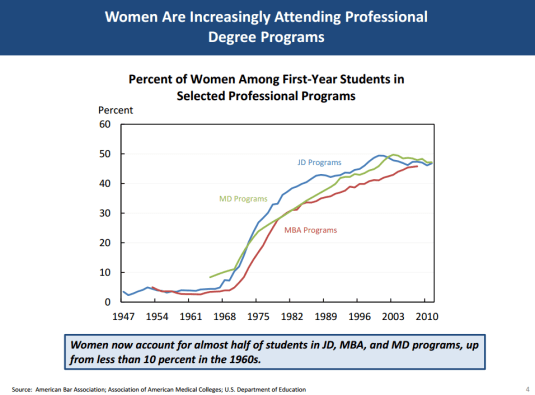
Source: whitehouse.gov
Celebrating humanity's flourishing through the spread of capitalism and the rule of law
07 Mar 2015 Leave a comment
in discrimination, economic history, economics of education, gender, labour economics, labour supply, occupational choice, politics - USA Tags: economics of fertility, engines of liberation, female labour supply, gender wage gap, reversing gender gap, The Pill
Source: whitehouse.gov
06 Mar 2015 Leave a comment
in discrimination, gender, human capital, labour economics, labour supply Tags: decline of unions, female labour force participation, gender analysis, gender wage gap, IMF, reversing gender wage gap, union power
we find strong evidence that lower unionization is associated with an increase in top income shares in advanced economies during the period 1980–2010

Gender analysis! Gender analysis! Where is the gender analysis, which is central to any analysis of inequality in and outside of the labour market!
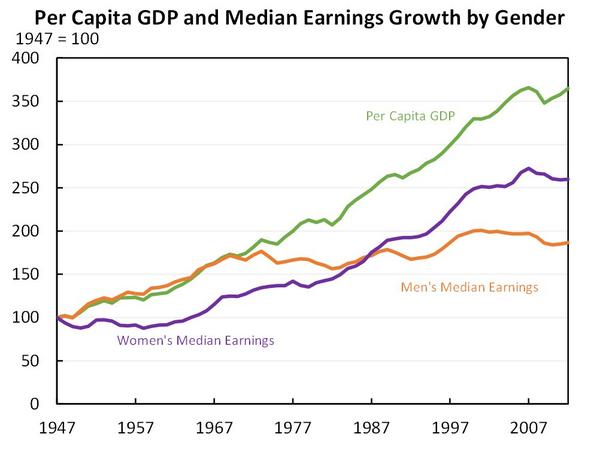
Women have done swimmingly over the last few decades in terms of closing the gender wage gap, increasing labour force participation and overtaking men in investment in higher education.
Who's the weaker sex? Women now make up the majority of university students around the world econ.st/1x1cUli http://t.co/6YWv6SuQc4—
The Economist (@TheEconomist) March 13, 2015
As for unions and women, their record of discrimination against women as threat to the union wage premium was so appalling that even Hollywood was willing to take a swipe at unions and the hostility with which mining unions, for example, greeted the first female miners.
In spite of women’s early involvement in labour struggles, deeply ingrained prejudices against women taking a full role in the workplace were often reinforced by labour unions themselves. Women were seen as mere auxiliaries to the movement, or worse, as threats to men’s jobs.
HT: whitehouse.gov
02 Mar 2015 1 Comment
in discrimination, economics of education, gender, human capital, labour economics, occupational choice Tags: gender wage gap, reversing gender gap
Women started drifting away from computer science in the mid-1980s. The interpretation put forward by the professional grievance industry, that is, by National Public Radio in the USA is:
The share of women in computer science started falling at roughly the same moment when personal computers started showing up in U.S. homes in significant numbers.
These early personal computers weren’t much more than toys. You could play pong or simple shooting games, maybe do some word processing.
And these toys were marketed almost entirely to men and boys. This idea that computers are for boys became a narrative. It became the story we told ourselves about the computing revolution. It helped define who geeks were, and it created techie culture.
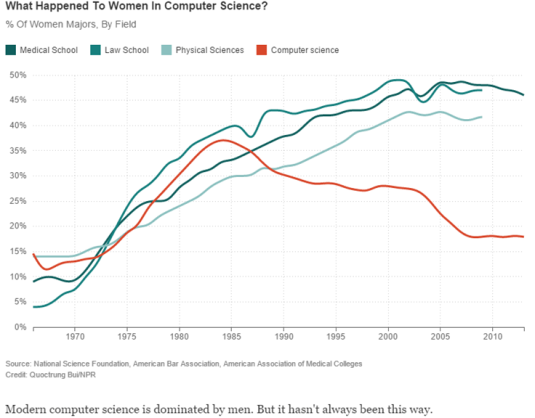
Source: NPR
Another interpretation is there are systematic differences between teenage boys and teenage girls in verbal and written skills. Young women moved away from enrolling in computer science because they could make better use of their superior written and verbal skills in medicine and law. Computer science is for those with inferior social skills, on average.
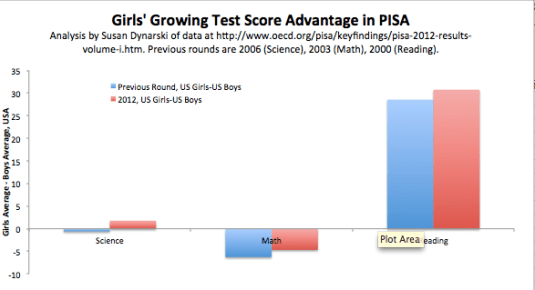
As for computers in the early days been marketed to men and boys, people with inferior verbal and reading skills would be attracted to sitting in front of the computer playing games because of their inferior social skills. Computers were expensive back in the 80s so marketing them to people with fewer social skills is sensible as they were more willing to spend money to fill the extra time they spend on their own.
The difference in reading and verbal skills between girls and boys at the age of 15 is equal to 6-months extra schooling. Six months schooling explains a lot of the wage gaps on ethnic, racial and gender lines. Not surprisingly, fewer women do computer science because their superior reading and verbal skills qualify them for medicine and law where they can take greater advantage of their mix of talents.
It is all about being the best you can be. As many women as men ending up in STEM occupations does not necessarily mean people are making the choices that help them be the best they can be because some women may not be taking advantage of their superior reading skills.
01 Mar 2015 Leave a comment
in economics Tags: gender wage gap, maternity leave, unintended consequence
The left-wing parties around the world and in New Zealand have long tried to keep women’s wages down and hold their careers back by increasing the generosity of maternity leave.
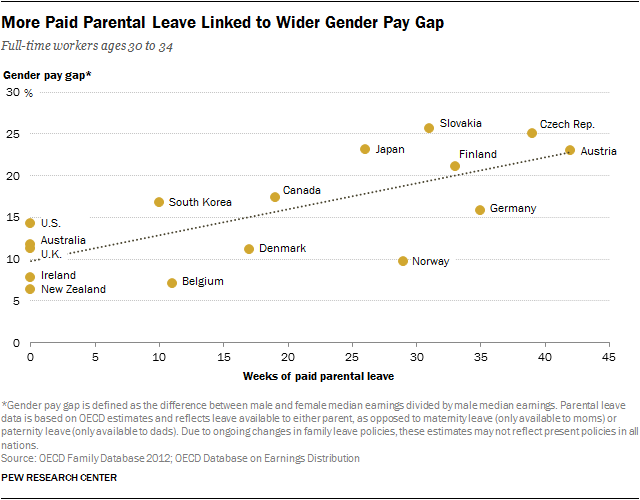
Francine Blau argues that:
More women will work more women will work as a result of maternity leave, but more of these women all work part time, instead of full-time.
At bottom, paying women to spend extended periods of time out of the workforce at crucial times of their career in their late 20s and their 30s does them no favours in terms of advancing their careers.
25 Feb 2015 Leave a comment
in discrimination, gender, human capital, labour economics Tags: compensating differences, gender wage gap, sex discrimination
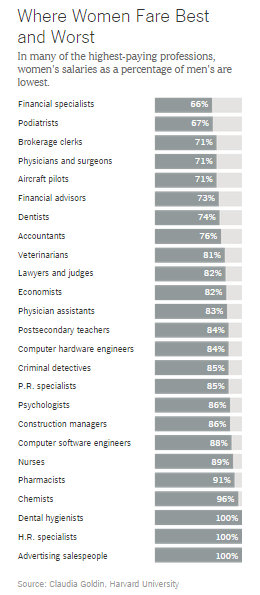
Occupations that most value long hours, face time at the office and being on call — like business, law and surgery — tend to have the widest pay gaps. That is because those employers pay people who spend longer hours at the office disproportionately more than they pay people who don’t, Dr. Goldin found. A lawyer who works 80 hours a week at a big corporate law firm is paid more than double one who works 40 hours a week as an in-house counsel at a small business.
Jobs in which employees can easily substitute for one another have the slimmest pay gaps, and those workers are paid in proportion to the hours they work.
Pharmacy is Dr. Goldin’s favorite example. A pharmacist who works 40 hours a week generally earns double the salary of a pharmacist who works 20 hours a week, and as a result, the pay gap for pharmacists is one of the smallest.
via artdiamondblog.com.
25 Feb 2015 Leave a comment

25 Feb 2015 Leave a comment
in discrimination, gender, human capital, labour economics, labour supply, occupational choice Tags: asymmetric marriage premium, gender wage gap
23 Feb 2015 Leave a comment
in discrimination, economic history, economics of marriage, gender, labour economics, law and economics, occupational choice, politics - USA Tags: engines of liberation, gender wage gap
12 Feb 2015 Leave a comment
in discrimination, economics of love and marriage, gender, labour economics, population economics Tags: gender wage gap
12 Feb 2015 Leave a comment
in economics of media and culture, industrial organisation, politics - Australia, politics - New Zealand, politics - USA, survivor principle Tags: demand for social insurance, gender wage gap, media bias

As discussed before, to survive in a competitive market, media outlets must serve that market as best they can.
The reader or viewer that is most likely to turn off or otherwise switch to another activity are women, often mothers. Women tend to be to the left than me because of their greater demand for social insurance.

To keep their most marginal viewers, media outlets pitch their stories slightly left of centre, aimed at women who are most likely to switch off if they are not seeing what they want to see.
30 Jan 2015 Leave a comment
in gender, labour economics, labour supply Tags: engines of liberation, female labour force participation, gender wage gap, sex discrimination

First, work changed to offer more jobs to women. Farming declined sharply; industrial jobs peaked and then declined. Brawn became less important; precise skills, learning, and personal service became more important.
The new economy generated millions of white-collar and “pink-collar” jobs that seemed “suited” to women. That cannot be the full story, of course; women also took over many jobs that had once been men’s, such as teaching and secretarial work.
Second, mothers responded to those job opportunities. Some took jobs because the extra income could help families buy cars, homes, furnishings, and so on. Some took jobs because the family needed their income to make up for husbands’ stagnating wages (a noteworthy trend after the 1970s). And some took jobs because they sought personal fulfilment in the world of work.
via Why Did Married Mothers Go To Work? » Sociological Images.
22 Jan 2015 Leave a comment
in discrimination, economics of love and marriage, gender, human capital, labour economics, labour supply, occupational choice, politics - USA Tags: employer discrimination, gender wage gap, sex discrimination
Celebrating humanity's flourishing through the spread of capitalism and the rule of law
Celebrating humanity's flourishing through the spread of capitalism and the rule of law
Celebrating humanity's flourishing through the spread of capitalism and the rule of law
Celebrating humanity's flourishing through the spread of capitalism and the rule of law
Celebrating humanity's flourishing through the spread of capitalism and the rule of law
Celebrating humanity's flourishing through the spread of capitalism and the rule of law
Celebrating humanity's flourishing through the spread of capitalism and the rule of law
A History of the Alt-Right
Econ Prof at George Mason University, Economic Historian, Québécois
Celebrating humanity's flourishing through the spread of capitalism and the rule of law
Scholarly commentary on law, economics, and more
Beatrice Cherrier's blog
Celebrating humanity's flourishing through the spread of capitalism and the rule of law
Celebrating humanity's flourishing through the spread of capitalism and the rule of law
Celebrating humanity's flourishing through the spread of capitalism and the rule of law
Why Evolution is True is a blog written by Jerry Coyne, centered on evolution and biology but also dealing with diverse topics like politics, culture, and cats.
Celebrating humanity's flourishing through the spread of capitalism and the rule of law
A rural perspective with a blue tint by Ele Ludemann
DPF's Kiwiblog - Fomenting Happy Mischief since 2003
Celebrating humanity's flourishing through the spread of capitalism and the rule of law
The world's most viewed site on global warming and climate change
Tim Harding's writings on rationality, informal logic and skepticism
A window into Doc Freiberger's library
Let's examine hard decisions!
Commentary on monetary policy in the spirit of R. G. Hawtrey
Thoughts on public policy and the media
Celebrating humanity's flourishing through the spread of capitalism and the rule of law
Politics and the economy
A blog (primarily) on Canadian and Commonwealth political history and institutions
Reading between the lines, and underneath the hype.
Economics, and such stuff as dreams are made on
"The British constitution has always been puzzling, and always will be." --Queen Elizabeth II
Celebrating humanity's flourishing through the spread of capitalism and the rule of law
Celebrating humanity's flourishing through the spread of capitalism and the rule of law
WORLD WAR II, MUSIC, HISTORY, HOLOCAUST
Undisciplined scholar, recovering academic
Celebrating humanity's flourishing through the spread of capitalism and the rule of law
Res ipsa loquitur - The thing itself speaks
In Hume’s spirit, I will attempt to serve as an ambassador from my world of economics, and help in “finding topics of conversation fit for the entertainment of rational creatures.”
Researching the House of Commons, 1832-1868
Articles and research from the History of Parliament Trust
Reflections on books and art
Posts on the History of Law, Crime, and Justice
Celebrating humanity's flourishing through the spread of capitalism and the rule of law
Exploring the Monarchs of Europe
Cutting edge science you can dice with




Recent Comments