Only 2 general purpose technologies in the 20th century?
07 Mar 2020 Leave a comment
in applied price theory, economic growth, economic history, economics of education, energy economics, entrepreneurship, financial economics, history of economic thought, human capital, industrial organisation, labour economics, labour supply, macroeconomics, managerial economics, occupational choice, organisational economics, survivor principle Tags: creative destruction, general purpose technologies
Is the direction of technological change mostly skill biased?
18 Apr 2016 Leave a comment
in economic history, entrepreneurship, industrial organisation, survivor principle Tags: general purpose technologies, induced innovation, skill biased technological change
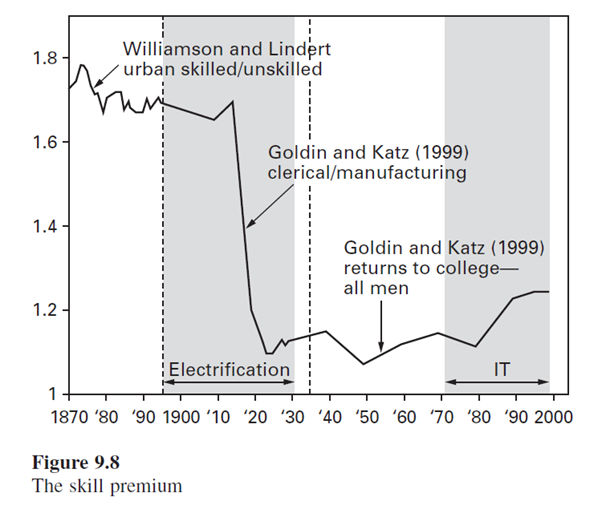
Source: Philippe Aghion and Peter Howitt THE ECONOMICS OF GROWTH.
Almost every major patent concept from the 1930s was in chemistry. Today, all software.
11 Feb 2015 Leave a comment
Real business cycles and learning the value of major technological changes
17 Dec 2014 Leave a comment
in business cycles, entrepreneurship, macroeconomics, technological progress Tags: boom and bust, general purpose technologies, real business cycles
The true value of any technological improvement is uncertain. Investors adopt a new technology after forecasting the likely productivity of the new technology. Investor learning in the face of imperfect information about the true value of major new technologies can also lead to business cycle fluctuations (Li 2007).

As a new technology slowly diffuses, entrepreneurs learn more about the true potential of the new technology and re-evaluate in hindsight whether they have invested beyond the optimal amount. If entrepreneurs have not over-invested, they revise their beliefs about the magnitude of the innovation and invest more.
Because the agents have to learn the magnitude of the technology shock, they are cautious in making investment decisions before they have learned much about the underlying technology. Consequently, GDP growth is gradual, which stretches out the length of booms.
When entrepreneurs later find that investment has over-shot the optimal amount, they reduce investment demand perhaps sharply and start a recession (Li 2007). This eventuality may seed a recession within many major technology advances such as the IT boom in the 1990s and the computer revolution in the 1970s.
The true value of the major technological improvement is often discovered only after investment over-shoots the optimal level (Li 2007). A general technological innovation affecting many industries is required for the cluster of entrepreneurial errors about the true magnitude of the productivity increase to seed a recession (Li 2007).
The 2001 US recession followed a long boom involving major new information and communication technologies that raised the productivity of many existing technologies. The information, communications and software boom lasted over a decade in the US (Li 2007).

Entrepreneurs invested gradually in new information and communication capital to learn more about the underlying technologies that they embodied. These new information and communication technologies were productivity improvements of a major but uncertain scope (Li 2007).
The eventual productivity gains come from two complex sources – both from adopting the new technology itself and from its interface with existing capital and expertise. Because both productivity gains must be forecasted and because both are discovered only by experimentation and learning by doing, it is entirely possible that entrepreneurs can invest ahead of consumer demand.
This surplus capacity will emerge despite the best efforts of investors to mitigate this risk by staggering investments to learn more about the true value of the new technology. This investor caution and staggering to allow for more learning is an important factor that stretches out the length of investment booms in major new technologies (Li 2007).

There was a sharp decline in US investment in 2001, with large accumulations of unused capital in some sectors. For example, 90% of the optical fibre laid in the US in the 1990s was unused in the years that followed. Entrepreneurs discovered the optimum investment level in, for example, optical cable fibre by investing past it and revised plans for further investments in light of this over-shooting (Li 2007).

Real business cycles of a significant magnitude can emerge simply from technological learning.
Li (2007) argued that many investment booms start with the advent of a revolutionary technology and ended with overinvestment. For example, canal building boomed after the invention of the steamboat, and by the year 1860 more than 4,000 miles of canal had been completed. However, many of these canals did not live up to the expectations of their promoters. Many of these projects eventually turned out to be financial failures.
Later in the same century, the railroad expansion shared a similar fate. Thousands of miles of railroad were built and left unused or under used, a phenomenon described by Schumpeter (1949) as construction “ahead of demand.”
That real business cycle theory required technological regress for there to be recessions is one of its oldest criticisms. That criticism that standard equilibrium business cycle models have difficulties in predicting the investment boom and overshooting grows weaker by the day.
Li presents a strong internal propagation mechanism with respect to technology shocks and endogenous recessions without invoking technological regress:
…firms invest in new capital to take advantage of the IT revolution, without knowing the limit to which this new technology can increase productivity.
The belief of this limit becomes increasingly optimistic over time as investors repeatedly realize that they have not invested enough to exhaust the potential of the new technology. Such belief revisions lead to increasingly aggressive investment and a capital overhang, followed by a recession.
 Utopia, you are standing in it!
Recent Comments