Angela Merkel’s rise to power, in five steps | The Economist
24 Sep 2017 Leave a comment
in Public Choice Tags: Germany
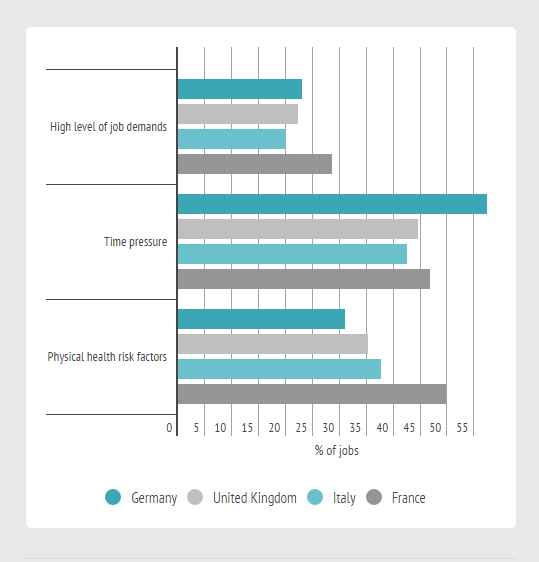
Why are French jobs so miserable and dangerous?
13 Mar 2017 Leave a comment
in labour economics Tags: British economy, compensating differentials, Denmark, France, Germany, Italy
Life behind the Berlin Wall
13 Jan 2017 Leave a comment
in economic history, Marxist economics Tags: Berlin, Berlin wall, fall of communism, Germany
The Berlin Wall fell #OTD 1989
10 Nov 2016 Leave a comment
in liberalism, Marxist economics Tags: Berlin, Berlin wall, fall of communism, Germany
1988 East German Map Which Shows West Berlin
10 Nov 2016 Leave a comment
in economic history, economics of media and culture Tags: Berlin, Berlin wall, East Germany, fall of communism, Germany, West Germany
How did Germany and Japan achieve record economic growth following World War II?
08 Nov 2016 Leave a comment
in applied price theory, development economics, economic growth, economics of natural disasters, growth miracles, macroeconomics Tags: convergence, Germany, Japan
Tertiary educational attainment, 2000 and 2014, USA, UK, France, Germany, Canada, Australia
24 Jul 2016 Leave a comment
in economic history, economics of education, human capital, labour economics Tags: Australia, Canada, France, Germany, Italy, tertiary educational attainment.
The British, Australians, and Italians experienced strong growth in tertiary attainment since the year 2000. In the case of the Italians, it was from a low base. There is still a big difference in tertiary attainment between English-speaking and other countries.
Source: OECD Factbook 2015-2016.
German, French, British, and US real housing prices, March 1975 to March 2016
15 Jul 2016 1 Comment
in economic history, economics of regulation, politics - USA, urban economics Tags: British economy, France, Germany, housing affordability
Still have not seen a decent explanation for why German housing prices seem to fall for decades on the trot.
German territory lost in the 20th century
04 Jun 2016 Leave a comment
in defence economics, economic history Tags: East Germany, economics of borders, Germany, maps, World War I, World War II
Equilibrium unemployment rate: USA, UK, France, Germany, Canada & Australia, 1985-2017
02 Jun 2016 Leave a comment
in business cycles, economic growth, economic history, global financial crisis (GFC), great recession, labour economics, labour supply, unemployment Tags: British economy, Canada, equilibrium unemployment rate, France, Germany, natural unemployment rate
I do admire the way in which the USA has been able to have a steadily falling equilibrium unemployment rate since 1984 through thick and thin. The Great Recession had no impact on the US equilibrium unemployment rate. Not only has the largest member been able to do this, the OECD host country (red squares) has had a pretty steady natural unemployment rate too all things considered.
Source: OECD Economic Outlook June 2016 Data extracted on 01 Jun 2016 12:40 UTC (GMT) from OECD.Stat
Trading across Borders Doing Business ranking 2016 – high income OECD countries
30 May 2016 Leave a comment
in international economics Tags: Australia, British economy, Common market, customs unions, economics of borders, European Union, free trade areas, Germany
What did Australia do wrong to have the worst ranking of the high income countries for doing business across borders. New Zealand is not much better. The British are not benefiting as much as they could from the common market. Being in continental Europe must have advantages except if your Germany.
Gap in GDP per Australian, Canadian, French, German, Japanese, New Zealander and British hour worked with the USA
28 May 2016 Leave a comment
in economic growth, economic history, labour economics, labour supply, macroeconomics, politics - Australia, politics - New Zealand, politics - USA, public economics Tags: Australia, British economy, Canada, Eurosclerosis, France, Germany, Japan, labour productivity, measurement error, taxation and labour supply
This data tells more of a story than I expected. Firstly, New Zealand has not been catching up with the USA. Japan stopped catching up with the USA in 1990. Canada has been drifting away from the USA for a good 30 years now in labour productivity.![]()
Data extracted on 28 May 2016 05:15 UTC (GMT) from OECD.Stat from OECD Compendium of Productivity Indicators 2016 – en – OECD.
Australia has not been catching up with the USA much at all since 1970. It has maintained a pretty consistent gap with New Zealand despite all the talk of a resource boom in the Australia; you cannot spot it in this date are here.
Germany and France caught up pretty much with the USA by 1990. Oddly, Eurosclerosis applied from then on terms of growth in income per capita.
European labour productivity data is hard to assess because their high taxes lead to a smaller services sector where the services can be do-it-yourself. This pumps up European labour productivity because of smaller sectors with low productivity growth.

Recent Comments