HT: Catallaxyfiles
Celebrating humanity's flourishing through the spread of capitalism and the rule of law
14 Nov 2014 Leave a comment
in environmental economics, global warming, politics - USA Tags: climate alarmism, expressive voting, global warming
HT: Catallaxyfiles
12 Nov 2014 Leave a comment
in environmental economics, environmentalism, global warming, politics - USA Tags: climate alarmism, expressive politics, global warming, international law, Kyoto Protocol
Last week, I planned to write a blog about how Obama might do a Clinton: safe in the knowledge that Congress will never approve any of his climate change agreements, he will run round the world signing up to all sorts of ambitious carbon emission reduction goals.
The agreement Obama just signed today with the Chinese after the secret talks over the congressional election period is an example. This secret agreement goes to show that the Obama administration can actually keep a secret.
The agreement with China and any other futures similar agreements will win Obama brownie points with the Left of his party, but not bother anyone else in particular because they know they’ll never get through Congress.
The moment Bush took office in 2001, the Democrats started asking why wouldn’t Bush submit the Kyoto protocol to the Senate for ratification.
Bill Clinton had 801 days left in his administration after he signed the Kyoto protocol in December 1997 to submit it for Senate ratification. He did not lift a finger.
Clinton was safe in the knowledge that prior to the signing of the Kyoto protocol, the Senate voted 95 to nil in July 1997 to not ratify any treaty on climate change that did not impose mandatory obligations on Russia, China and other major developing countries.

President Clinton approved and signed into law appropriations bills for fiscal years 1999, 2000, and 2001 that included language prohibiting the Environmental Protection Agency from using its funds to “issue rules, regulations, decrees, or orders for the purpose of implementation, or in preparation for implementation, of the Kyoto Protocol” until the Protocol is ratified by the Senate and entered into force under the terms of the treaty.

The major feature of the Kyoto Protocol is that it sets binding targets for 37 industrialized countries and the European community for reducing greenhouse gas (GHG) emissions. These amount to an average of five per cent reduction against 1990 levels over the five-year period 2008-2012.

Developing countries, including China and India, weren’t mandated to reduce emissions, given that they’d contributed a relatively small share of the current century-plus build-up of CO2.
The Europeans were happy to sign the Kyoto Protocol after the Americans pulled out because the emissions trading price in any such protocol would be very low because no American companies would have to buy emission credits.
12 Nov 2014 1 Comment
in environmental economics, global warming, politics - New Zealand, politics - USA Tags: climate alarmism, expressive voting, global warming, international environmental law, international law, international trade law, Leftover Left, preferential trading agreements
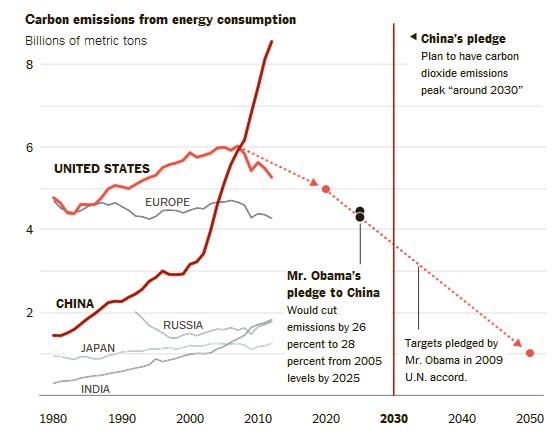
The United States and China have unveiled a secretly negotiated deal to reduce their greenhouse gas output, with China agreeing to cap emissions for the first time and the US committing to deep reductions by 2025. Jointly announced in Beijing by President Obama and President Xi Jinping, includes new targets for carbon emissions reductions by the United States and a first-ever commitment by China to stop its emissions from growing by 2030.
https://twitter.com/CearaProut/status/531251207033982977
Will protestors take to streets about the secrecy that proceeded the negotiation of this international agreement?
The Left over Left picks and chooses the international law that it champion:
09 Nov 2014 Leave a comment
in environmental economics, global warming Tags: climate alarmism, global warming
09 Nov 2014 Leave a comment
in climate change, energy economics, environmental economics, global warming Tags: Bjørn Lomborg, climate alarmism, global warming, green rent seeking, IPCC
The second IPCC installment showed that the temperature rise that we are expected to see sometime around 2055-2080 will create a net cost of 0.2-2% of GDP – the equivalent of less than one year of recession…
Again, not surprisingly, politicians tried to have this finding deleted. British officials found the peer-reviewed estimate “completely meaningless,” and, along with Belgium, Norway, Japan, and the US, wanted it rewritten or stricken. One academic speculated that governments possibly felt “a little embarrassed” that their previous exaggerated claims would be undercut by the UN.
The third installment of the IPCC report showed that strong climate policies would be more expensive than claimed as well – costing upwards of 4% of GDP in 2030, 6% in 2050, and 11% by 2100.
And the real cost will likely be much higher, because these numbers assume smart policies, instantly enacted, with key technologies magically available.
03 Nov 2014 Leave a comment
in environmental economics, global warming Tags: climate alarmism, global warming
03 Nov 2014 Leave a comment
in economics of climate change, energy economics, environmental economics, environmentalism Tags: climate alarmism, global warming
by Judith Curry
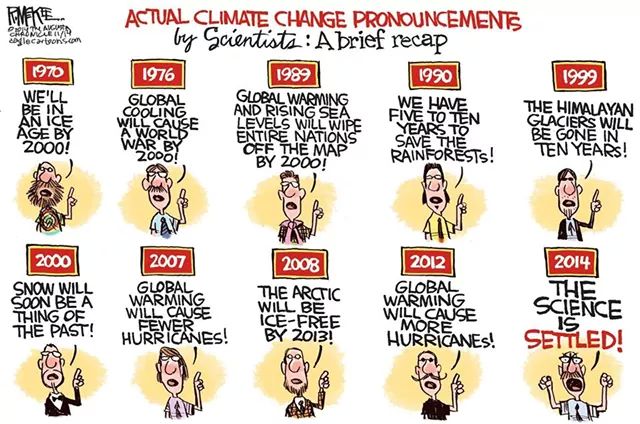
I think we have a very brief window of opportunity to deal with climate change . . . no longer than a decade at most. – James Hansen 2006
We have only four more years to act on climate change. – James Hansen 2009
View original post 980 more words
03 Nov 2014 Leave a comment
in climate change, economics of climate change, energy economics, environmental economics Tags: climate alarmism, global warming
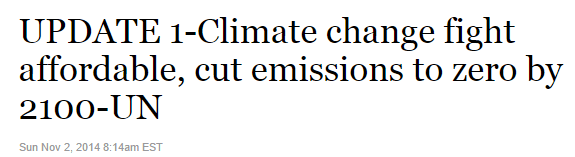
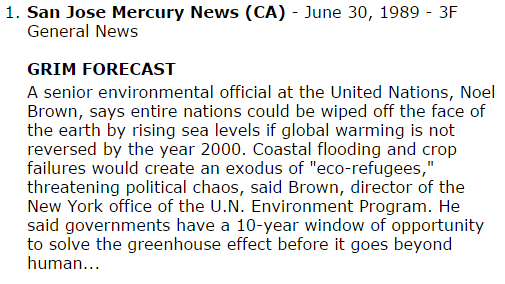
Celebrate! The UN has granted Earth a 100 year reprieve from global warming.
In 1989, the UN said we had until the end of the 20th century to save the planet from global warming – but now they say we have until the end of the 21st century.
UPDATE 1-Climate change fight affordable, cut emissions to zero by 2100-UN
01 Nov 2014 Leave a comment
in applied welfare economics, energy economics, environmental economics, environmentalism Tags: global warming, green rent seeking
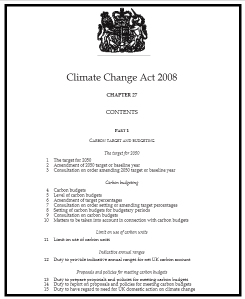 A hard hitting article appears in the Mail which slams the climate change act.
Six years ago today, an ambitious Labour politician, newly appointed climate change secretary, set Britain on a ruinous path that threatens our energy-dependent civilisation with collapse.
Such is the devastating conclusion of Owen Paterson, the Tory former Environment Secretary, who yesterday joined Lord Lawson among the highest-profile critics of the political consensus on energy policy.
For it was on October 16, 2008, that the new secretary of state – Ed Miliband, by name – set us the legally binding goal of meeting the EU’s wildly ambitious target to cut carbon emissions by 80 per cent before 2050 (and how significant that no other country has followed his lead).
View original post 89 more words
Celebrating humanity's flourishing through the spread of capitalism and the rule of law
Scholarly commentary on law, economics, and more
Beatrice Cherrier's blog
Celebrating humanity's flourishing through the spread of capitalism and the rule of law
Celebrating humanity's flourishing through the spread of capitalism and the rule of law
Celebrating humanity's flourishing through the spread of capitalism and the rule of law
Why Evolution is True is a blog written by Jerry Coyne, centered on evolution and biology but also dealing with diverse topics like politics, culture, and cats.
Celebrating humanity's flourishing through the spread of capitalism and the rule of law
Celebrating humanity's flourishing through the spread of capitalism and the rule of law
A rural perspective with a blue tint by Ele Ludemann
DPF's Kiwiblog - Fomenting Happy Mischief since 2003
Celebrating humanity's flourishing through the spread of capitalism and the rule of law
The world's most viewed site on global warming and climate change
Tim Harding's writings on rationality, informal logic and skepticism
A window into Doc Freiberger's library
Let's examine hard decisions!
Commentary on monetary policy in the spirit of R. G. Hawtrey
Thoughts on public policy and the media
Celebrating humanity's flourishing through the spread of capitalism and the rule of law
Politics and the economy
A blog (primarily) on Canadian and Commonwealth political history and institutions
Reading between the lines, and underneath the hype.
Economics, and such stuff as dreams are made on
"The British constitution has always been puzzling, and always will be." --Queen Elizabeth II
Celebrating humanity's flourishing through the spread of capitalism and the rule of law
Celebrating humanity's flourishing through the spread of capitalism and the rule of law
WORLD WAR II, MUSIC, HISTORY, HOLOCAUST
Undisciplined scholar, recovering academic
Celebrating humanity's flourishing through the spread of capitalism and the rule of law
Res ipsa loquitur - The thing itself speaks
Celebrating humanity's flourishing through the spread of capitalism and the rule of law
Researching the House of Commons, 1832-1868
Articles and research from the History of Parliament Trust
Reflections on books and art
Posts on the History of Law, Crime, and Justice
Celebrating humanity's flourishing through the spread of capitalism and the rule of law
Exploring the Monarchs of Europe
Cutting edge science you can dice with
Small Steps Toward A Much Better World
“We do not believe any group of men adequate enough or wise enough to operate without scrutiny or without criticism. We know that the only way to avoid error is to detect it, that the only way to detect it is to be free to inquire. We know that in secrecy error undetected will flourish and subvert”. - J Robert Oppenheimer.
The truth about the great wind power fraud - we're not here to debate the wind industry, we're here to destroy it.
Celebrating humanity's flourishing through the spread of capitalism and the rule of law
Celebrating humanity's flourishing through the spread of capitalism and the rule of law
Economics, public policy, monetary policy, financial regulation, with a New Zealand perspective
Celebrating humanity's flourishing through the spread of capitalism and the rule of law
Restraining Government in America and Around the World






 Utopia, you are standing in it!
Recent Comments