Mises on why economics analysis is so unpopular
14 Jun 2015 Leave a comment
in applied price theory, applied welfare economics, comparative institutional analysis, constitutional political economy, economics of bureaucracy, income redistribution, Ludwig von Mises, Public Choice, rentseeking Tags: antiforeign bias, antimarket bias, expressive voting, green rent seeking, makework bias, NIMBYs, rational ignorance, rational irrationality
Formal carbon pricing initiatives around the world
11 Jun 2015 Leave a comment
in environmental economics, global warming Tags: bootleggers and baptists, carbon pricing, carbon tax, expressive voting, global warming, green rent seeking
#Carbonpricing is expanding w/ initiatives now valued at nearly $50 bil: wrld.bg/NBuz0 http://t.co/qELgE97i1p—
World Bank Pubs (@WBPubs) May 29, 2015
Carbon pricing expanded in the last 18 months. New report shows where & how: wrld.bg/Nrhsq http://t.co/D4uQtjl6EZ—
IFC (@IFC_org) May 27, 2015
1,800 mass transit systems in the US — 2% report fare revenues exceeding operating expenses
11 Jun 2015 Leave a comment
in politics - USA, transport economics Tags: buses, green rent seeking, public transport, public transport deficits, trains
Of the 1,800+ US mass transit systems ~2% reported that fare revenue exceeded operating costs bit.ly/1EoQyqD http://t.co/Q6t9pB7q8a—
The Hamilton Project (@hamiltonproj) May 14, 2015
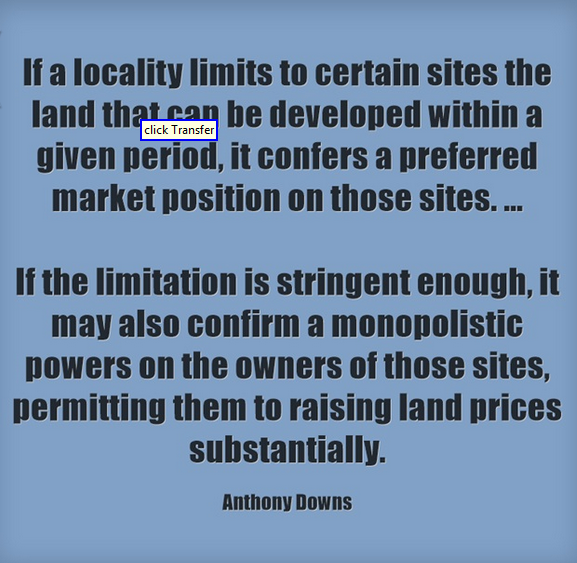
The principle of competitive land supply – Anthony Downs
16 May 2015 Leave a comment
in applied price theory, applied welfare economics, economics of regulation, urban economics Tags: Anthony Downs, green rent seeking, housing affordability, land supply, land use regulation, NIMBYs, offsetting behaviour, RMA, unintended consequences
Urban planners are confident souls
15 May 2015 Leave a comment
in development economics, economics of regulation, environmental economics, growth miracles, politics - Australia, politics - New Zealand, politics - USA, urban economics Tags: green rent seeking, housing affordability The fatal conceit, land use regulation, offsetting behaviour, RMA, The pretence to knowledge, unintended consequences, urban planning, zoning

The footprint of Big Wind and Big Solar
21 Apr 2015 Leave a comment
in energy economics, environmental economics Tags: Big Solar, Big Wind, green rent seeking, land supply, solar power
On appeals to emotion
11 Apr 2015 Leave a comment
in development economics, energy economics, environmental economics, environmentalism, global warming, growth disasters, health economics, liberalism, resource economics Tags: activists, bootleggers and baptists, climate alarmism, conjecture and refutation, green rent seeking, peak oil, population bomb, precautionary principle
Still more evidence of mass kidnappings of environmental activists
25 Mar 2015 Leave a comment
in energy economics, environmental economics, environmentalism, global warming Tags: activists, Big Wind, bootleggers and baptists, do gooders, green hypocrisy, green rent seeking, trade-offs, world heritage areas
The international success of Big Wind
24 Mar 2015 Leave a comment
in environmental economics, global warming, rentseeking Tags: Big Wind, climate alarmism, global warning, green rent seeking, renewable resources, wind power
On burden of proof
20 Mar 2015 Leave a comment
in environmental economics, environmentalism, global warming, liberalism, rentseeking Tags: climate alarmism, conjecture and refutation, green rent seeking, philosophy of science, precautionary principle
Why masterly inactivity will be the American response to global warming
20 Mar 2015 1 Comment
in energy economics, environmental economics, environmentalism, global warming, Public Choice Tags: climate alarmism, global warming, green rent seeking, opinion polls, voting
Richard Lindzen on back when periods of warming were climate optima
12 Mar 2015 1 Comment
in economic history, economics of bureaucracy, environmental economics, global warming, Public Choice, rentseeking Tags: Anti-Science left, climate alarmism, green rent seeking, Richard Lindzen

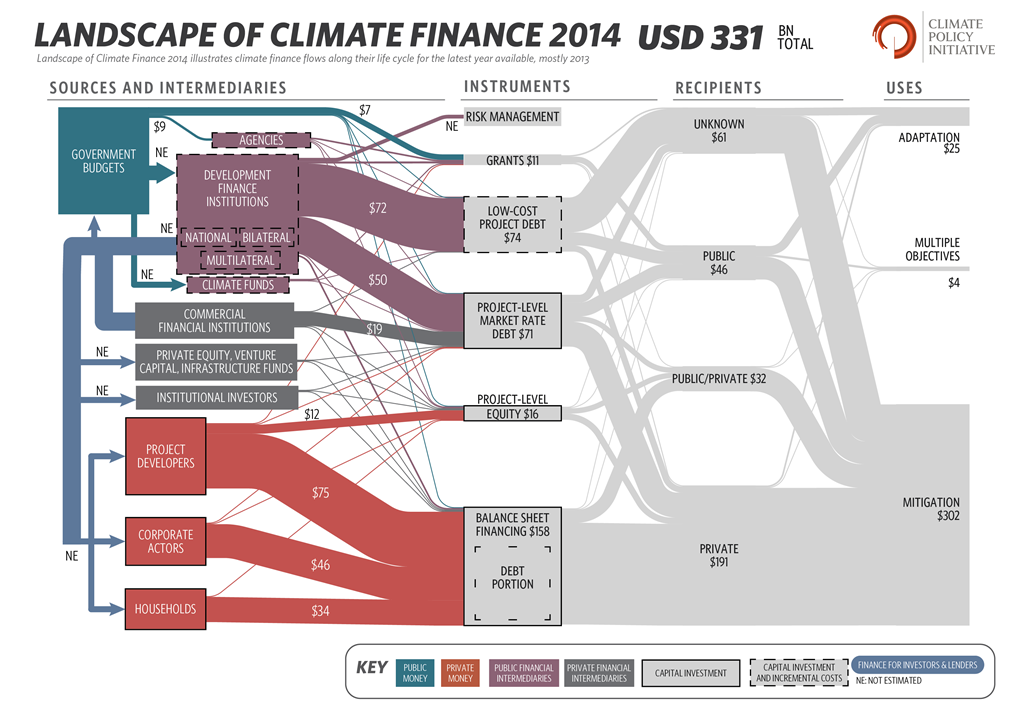
Follow the money – The Global Landscape of Climate Finance 2014 CPI Report Climate Policy Initiative
09 Mar 2015 Leave a comment
in environmental economics, global warming, Public Choice, rentseeking Tags: bootleggers and baptists, climate alarmism, global warming, green rent seeking
In 2013, annual global climate finance flows totalled approximately USD 331 billion, falling USD 28 billion below 2012 levels.
Public actors and intermediaries contributed USD 137 billion (USD 134-140 billion) largely unchanged from last year. Private investment totalled USD 193 billion, falling by USD 31 billion or 14% from 2012, see Figure ES1. The actual decrease in total flows may be even larger as, for the first time, Landscape 2014 captures public finance flowing to large hydro and research and development (USD 4 billion and USD 3 billion respectively).
Climate finance flows were split almost equally between developed (OECD) and developing (non-OECD) countries, USD 164 billion and USD 165 billion respectively. The amount we tracked flowing from developed to developing countries fell by USD 8 billion from 2012, to USD 34 billion, with multilateral DFI contributions falling by USD 5 billion and private investment contracting by USD 2 billion.
Almost three-quarters of total flows were invested in their country of origin. Private actors had an especially strong domestic investment focus with USD 174 billion or 90% of their investments remaining in the country of origin. This demonstrates that investment environments that are more familiar and perceived to be less risky are key to investment decisions, highlighting the importance of domestic policy frameworks in unlocking scaled up climate finance flows.


 Utopia, you are standing in it!
Recent Comments