Step Inside The Most Densely Populated Place on Earth
18 Jan 2017 Leave a comment
in constitutional political economy, development economics, international economic law, international economics, International law, urban economics Tags: Hong Kong
Kowloon: City of anarchy
22 May 2016 Leave a comment
in economics of crime, international economics, International law, law and economics, property rights Tags: Hong Kong


Hong Kong’s per capita GDP has bested that of Western Europe
11 Mar 2016 Leave a comment
in development economics, economic history Tags: Hong Kong
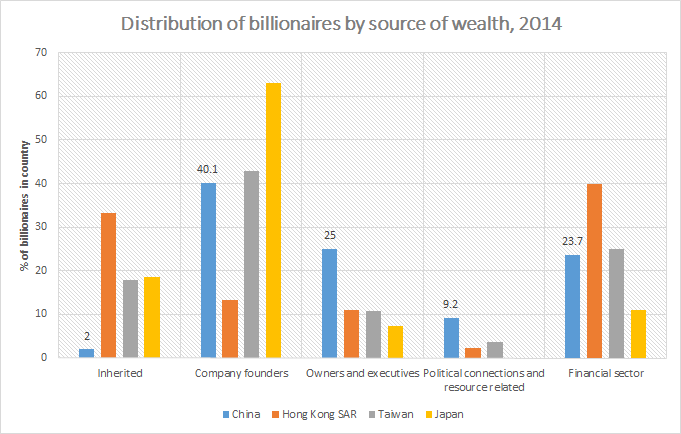
Chinese, Hong Kong, Taiwanese and Japanese billionaires by source of wealth
24 Feb 2016 Leave a comment
in development economics, economic history, entrepreneurship, financial economics, growth miracles, industrial organisation, rentseeking, survivor principle Tags: billionaires, China, entrepreneurial alertness, Hong Kong, Japan, superstar wages, superstars, Taiwan
Surprisingly few billionaires in any of the 4 countries obtained their wealth through political connections. Founding a company seems to be still the path of great wealth even in Japan these days. Hong Kong is a financial centre so the large number of billionaires in its financial sector is no surprise.
John Cowperthwaite passed this day 2006.
21 Jan 2016 Leave a comment
in development economics, economic history, growth miracles Tags: Hong Kong, John Cowperthwaite
Hong Kong has overtaken Western Europe in living standards
08 Dec 2015 Leave a comment
in development economics, economic history Tags: Hong Kong
He who is first is now last: real GDP per capita of the East Asian Tigers since 1950
05 Nov 2015 1 Comment
in development economics, economic history, growth miracles Tags: East Asian Tigers, Hong Kong, Japan, Singapore, South Korea, Taiwan
Japan has gone first to be last having been just overtaken in the last year or two by South Korea on a per capita real GDP basis, PPP. The Lost Decade certainly has taken its toll on Japanese relative prosperity. Singapore overtook Japan in the 1970s – a testament to the Singapore miracle. Hong Kong too overtook Japan on a purchasing power basis in the mid-1990s followed not long after by Taiwan. Singapore is seriously rich.
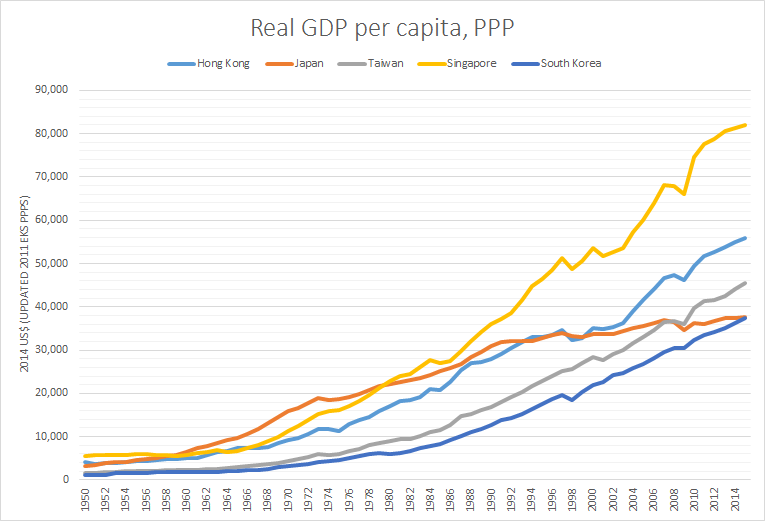
Source: The Conference Board. 2015. The Conference Board Total Economy Database™, May 2015, http://www.conference-board.org/data/economydatabase/
Chinese and Hong Kong fertility since the one child policy was adopted
01 Nov 2015 Leave a comment
in development economics, growth disasters, growth miracles, Marxist economics, population economics Tags: China, economics of fertility, Hong Kong, one child policy, The fatal conceit, The pretense to knowledge
Are Hong Kong & Macau Countries?
11 Aug 2015 Leave a comment
in International law Tags: geography, Hong Kong, Macau
The fates of two islands under constant threat from a neighbouring military colossus
01 Aug 2015 Leave a comment
in applied price theory, applied welfare economics, Austrian economics, comparative institutional analysis, constitutional political economy, development economics, economics of media and culture, economics of regulation, growth disasters, growth miracles, income redistribution, industrial organisation, law and economics, liberalism, Marxist economics, property rights, Public Choice, rentseeking, survivor principle Tags: anticapitalist mentality, antimarket bias, capitalism and freedom, China, Cuba, expressive voting, Hong Kong, Leftover Left, public intellectuals, rational ignorance, rational irrationality, Twitter left
Hong Kong and Venezuela compared
27 Jul 2015 Leave a comment
in applied price theory, applied welfare economics, comparative institutional analysis, constitutional political economy, development economics, economics of bureaucracy, growth disasters, growth miracles, income redistribution, Public Choice, rentseeking Tags: capitalism and freedom, Hong Kong, Latin American crony capitalism, Venezuela
Socialism works -Venezuela twice as rich as Hong Kong!
No, wait, that was in 1960. http://t.co/sqwVnMc19t—
Screwed by State (@ScrewedbyState) July 26, 2015
Why a country’s average height is a good way of measuring its development | The Guardian
31 Mar 2015 Leave a comment
in development economics, growth disasters, growth miracles, health economics Tags: economics of physiology, Hong Kong, Japan, Philippines, Singapore, South Korea

I spotted this 20 years ago when I first travelled in Asia and then lived Japan for two years. In Japan in 1995, each generation of Japanese was head and shoulders taller than the last. In the Philippines, I could look over the crowd – it was great to be tall.

No more, no longer. In the Philippines, young Filipinos are often almost as tall as me.

When I visited Hong Kong recently, both the young Chinese men and women were a bit taller than me at McDonald’s. I am average height for my generation of Australian men.

via Why a country’s average height is a good way of measuring its development | News | The Guardian.
A tale of two cities – Hong Kong’s and Singapore’s different paths to prosperity
13 Oct 2014 Leave a comment
in development economics, entrepreneurship, industrial organisation Tags: Alywn Young, development economics, Hong Kong, industry policy, industry targeting, rent seeking, Singapore, tale of two cities, tyranny of numbers
Hong Kong and Singapore had different paths to prosperity. Alywn Young found that Hong Kong had made real productivity gains, but Singapore grew by a massive dose of savings and investment, including foreign investment.
For most of the post-war era, the Hong Kong government adopted a policy of minimal intervention. the government of Singapore has pursued maximalist policies involving widespread state participation in economic activity and aggressive industry targeting policies.
The share of investment in Singapore’s GDP rose from 9% in 1960 to 43% in 1984, while Hong Kong’s remained steady at about 20%. Productivity growth in the aggregate non-agricultural economy was a miserable -0.3% in Singapore and 2.3% in Hong Kong.
What does this mean in practical terms? Real consumption, real consumer spending, per capita in Hong Kong is 20% or more higher than in Singapore!
Hong Kong actually enjoyed their prosperity. Robert Barro explains this in a comment on Young’s paper:
In 1985, when Singapore’s per capita real GDP was 102% of Hong Kong’s, the consumption was only 70% of Hong Kong’s. To put it another way, Hong Kong’s per capita real consumption grew by 5.9% per year from 1960 to 1985, about the same as for GDP, whereas Singapore’s grew by only 2.8% per year, much less than GDP.
In terms of output per capita and output per worker, the growth of Hong Kong and Singapore are equally impressive. Hong Kong does much better in terms of productivity growth.
Hong Kong did not require as rapid capital accumulation as Singapore. Since capital accumulation is financed either by domestic saving or foreign saving, people in Hong Kong can afford to save less or borrow less from foreign economies. Saving less now means more consumption now.
In the case of Hong Kong, their living standards are far superior to Singapore’s. The government of Singapore wasted a good 20 to 30% of national income on industry targeting and compulsory savings.
Hong Kong experienced rapid total productivity growth, while Singapore experienced no improvement whatsoever in total productivity during its East Asian Tiger years. Young (1992, 1994, 1995) demonstrated that from 1967 onward total factor productivity growth in Singapore was next to nil, and for significant parts of the period most likely negative. Only productivity allows a nation to support and enjoy high wages.
 Utopia, you are standing in it!
Recent Comments