Meanwhile, Waring spent her career as a windbag
01 Jan 2020 Leave a comment
in applied price theory, discrimination, economic growth, economic history, economics of education, economics of information, economics of love and marriage, economics of media and culture, gender, health and safety, human capital, industrial organisation, labour economics, labour supply, law and economics, macroeconomics, minimum wage, occupational choice, poverty and inequality Tags: household production, real business cycles, The Great Enrichment

Waring mustn’t read any economics for over 30 years @women_nz
01 Jan 2020 Leave a comment
in applied price theory, business cycles, econometerics, economic growth, economic history, economics of education, economics of love and marriage, gender, human capital, labour economics, labour supply, law and economics, macroeconomics, Marxist economics, monetary economics, occupational choice, poverty and inequality, public economics, unemployment Tags: household production, real business cycles
The 1940s UK Kitchen shows how time consuming housework was
19 Jul 2017 Leave a comment
in defence economics, economic history, gender, labour economics, labour supply Tags: engines of liberation, household production, World War II
A gendered division of labour and household effort
30 Apr 2017 Leave a comment
in discrimination, economics of love and marriage, gender, labour economics, labour supply Tags: gender gap, gender wage gap, household production, housework, leisure time, marriage and divorce
A major factor driving the gendered division of labour and household effort is technology. Tiny differences in comparative advantage such as in child rearing immediately after birth can lead to large differences in specialisation in the market work and in market-related human capital and home production related work and household human capital (Becker 1985, 1993).
These specialisations are reinforced by learning by doing where large differences in market and household human capital emerge despite tiny differences at the outset (Becker 1985, 1993). This gendered division of labour and household effort is hard to change because large payments must be made to influence choices about care giving by highly specialised people with large but different accumulations of market and household human capital.
From a luck egalitarian perspective, many of the differences in earnings and occupations flow accidents of birth in deciding gender and who parents might be. Social inequalities that flow from brute bad luck call for interventions to put them right, if they work.
Many laws already make up for brute bad luck such as job protections while on maternity leave, and government funded parental leave pay and child care subsidies. Employers can do little to redress these accidents of birth nor do they have sufficient resources to put them right. For this reason, for example, parental leave pay is usually taxpayer funded rather than employer funded.
…
Capitalism was the engine of liberation from domestic drudgery
12 Mar 2017 Leave a comment
in economic history, labour economics, labour supply Tags: creative destruction, engines of liberation, household production, housework, technology diffusion, The Great Enrichment
…
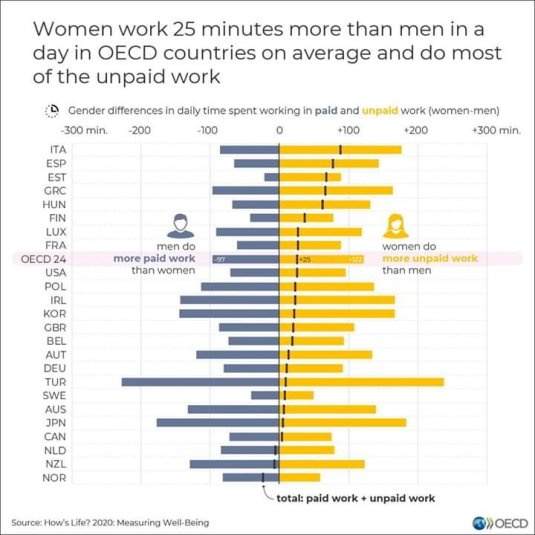
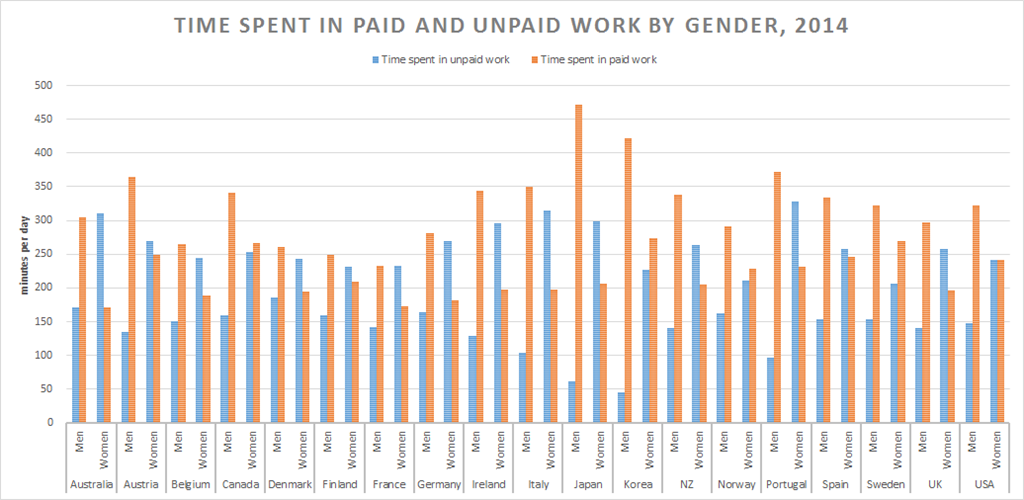
Time spent in paid and unpaid work across the OECD by gender
30 Jul 2016 1 Comment
in economics of love and marriage, gender, labour economics, labour supply Tags: asymmetric marriage premium, female labour force participation, household production, marital division of labour
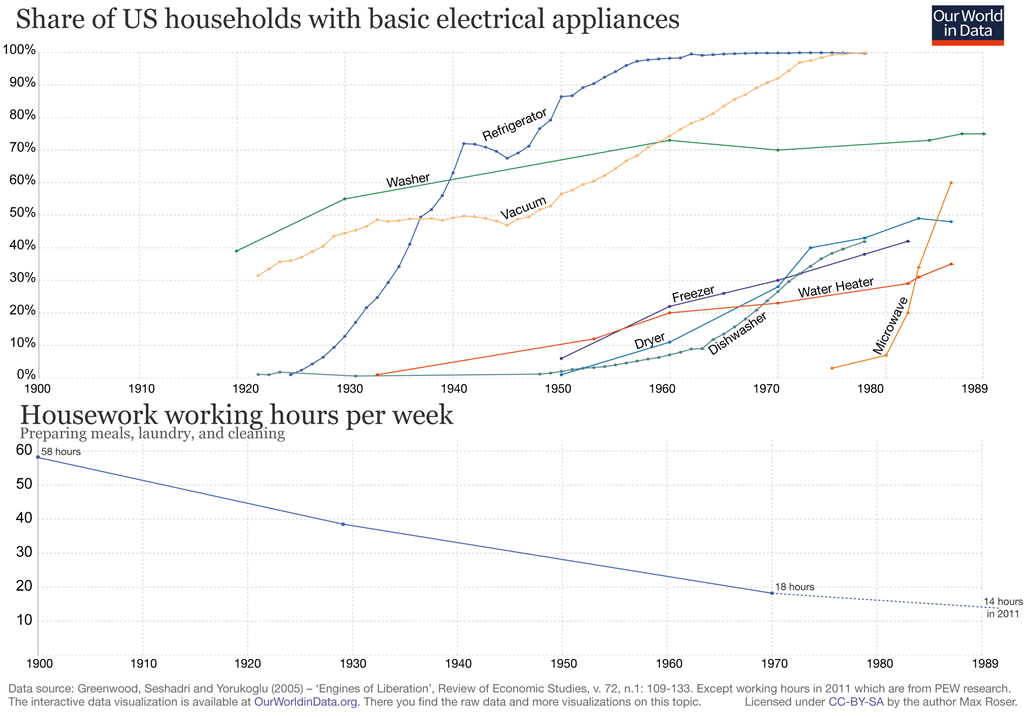
The diffusion rates of household appliances in the 20th century
06 Nov 2015 Leave a comment
in economic history, gender, industrial organisation, labour economics, survivor principle Tags: creative destruction, engines of liberation, household production, international technology diffusion, marital division of labour, technology diffusion
Why household appliances are the 20th century’s most disruptive technologies bit.ly/1LsZEJC
at @wef https://t.co/qwI3FpXhwz—
Max Roser (@MaxCRoser) October 24, 2015
The marital division of labour
24 Oct 2015 Leave a comment
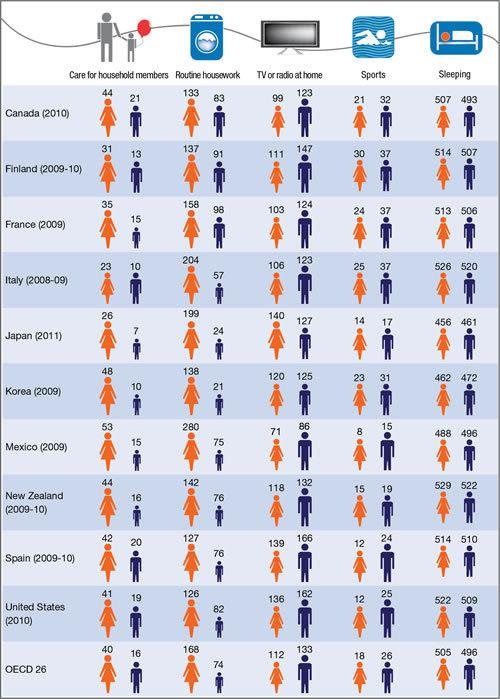
Women still do most of the household chores? Data on who does what in the house: goo.gl/3doqy4 #statistics https://t.co/fnY0d9OgkT—
DataStories (@LindaRegber) October 24, 2015
Men need to get off the sofa and do some housework
04 Oct 2015 Leave a comment
in economics of love and marriage Tags: asymmetric marriage premium, household production, marital division of labour, marriage and divorce
Men need to get off the sofa and do some housework, data show wapo.st/1LOS9OQ http://t.co/yRfwISaXaH—
Know More (@knowmorewp) September 30, 2015
Creative destruction in household types
25 Jul 2015 Leave a comment
in economic history, population economics Tags: creative destruction, household production, marital division of labour, Population demographics, single mothers, single parents
Number and Type of Households since 1940
More income graphics: bit.ly/11be39y http://t.co/noyPIlRRCa—
Catherine Mulbrandon (@VisualEcon) July 11, 2013
This chart shows how Americans spend every single minute in the average day
08 Jul 2015 Leave a comment
in labour economics, labour supply Tags: household division of labour, household production, labour demographics, marital division of labour, Population demographics, time use surveys

via via This chart shows how Americans spend every single minute in the average day – The Washington Post.
The household division of labour and recreation
03 Jul 2015 Leave a comment
in economics of love and marriage, law and economics Tags: household division of labour, household production, marriage and divorce
Why do middle-aged German men become sensitive new age guys?
24 May 2015 Leave a comment
in economics of love and marriage, labour economics, labour supply, occupational choice, population economics Tags: economics of family, Germany, household production, marital division of labour, marriage and divorce
The gender gap in housework narrows as men in Germany approach and enter retirement family-studies.org/how-mens-retir… http://t.co/5Q8IaHkSC4—
Inst. Family Studies (@FamStudies) May 04, 2015
Where in the world do men do the most housework?
21 May 2015 Leave a comment
in economics of love and marriage Tags: household production, marital division of labour
Where in the world do men do the most #housework?
statista.com/chart/3258/whe… http://t.co/CkAcSdclWB—
Statista (@StatistaCharts) February 24, 2015
 Utopia, you are standing in it!
Recent Comments