Why Does 1% of History Have 99% of the Wealth? @Oxfam #TPPANoWay
06 Feb 2016 Leave a comment
in development economics, economic history, growth disasters, growth miracles, history of economic thought, international economics Tags: capitalism and freedom, free trade, global poverty, globalisation, industrial revolution, international technology diffusion, technology diffusion, The Great Enrichment, The Great Fact, TPPA
Poverty’s development 1800-2015
05 Feb 2016 Leave a comment
in development economics, economic history, growth disasters, growth miracles, technological progress Tags: global poverty, industrial revolution, The Great Enrichment, The Great Escape, The Great Fact
The robot revolution is overrated
22 Nov 2015 Leave a comment
in applied price theory, economic history, industrial organisation, international economics, labour supply Tags: automation, creative destruction, entrepreneurial alertness, industrial revolution, mechanisation, robots, technological unemployment
Deirdre McCloskey on Piketty, the Bourgeoisie Deal, the Bolshevik Deal, and the Bridal Deal
17 Nov 2015 Leave a comment
in applied price theory, applied welfare economics, comparative institutional analysis, constitutional political economy, development economics, economic history, economics of bureaucracy, growth disasters, growth miracles, Public Choice Tags: bourgeoisie deal, capitalism and freedom, Deirdre McCloskey, industrial revolution, The Great Enrichment, The Great Escape, The Great Fact, Thomas Piketty

.
Robert Lucas on income redistribution and economic growth
05 Nov 2015 Leave a comment
in development economics, growth disasters, growth miracles, macroeconomics, Robert E. Lucas Tags: capitalism and freedom, industrial revolution, The Great Enrichment, The Great Escape, The Great Fact

@Oxfam fewer people living in absolute poverty today than in 1820
29 Oct 2015 Leave a comment
in economic history Tags: capitalism and freedom, extreme poverty, industrial revolution, Leftover Left, The Great Enrichment, The Great Escape, The Great Fact, Twitter left
There are fewer people living in absolute poverty today than there were in 1820. buff.ly/1OlOpX3 #progress http://t.co/LfC8I5gEE9—
HumanProgress.org (@humanprogress) October 07, 2015
Deirdre McCloskey’s speech on ‘Bourgeois Dignity’
03 Aug 2015 Leave a comment
in applied price theory, applied welfare economics, comparative institutional analysis, constitutional political economy, economic history, entrepreneurship, industrial organisation, law and economics, property rights, survivor principle Tags: Deirdre McCloskey, entrepreneurial alertness, industrial revolution, The Great Enrichment, The Great Fact
Colonial upstarts! British, American and Canadian real GDP per capita, 1775–2010
18 May 2015 Leave a comment
in economic growth, economic history, macroeconomics Tags: British economy, Canada, convergence, industrial revolution
The USA only overtook Britain in per capita GDP per capita in purchasing power parity terms early in the 20th century. Canada overtook the mother country in the post-war period.
Figure 1: British, American and Canadian GDP per capita (1990 Int. GK$PPP), 1775 – 2010

Source: The Maddison-Project, http://www.ggdc.net/maddison/maddison-project/home.htm 2013 version.
Figure 2: British, American and Canadian GDP per capita (1990 Int. GK$PPP), 1775 – 1870
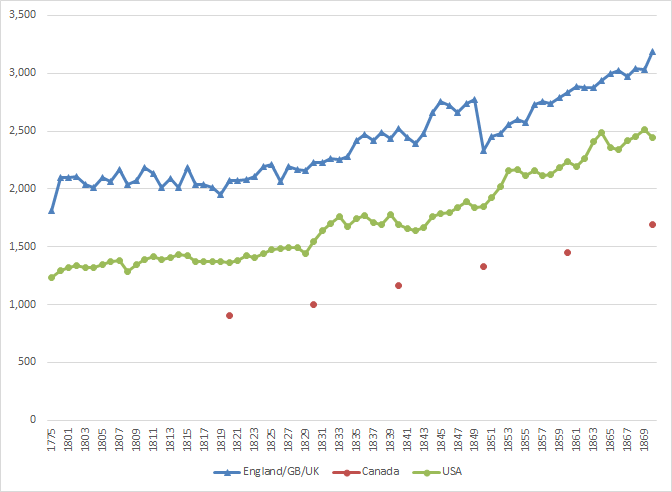
Source: The Maddison-Project, http://www.ggdc.net/maddison/maddison-project/home.htm 2013 version.
Figure 3: British, American and Canadian GDP per capita (1990 Int. GK$PPP), 1870 – 2010
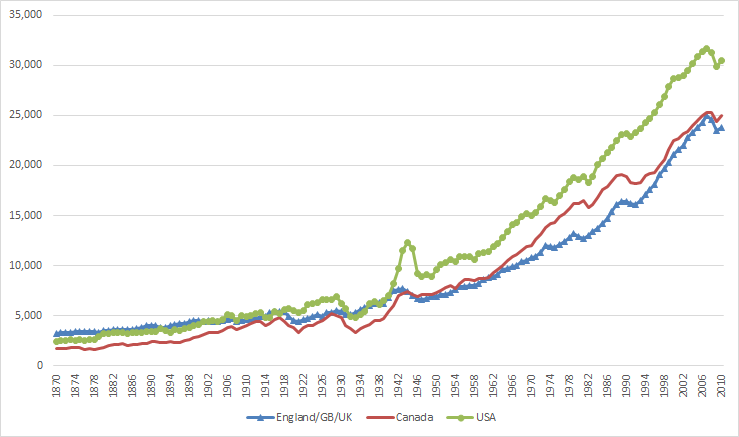
Source: The Maddison-Project, http://www.ggdc.net/maddison/maddison-project/home.htm 2013 version.
Organic farming is a rebranding of pre-industrial revolution agriculture
09 May 2015 Leave a comment
in economics of information, economics of media and culture, economics of regulation, health economics, technological progress Tags: agricultural economics, consumer fraud, industrial revolution, organic farming, quackery, The Great Enrichment, The Great Escape
The Great Escape (from mortality inequality).
27 Feb 2015 Leave a comment
in health economics, Sam Peltzman Tags: capitalism and freedom, industrial revolution, infant mortality, The Great Escape, The Great Fact
Sam Peltzman in "Mortality Inequality" used the Lorenz curve to measure mortality inequality. The top figure below is based on data for 1852; the bottom figure on data for 2002. A straight line in the figure below at a 45-degree angle shows perfect equality of mortality: that is, 20% of the population lives 20% of the total life-years at this time; 40% of the population lives 40% of the life-years for this group, and so on.
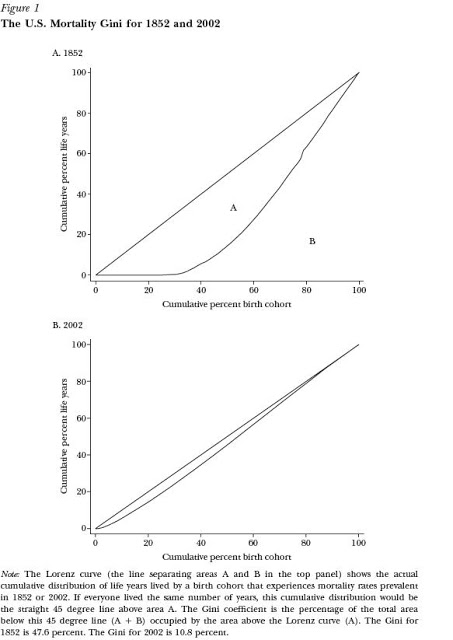
The curved line is the data In 1852 in the USA and in 2002. It shows that with high infant mortality, the bottom 30% of the distribution lived close to 0% of the life years in 1852.

Economics as Incredulity : Working conditions during the Industrial Revolution
16 Feb 2015 Leave a comment


 Utopia, you are standing in it!
Recent Comments