
Source: Edward Prescott
Celebrating humanity's flourishing through the spread of capitalism and the rule of law
17 Dec 2014 Leave a comment
in labour economics, labour supply, population economics Tags: ageing society, demographics, Japan
As its new parliament comes in, here's a look at Japan's longer-term economic challenges pewrsr.ch/1pjgZx5 http://t.co/StGWEGdNfi—
PewResearch FactTank (@FactTank) December 16, 2014
15 Dec 2014 Leave a comment
What if #Abenomics fails? #Japan's Abe Faces Challenge to Stoke Economy After Election Victory bloom.bg/1GDvKgO http://t.co/hhBVEZQPJ7—
Holger Zschaepitz (@Schuldensuehner) December 15, 2014
15 Dec 2014 Leave a comment
in economic growth, macroeconomics, politics, Public Choice Tags: Edward Prescott, Japan

the ruling bloc secured a two-thirds supermajority in the 475-seat House of Representatives, giving it the power to override the Upper House.
When I arrived in Japan in 1995, the LDP was out of power and written off.
The LDP were true stayers in politics. They managed to get back into power soon after the 1995 general election by forming a coalition with the Socialist party.
The Socialist party leader was initially the Prime Minister then he resigned later and was replaced by an LDP Prime Minister.
The grip on power of the LDP was consolidated by the great competence of the Koizumi administration.

Source: Edward Prescott
The LDP lost power again in about 2007 but regained power in the next election through the extreme incompetence of their opposition.
In the current election, the main opposition party were unable even to put up enough candidates to actually win a majority.
The key contribution of the main opposition parties in Japan was well stated when they last won an election in 2007. They have shown that they can actually win an election when the LDP performs poorly. That is an important discipline that may not have been there in the 1980s.
via Abe’s snap election pays off with big win for LDP | The Japan Times.
16 Nov 2014 Leave a comment
in budget deficits, business cycles, economic growth, global financial crisis (GFC), great recession Tags: Euroland, great recession, Japan, lost decades
14 Oct 2014 Leave a comment
in organisational economics, personnel economics, Public Choice Tags: agent principal problems, Eric Rasmusen, GRIPS, Japan, Mark Ramseyer, political science, public choice
Gullible gaijin (外人), especially those in the foreign media, foreign ministries and academia think that the bureaucrats rule Japan. Nothing could be further from the truth.
I’ll illustrate this first with the way in which the ruling Liberal Democratic Party (LDP) in Japan exercises a tight control over the courts.
Judges in Japan are career judges starting straight out of a specialised Law School for trainee judges in their late 20s as an assistant judge with various promotions all the way to the top to various courts with different jurisdictions in different places in Japan.
Control over transfers between courts in different parts of Japan as well as over promotions is the key to making sure judges know what is required of them and punishing those judges who step out of line.
Japanese lower court judges are reassigned every three years to different courts in different parts of the country. Most Japanese judges find administrative duties prestigious and branch office assignments embarrassing.
The judicial secretariat supervised by the Supreme Court can moves judges up and down the hierarchy from the High Courts (the courts of appeals) to the District Courts (the trial courts) to the Family Courts and to the branch offices of the District and Family Courts. It routinely sends judges to less prestigious postings. Supreme Court judges are appointed directly by the government in their 60s and must retire at the age of 70.
Every Japanese judge knows that when they are reassigned, the next reassignment is not necessarily as prestigious as the last, depending on how they rule in contentious cases.
J. Mark Ramseyer and Eric B. Rasmusen have written several very good papers and a book on this topic of judicial independence, or more correctly, the lack of judicial independence in Japan.
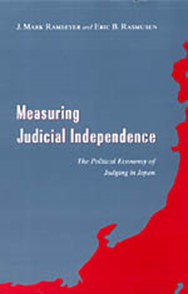
Lower court judges defer to the wishes of the LDP on sensitive political questions because they will do better in their careers. Japan has a judicial career structure that rewards and punishes judges according to their work product, including their rulings in sensitive political cases.
Ramseyer and Rasmusen reviewed the quality of the assignments of 400 judges after deciding politically charged cases, holding constant proxies for effort, intelligence, seniority, and political bias. These political sensitive cases involve judges:
Ramseyer and Rasmusen found that judges who defer to the LDP in politically disputes do better in their career assignments than those who do not. Similarly, judges who grant injunctions against the national (but not local) government have less successful careers.
This distinction is important because the national government wants to keep local governments in line with the laws they pass. This differentiation between issuing injunctions against local governments, but not the national government, shows the detail at which judicial decisions are controlled by the ruling party through favourable assignments and promotions.
Ramseyer and Rasmusen also found that:
If the national government, the ruling LDP, exercises such close control over the courts, it would be surprising that they let the bureaucracy tell them what to do.
The LDP controls the bureaucracy, even though it isn’t apparent, as explained by Mark Ramseyer.

The most reliable agent for your interests is the agent who thinks he in charge because the face has grown to fit the mask. Ramseyer as pointed out that a bureaucracy would act the same whether
Ramseyer and Rosenbluth argue that the institutional framework of government – the rules of the game among political players – decisively shapes the character of political competition and incentives in Japan.
The ruling LDP works within Japanese electoral rules to maximize its success with voters, and within constitutional constraints to enforce its policies on bureaucrats and judges.
The LDP has several ways of keeping the bureaucracy under control:
The LDP keeps bureaucratic action closely in line with its preferences through the control of promotions and three yearly transfers and by encouraging intense rivalry between ministries.
Bureaucrats who do as they are told and anticipate the needs of their political masters in the LDP get the best transfers and are promoted to the top and then win the best post-retirement positions.
Japanese bureaucrats start retiring in their mid 40s so having a favourable post retirement job is vital. The Japanese system is based on back loading of pay. This is a well-known system for ensuring fidelity of agents where effort and performance is more difficult to monitor.
The main payoff been a bureaucrat in Japan is the prize at the end of the road. This prize will be denied for you if you step out of line, don’t do as you’re told and don’t know what is required of you.
My political science professor in Japan at the National Graduate Institute of Policy Studies (GRIPS) introduced me to the work of Mark Ramseyer in 1996. Ramseyer is completely fluent in Japanese and writes in Japanese as well as English on law and economics.
02 Oct 2014 Leave a comment
in comparative institutional analysis Tags: Hanko, Japan

Instead of signing their name, Japanese stamp their name on forms, bank withdrawal slips and letters with a hanko (a signature stamp).
Without a hanko one can’t open a bank account in Japan or register for a university class. One professor told the Los Angeles Times, "I don’t exist in this society without my hanko."

Hankos are cylinders about the size of a piece of chalk. They have the person’s name carved at one end in Chinese characters and they leave an imprint after being stamped in ink.

Everyone from the Emperor to a homeless man living in a park has a hanko, and they are used for everything from finalizing a multi-million-dollar business deal to signing for packages delivered to one’s house.
The average Japanese has five hankos but only one is registered with the government to certify ownership and it is only used on important documents. Since these seals are considered too valuable to carry around, people have other seals to use for things like bank transactions and taking deliveries. A certificate of authenticity is required for any hanko used in a significant business transaction.
Many government documents have several hanko stamps. According to one estimate, typical bureaucrats puts his hanko on 100,000 documents in a 25 year career.
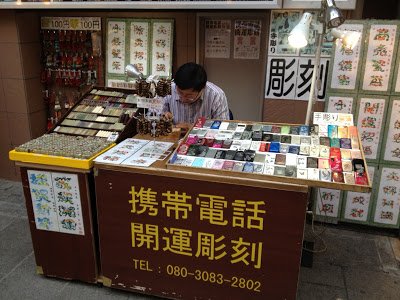
When I had a bank account in Japan, my hanko was the letters JR inside a circle. Anyone who stole that hanko could run of with my bank account balance. This did worry me and my friends at the International house . Anyone can go to a shop at the train station and get a hanko made with my initials on it.
02 Oct 2014 Leave a comment
Most of this fascinating book appears to be readable at Google books.
09 Aug 2014 2 Comments
in war and peace Tags: atomic bombings, hand wringing, Japan, World War II

Those that argue that Japan surrendered for reasons other than the atomic bomb put forward contradictory arguments.
The first is the Japan was already seeking terms for surrender. That is true, but among those terms was avoiding occupation.
The Japanese leadership had already interpreted the terms of the Potsdam declaration was a sign of weakness. They hoped that by making the invasion of Japan as bloody as possible, they could extract even better terms in light of this sign of weakness at Potsdam. Kyushu, the obvious initial invasion site in southern Japan, was being heavily reinforced by the middle of 1945.
Japan no longer had a realistic prospect of winning the war by the end of 1944 and they knew it.
Japan’s leaders believed they could make the cost of conquering Japan too high for the Allies to accept, leading to some sort of armistice rather than total defeat. The Japanese army fought to the death with 99% plus casualty rates as the Americans moved from island to island to show that any attempt to invade Japan would be too high a price to pay.

The second explanation as to why the atomic bombing was unnecessary contradicts the first. The second explanation is Japan surrendered because Russia into the war rather than because of the atomic bombings.
You can’t have it both ways Japan seeking terms before the bombing and Japan seeking terms after the bombing only because Russia into the war.

After the atomic bombing of the Japanese War Cabinet split 3:3 on seeking terms. A figurehead Emperor was then used to purportedly intervened so that no one lost face. That Japanese government could have fallen such as Tojo’s government did in 1944 simply by either the Army or the Navy ministers resigning. The army and navy ministers did not resign, but the generals in the Tokyo military district sat on the fence to see what happened at the attempted military coup by junior officers who were attempting to stop surrender.
The 12-15 August coup plotters failed to persuade the Eastern District Army and the high command of the Imperial Japanese Army to move against the surrender.
Importantly, the junior officers leading the coup felt secure enough to approach the Army minister and senior army officers as potential co-conspirators. The army leadership knew of the coup plans but neither joined the plotters nor arrested them.
Once again, the revisionist literature never addresses the possibility of orderly surrender of Japanese forces overseas. If Japan just throwing the town before the bombings, they were more likely to go rogue. Become governments in exile.
Japanese politics of that time was extraordinarily violent with assassination a real risk for every prime minister. The Emperor was also surrounded with plenty of bodyguards.
In Downfall:The End of the Imperial Japanese Empire (1999), Richard Frank offered new research from previously unused and classified sources, along with closely detailed arguments, that Japan was nowhere near to surrendering in August of 1945:
It is fantasy, not history, to believe that the end of the war was at hand before the use of the atomic bomb.
How would you have brought the war with Japan to a conclusion? The willingness of the Japanese oligarchy to waste the blood of their own people and spill the blood of others without limit was central to their strategy of avoiding occupation and the dismantling of the old order.
Truman could have chosen to not use the 2 bombs at his disposal and let the fire bombings burn down most Japanese cities and towns from new air bases for B26s from Okinawa, let 100,000 Chinese be slaughtered on average every month at the hands of the occupying Japanese army, and invade in December and call forth a slaughter of a million or two more.
The bomb and only the bomb galvanised Japan’s peace party within the war cabinet to take actions necessary to terminate the Pacific War.

Would World War 2 have finished even one day earlier if the handwringers had their way on how wars should be fought by the good guys? Who would have won?
02 Aug 2014 Leave a comment
in applied price theory, entrepreneurship, macroeconomics Tags: barriers to riches, Britain, France, Germany, Japan, relative labour productivity, USA
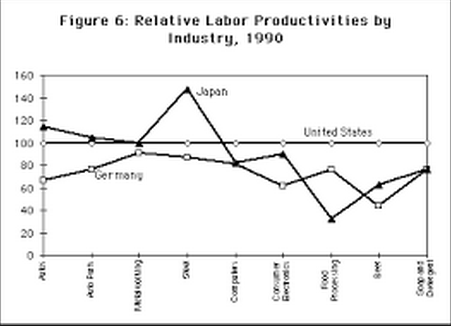
There are large productivity differences between the global industrial leaders at the industry level. In a 1993 McKinsey’s study, large differences were uncovered in value added per worker between the USA, Japan, France, the UK and Germany across individual industries, by a factor of three in some cases (Prescott and Parente 2000, 2005).
| Industry | Japan | Germany |
| Automobiles | 116 | 66 |
| Automobile Parts | 124 | 76 |
| Metal Working | 119 | 100 |
| Steel | 145 | 100 |
| Computer | 95 | 89 |
| Consumer Electronics | 115 | 62 |
| Food | 33 | 76 |
| Beer | 69 | 44 |
| Soap and Detergent | 94 | 76 |
Differences in the access to the global pool of useful knowledge cannot explain such large productivity differences at the sector and the individual industry levels between the USA, Japan, France, the UK and Germany and between these three European neighbours. The stock of useful technological knowledge does not vary that much across these countries (Prescott and Parente 2000, 2005). These countries produce and are the markets for the majority of that knowledge.
| Industry | Japan | Germany | U.K. | France |
| Retailing | 44 | 96 | 82 | 69 |
| Telecommunications | 66 | 50 | 38 | 56 |
| Banking | – | 68 | 64 | – |
Lags in technology diffusion cannot be important. The USA, Japan, France, the UK, and Germany define the global technological frontier.
Differences in the skills of the individual worker or in the total stock of human capital of all workers in a country cannot explain these differences in value added per worker. The USA, Japan, France, the UK and Germany all have relatively well-educated, experienced and tested labour forces. For example, the 1993 McKinsey’s study inquired into the education and skills levels of Japanese and German steel workers. Comparably skilled German steel workers were half as productive as their Japanese counterparts (Prescott and Parente 2000, 2005).
What differ between these countries at the glob technological frontier is the amount of the global pool of useful productive of knowledge that is used and as work practices. Ford Europe failed to adopt Japanese just-in-time production, but Ford U.S.A. has adopted it. In the beer industry, much of the high technology machinery in Japan and U.S. is manufactured in Germany but German breweries fail to use these more productive technologies. The less productive airline sector in Europe vis-à-vis the United States is the result of over-staffing.
13 Jul 2014 Leave a comment
in business cycles, global financial crisis (GFC), macroeconomics, monetary economics Tags: East Asian economic miracle, global financial crisis, Japan, Japanese banking system, Joseph Stiglitz, zombie banks
A man of his times, back in 1996, smoking Joe Stiglitz used to be an admirer of the Japanese banking system because of its long-range thinking and lending
Cooperative behaviour between firms and their banks was also evident in the operations of capital markets.
In Japan each firm had a long-standing relationship with a single bank, and that bank played a large role in the affairs of the firm.
Japanese banks, unlike American banks, are allowed to own shares in the firms to which they lend, and when their client firms are in trouble, they step in. (The fact that the bank owns shares in the firm means that there is a greater coincidence of interest than there would be if the bank were simply a creditor; see Stiglitz 1985.)
This pattern of active involvement between lenders and borrowers is seen in other countries of East Asia and was actively encouraged by governments.
That praise of the Japanese banking system in 1996 did not stop him criticising the Japanese Zombie banks in 2009. Shame, Stiglitz, shame.
Note: A zombie bank is a bank with an economic net worth of less than zero but continues to operate because its ability to repay its debts is shored up by implicit or explicit government credit support.
29 May 2014 Leave a comment
in applied price theory, personnel economics Tags: Japan
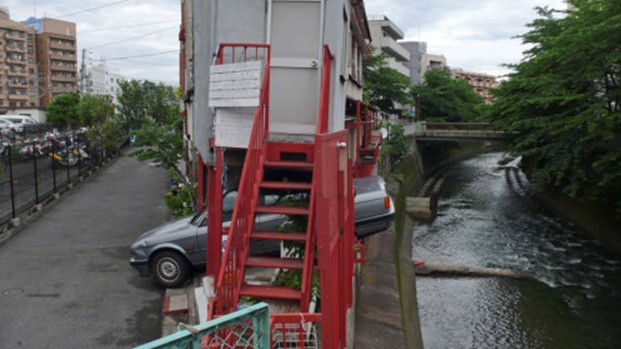
I bought a BMW in Japan. Before I could, I had to rent a car space and have a policeman come out to measure it to make sure it will big enough from my car.
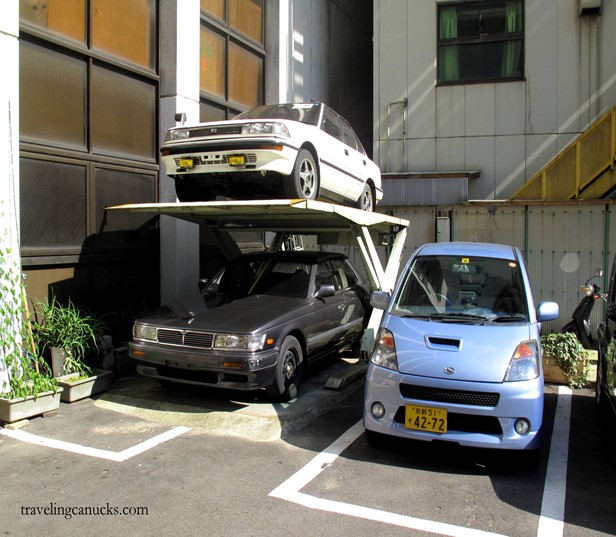
Anyone who steps out of line in the Tokyo Police Department, the car space measuring squad is where you will spend the rest of your career. I’m sure they envy the guys with the window seats in the big corporations.
Celebrating humanity's flourishing through the spread of capitalism and the rule of law
Scholarly commentary on law, economics, and more
Beatrice Cherrier's blog
Celebrating humanity's flourishing through the spread of capitalism and the rule of law
Celebrating humanity's flourishing through the spread of capitalism and the rule of law
Celebrating humanity's flourishing through the spread of capitalism and the rule of law
Why Evolution is True is a blog written by Jerry Coyne, centered on evolution and biology but also dealing with diverse topics like politics, culture, and cats.
Celebrating humanity's flourishing through the spread of capitalism and the rule of law
Celebrating humanity's flourishing through the spread of capitalism and the rule of law
A rural perspective with a blue tint by Ele Ludemann
DPF's Kiwiblog - Fomenting Happy Mischief since 2003
Celebrating humanity's flourishing through the spread of capitalism and the rule of law
The world's most viewed site on global warming and climate change
Tim Harding's writings on rationality, informal logic and skepticism
A window into Doc Freiberger's library
Let's examine hard decisions!
Commentary on monetary policy in the spirit of R. G. Hawtrey
Thoughts on public policy and the media
Celebrating humanity's flourishing through the spread of capitalism and the rule of law
Politics and the economy
A blog (primarily) on Canadian and Commonwealth political history and institutions
Reading between the lines, and underneath the hype.
Economics, and such stuff as dreams are made on
"The British constitution has always been puzzling, and always will be." --Queen Elizabeth II
Celebrating humanity's flourishing through the spread of capitalism and the rule of law
Celebrating humanity's flourishing through the spread of capitalism and the rule of law
WORLD WAR II, MUSIC, HISTORY, HOLOCAUST
Undisciplined scholar, recovering academic
Celebrating humanity's flourishing through the spread of capitalism and the rule of law
Res ipsa loquitur - The thing itself speaks
Celebrating humanity's flourishing through the spread of capitalism and the rule of law
Researching the House of Commons, 1832-1868
Articles and research from the History of Parliament Trust
Reflections on books and art
Posts on the History of Law, Crime, and Justice
Celebrating humanity's flourishing through the spread of capitalism and the rule of law
Exploring the Monarchs of Europe
Cutting edge science you can dice with
Small Steps Toward A Much Better World
“We do not believe any group of men adequate enough or wise enough to operate without scrutiny or without criticism. We know that the only way to avoid error is to detect it, that the only way to detect it is to be free to inquire. We know that in secrecy error undetected will flourish and subvert”. - J Robert Oppenheimer.
The truth about the great wind power fraud - we're not here to debate the wind industry, we're here to destroy it.
Celebrating humanity's flourishing through the spread of capitalism and the rule of law
Celebrating humanity's flourishing through the spread of capitalism and the rule of law
Economics, public policy, monetary policy, financial regulation, with a New Zealand perspective
Celebrating humanity's flourishing through the spread of capitalism and the rule of law
Restraining Government in America and Around the World

 Utopia, you are standing in it!
Recent Comments