The robots are coming, the robots are coming – been there, done that in Japan

When I was a kid, I used to like reading the Encyclopaedia Britannica. I read them from cover to cover.

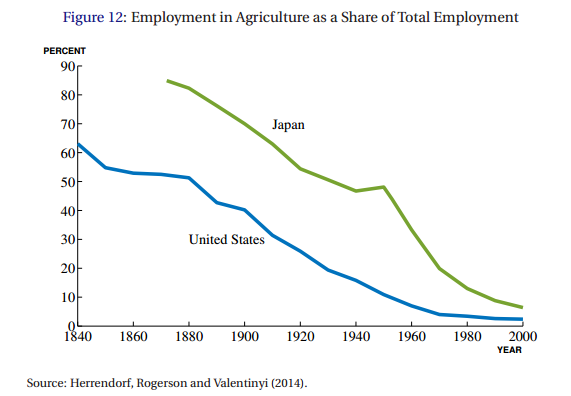
One of the things I recalled from the Encyclopaedia Britannica was that in 1961 nearly half of the Japanese workforce worked in the agricultural sector.
image

I notice that anomaly when I was reading the Encyclopaedia Britannica entry on Japan in the 1970s. Japan had undergoing an economic transformation since my Encyclopaedia Britannica’s were written in 1961. It was very much out of date.

Australian manufacturing was being outcompeted in every direction from automobiles to clothing and footwear by the Japanese manufacturing sector back when I was a teenager.

The Japanese economic miracle absorbed the Japanese agricultural labour force without anybody having time to shout "the robots are coming, the robots are coming".

There is a lesson in there somewhere for the current breathless journalism, with far too many academic fellow travellers about "the robots are coming, the robots are coming".

When I was a student at graduate school in Japan, I visited a Japanese factory in 1996 that was completely automated bar one function. Only once did a human hand actually touch the electrical goods they were making. Naturally, at the Q&A session at the end of our visit, I asked when was his job going to be automated.

Does vertical political integration reduce corruption in government?

Anti-Dismal blogged today on how vertical integration can reduce the double mark-up problem of monopolies. The one thing worse than a monopoly is dealing with a chain of monopolies. Buyers must pay a monopoly price to each step in the chain.

If these monopolies were to merge into one single monopoly, the monopolist would charge a lower single monopoly price. The vertical integration captures the deadweight social loss of the chain of monopoly prices. Monopoly profits are higher, yet the monopoly price paid by buyers is lower.

This blog post reminded me of a particularly astute short article in the Economist 15 or so years ago analysing Benazir Bhutto’s husband as a solution to the chain of monopolies problem.

When Benazir Bhutto became Prime Minister of Pakistan for the first, she appointed her husband Minister of Investments. He became known as Mr 10%.

The welfare gain for the downtrodden Pakistani’s was that if you paid Benazir Bhutto’s husband is 10%, you got what you pay for. No further bribes of more junior and petty officials were required if you paid Benazir Bhutto’s husband his 10%. Many investments and business that otherwise would have been blocked but for countless bribes to a chain of corrupt politicians and bureaucrats at every turn went ahead.

When Benazir Bhutto became Prime Minister of Pakistan for the second time, not only was her husband again appointed Minister of Investments, he had better economic advisers. He became Mr 40%. Benazir Bhutto’s husband wanted to capture the economic gains of single-stop bribery and corruption for his family.

My experience with Japanese overseas development assistance confirms the same. They budget 10% for bribes. Their main interest is effective bribery. If they pay a bribe, the Japanese ODA agency  expects to get what they pay and not have to pay a chain of more junior officials as well for the same thing.

Recoveries from recessions across the G-7

Japanese population has peaked and is now in rapid decline to 2050

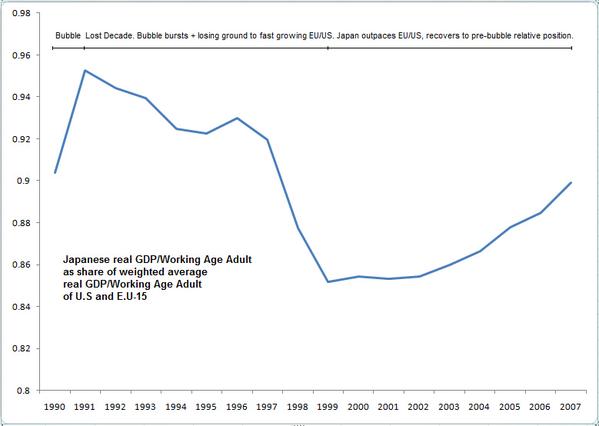
Relative productivity across the major economies

There will be a lot of old Japanese by 2050

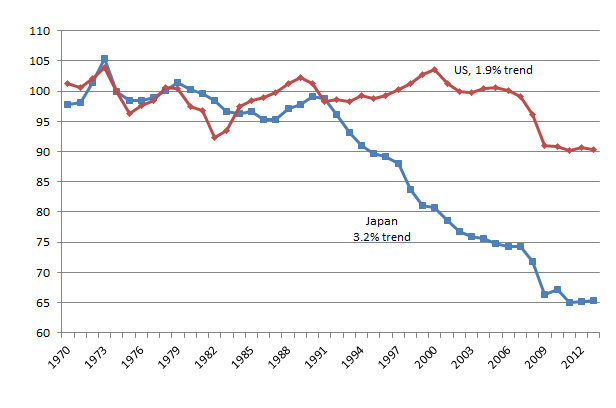
Real GDP per Japanese and American aged 15-64, 2013 price level, updated 2005 EKS PPP, detrended, 1970-2013

image

Source: Computed from OECD StatExtract and The Conference Board, Total Database, January 2014, http://www.conference-board.org/economics.

Note: When the line is flat, the economy is growing at its trend growth rate. A falling line means below trend growth; a rising line means of above trend growth. Detrended with values used by Edward Prescott.

The Japanese decline after 1992 are the Lost Decades. Japan recently returned to its 3.2% trend growth rate of the 1970s and 1980s for working age Japanese.

It could be argued that Japan is now on a permanently lower growth rate that implies no further catch up with the USA.

Customer service was always a priority in Japan

Why a country’s average height is a good way of measuring its development | The Guardian

I spotted this 20 years ago when I first travelled in Asia and then lived Japan for two years. In Japan in 1995, each generation of Japanese was head and shoulders taller than the last. In the Philippines, I could look over the crowd – it was great to be tall.

No more, no longer. In the Philippines, young Filipinos are often almost as tall as me.

Meat_China_US

When I visited Hong Kong recently, both the young Chinese men and women were a bit taller than me at McDonald’s. I am average height for my generation of Australian men.

via Why a country’s average height is a good way of measuring its development | News | The Guardian.

When did administering first aid in an ambulance become lawful in Japan

One of the pluses of moving to Japan to study in 1995 was I didn’t move to study in Japan before 1992, which was when Japanese ambulances were first allowed to administer first aid.

Prior to 1992, Japanese ambulances were not permitted to administer first aid.They just loaded you into the back of the ambulance and off they went.

I know this to be true because I visited the Tokyo Fire Department in 1997 on on a field trip. On page 400 or so of their hand-out, there is a discussion of the change in Japanese ambulance law in 1992 permitting limited first aid to be administered in an ambulance under the supervision of a doctor by radio.

In our tour of the Tokyo Fire Department, we saw the control room where the doctor was sitting who administer guidance while first aid was being administered in an ambulance. Japanese ambulance professionals still have relatively limited training compared to other advanced countries.

Japan’s working age population is seriously shrinking

Image

Will Japan sign on to a tough global climate treaty?

East Asian Tigers seem to run out of steam in the early 1990s

Source: Edward Prescott

Japanese relative economic decline

Embedded image permalinkHT: https://twitter.com/Noahpinion/status/551952006899060736?s=09

Emperor Hirohito at Hiroshima, December 7th, 1945

https://twitter.com/oldpicsarchive/status/558734426474311682

Previous Older Entries Next Newer Entries

David Andolfatto

Celebrating humanity's flourishing through the spread of capitalism and the rule of law

Monetary Non-Neutrality

Celebrating humanity's flourishing through the spread of capitalism and the rule of law

Reason Magazine

Celebrating humanity's flourishing through the spread of capitalism and the rule of law

Coyote Blog

Celebrating humanity's flourishing through the spread of capitalism and the rule of law

Thoughts from the North

Celebrating humanity's flourishing through the spread of capitalism and the rule of law

Fardels Bear

A History of the Alt-Right

Vincent Geloso

Econ Prof at George Mason University, Economic Historian, Québécois

Bassett, Brash & Hide

Celebrating humanity's flourishing through the spread of capitalism and the rule of law

Truth on the Market

Scholarly commentary on law, economics, and more

The Undercover Historian

Beatrice Cherrier's blog

Matua Kahurangi

Celebrating humanity's flourishing through the spread of capitalism and the rule of law

Temple of Sociology

Celebrating humanity's flourishing through the spread of capitalism and the rule of law

Velvet Glove, Iron Fist

Celebrating humanity's flourishing through the spread of capitalism and the rule of law

Why Evolution Is True

Why Evolution is True is a blog written by Jerry Coyne, centered on evolution and biology but also dealing with diverse topics like politics, culture, and cats.

NoTricksZone

Celebrating humanity's flourishing through the spread of capitalism and the rule of law

Homepaddock

A rural perspective with a blue tint by Ele Ludemann

Kiwiblog

DPF's Kiwiblog - Fomenting Happy Mischief since 2003

The Dangerous Economist

Celebrating humanity's flourishing through the spread of capitalism and the rule of law

Watts Up With That?

The world's most viewed site on global warming and climate change

The Logical Place

Tim Harding's writings on rationality, informal logic and skepticism

Doc's Books

A window into Doc Freiberger's library

The Risk-Monger

Let's examine hard decisions!

Uneasy Money

Commentary on monetary policy in the spirit of R. G. Hawtrey

Barrie Saunders

Thoughts on public policy and the media

Liberty Scott

Celebrating humanity's flourishing through the spread of capitalism and the rule of law

Point of Order

Politics and the economy

James Bowden's Blog

A blog (primarily) on Canadian and Commonwealth political history and institutions

Science Matters

Reading between the lines, and underneath the hype.

Peter Winsley

Economics, and such stuff as dreams are made on

A Venerable Puzzle

"The British constitution has always been puzzling, and always will be." --Queen Elizabeth II

The Antiplanner

Celebrating humanity's flourishing through the spread of capitalism and the rule of law

Bet On It

Celebrating humanity's flourishing through the spread of capitalism and the rule of law

History of Sorts

WORLD WAR II, MUSIC, HISTORY, HOLOCAUST

Roger Pielke Jr.

Undisciplined scholar, recovering academic

Offsetting Behaviour

Celebrating humanity's flourishing through the spread of capitalism and the rule of law

JONATHAN TURLEY

Res ipsa loquitur - The thing itself speaks

Conversable Economist

In Hume’s spirit, I will attempt to serve as an ambassador from my world of economics, and help in “finding topics of conversation fit for the entertainment of rational creatures.”

The Victorian Commons

Researching the House of Commons, 1832-1868

The History of Parliament

Articles and research from the History of Parliament Trust

Books & Boots

Reflections on books and art

Legal History Miscellany

Posts on the History of Law, Crime, and Justice

Sex, Drugs and Economics

Celebrating humanity's flourishing through the spread of capitalism and the rule of law

European Royal History

Exploring the Monarchs of Europe

Tallbloke's Talkshop

Cutting edge science you can dice with

Marginal REVOLUTION

Small Steps Toward A Much Better World

NOT A LOT OF PEOPLE KNOW THAT

“We do not believe any group of men adequate enough or wise enough to operate without scrutiny or without criticism. We know that the only way to avoid error is to detect it, that the only way to detect it is to be free to inquire. We know that in secrecy error undetected will flourish and subvert”. - J Robert Oppenheimer.