Squeamishness kills alert: were the atomic bombings unnecessary? Would have Japan surrendered anyway?

https://twitter.com/makingdayscount/status/629162313879154688

https://twitter.com/historyfacts247/status/629304405024763904

https://twitter.com/AmericanVet3/status/630359758273384448

Jim Rose's avatarUtopia, you are standing in it!

Those that argue that Japan surrendered for reasons other than the atomic bomb put forward contradictory arguments.

The first is the Japan was already seeking terms for surrender. That is true, but among those terms was avoiding occupation.

The Japanese leadership had already interpreted the terms of the Potsdam declaration was a sign of weakness. They hoped that by making the invasion of Japan as bloody as possible, they could extract even better terms in light of this sign of weakness at Potsdam. Kyushu, the  obvious initial invasion site in southern Japan, was  being heavily reinforced  by the middle of 1945.

Japan no longer had a realistic prospect of winning the war by the end of 1994 and they knew it.

Japan’s leaders believed they could make the cost of conquering Japan too high for the Allies to accept, leading to some sort of armistice rather than total defeat. The Japanese…

View original post 529 more words
Creative destruction in oldest businesses

How The Japan Times reported the atomic bombings

via How The Japan Times reported the atomic bombings of Hiroshima and Nagasaki | The Japan Times.

Unemployment rates across the OECD member countries

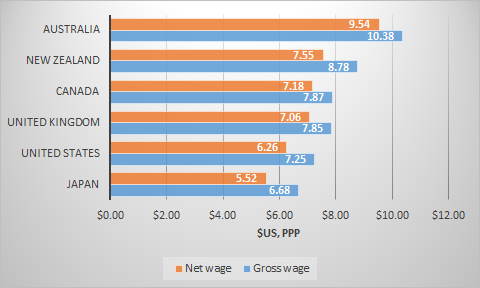
Hourly minimum wages before and after taxes, USA, UK, Canada, Australia, New Zealand and Japan

Figure 1: Hourly minimum wage before and after taxes, 2013, US dollars at purchasing power parities, single-person household

image

Source: OECD Focus on Minimum Wages after the crisis (2015).

A lot of countries borrowed a lot of money recently

Richer is greener: environmentalists are Environmental Kuznets Curve deniers

The Kuznets environmental curve describes an empirical regularity between environmental quality and economic growth. Outdoor water, air and other pollution first worse and then improves as a country first experiences economic growth and development.

While many pollutants exhibit this pattern in the Kuznets environmental curve, peak pollution levels occur at different income levels for different pollutants, countries and time periods. John Tierney explains:

In dozens of studies, researchers identified Kuznets curves for a variety of environmental problems.

There are exceptions to the trend, especially in countries with inept governments and poor systems of property rights, but in general, richer is eventually greener.

As incomes go up, people often focus first on cleaning up their drinking water, and then later on air pollutants like sulphur dioxide.

As their wealth grows, people consume more energy, but they move to more efficient and cleaner sources — from wood to coal and oil, and then to natural gas and nuclear power, progressively emitting less carbon per unit of energy.

When I was living in Japan in the mid 1990s, they just completed a period of rapid operation of the Kuznets environmental curve. I was told by my professors at Graduate School that in the 1960s, cities and prefectures welcomed polluting industries because of the better paid jobs they offered. At that time, shipping companies used like to go to Tokyo because the pollution in Tokyo Bay was so bad that it would clean all the barnacles off their ships. That made them sail faster.

image

Japanese incomes and wages doubled over the course of the 1960s. The Japanese voter was now prepared to support stricter pollution standards and environmental controls.

In the early 1970s, the ruling LDP stole the long-standing environmental policies of their opponents in a big crack down on pollution because the country could now afforded them.

Plenty of developing countries are democracies now. Their people could demand through the ballot box higher environmental standards and clean tap water but they don’t because of its cost to economic development.

The environmental movement lives in a state of denial regarding the relationship between economic growth and environmental quality.

The Empire of Japan in 1939

Top performers in science by gender, USA, UK, Japan, Canada, Australia and New Zealand

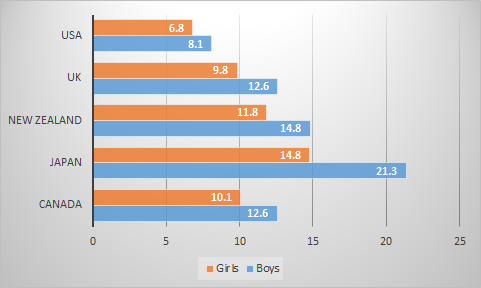
Why are Japanese 15-year-old girls as good at science as teenagers anywhere else in the world?

Figure 1: Percentage achieving the proficiency level 5 or higher in sciences by gender, USA, UK, Japan, Canada, Australia, New Zealand, 2012

image

Source: OECD StatExtract.

Top performers in maths by gender, USA, UK, Japan, Canada, Australia and New Zealand

Figure 1: Percentage achieving the proficiency level 5 or higher in mathematics by gender, USA, UK, Japan, Canada, Australia, New Zealand, 2012

image

Source: OECD StatExtract.

Top performers in reading by gender, USA, UK, Japan, Canada, Australia and New Zealand

Figure 1: percentage achieving the proficiency level 5 or higher in reading by gender, USA, UK, Japan, Canada, Australia, New Zealand, 2012

image

Source: OECD StatExtract.

Japan’s population distribution by age – 1950, 2007, and 2050

Image

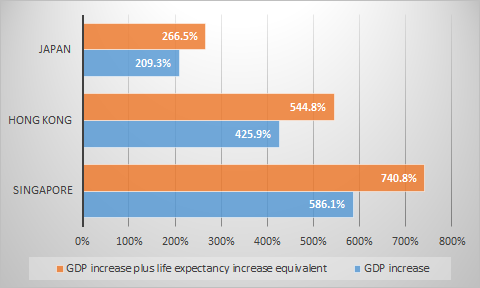
The Quantity and Quality of Japanese, Singaporean and Hong Kong Lives, 1965 to 1995

Figure 1: increase in real GDP and increase in real GDP plus life expectancy GDP increase equivalent, Japan, Singapore and Hong Kong, 1965 to 1995

image

Source: Becker, Gary S., Tomas J. Philipson, and Rodrigo R. Soares. The Quantity and Quality of Life and the Evolution of World Inequality, NBER Working Paper No. 9765 (June 2003).

GDP per capita is usually used to proxy for the quality of life of individuals living in different countries. Becker and his co-authors computed a "full" growth rate that incorporates the gains in health and life expectancy.

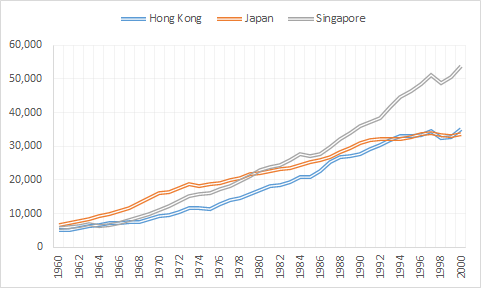
Figure 2 shows that Japan, Hong Kong and Singapore started from similar levels of real GDP per capita PPP in 1960.

Figure 2: GDP per capita in 2014 US$ (converted to 2014 price level with updated 2011 PPPs), Hong Kong, Japan and Singapore, 1960 – 2000

image

Source: The Conference Board. 2015. The Conference Board Total Economy Database™, May 2015, http://www.conference-board.org/data/economydatabase/

Who will be the 20 largest economies in 2030?

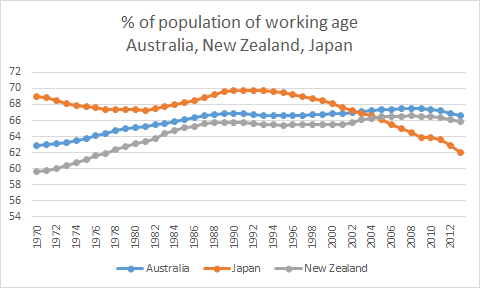
Working age populations of Australia, New Zealand and Japan

image

HT: OECD

Previous Older Entries Next Newer Entries

David Andolfatto

Celebrating humanity's flourishing through the spread of capitalism and the rule of law

Monetary Non-Neutrality

Celebrating humanity's flourishing through the spread of capitalism and the rule of law

Reason Magazine

Celebrating humanity's flourishing through the spread of capitalism and the rule of law

Coyote Blog

Celebrating humanity's flourishing through the spread of capitalism and the rule of law

Thoughts from the North

Celebrating humanity's flourishing through the spread of capitalism and the rule of law

Fardels Bear

A History of the Alt-Right

Vincent Geloso

Econ Prof at George Mason University, Economic Historian, Québécois

Bassett, Brash & Hide

Celebrating humanity's flourishing through the spread of capitalism and the rule of law

Truth on the Market

Scholarly commentary on law, economics, and more

The Undercover Historian

Beatrice Cherrier's blog

Matua Kahurangi

Celebrating humanity's flourishing through the spread of capitalism and the rule of law

Temple of Sociology

Celebrating humanity's flourishing through the spread of capitalism and the rule of law

Velvet Glove, Iron Fist

Celebrating humanity's flourishing through the spread of capitalism and the rule of law

Why Evolution Is True

Why Evolution is True is a blog written by Jerry Coyne, centered on evolution and biology but also dealing with diverse topics like politics, culture, and cats.

NoTricksZone

Celebrating humanity's flourishing through the spread of capitalism and the rule of law

Homepaddock

A rural perspective with a blue tint by Ele Ludemann

Kiwiblog

DPF's Kiwiblog - Fomenting Happy Mischief since 2003

The Dangerous Economist

Celebrating humanity's flourishing through the spread of capitalism and the rule of law

Watts Up With That?

The world's most viewed site on global warming and climate change

The Logical Place

Tim Harding's writings on rationality, informal logic and skepticism

Doc's Books

A window into Doc Freiberger's library

The Risk-Monger

Let's examine hard decisions!

Uneasy Money

Commentary on monetary policy in the spirit of R. G. Hawtrey

Barrie Saunders

Thoughts on public policy and the media

Liberty Scott

Celebrating humanity's flourishing through the spread of capitalism and the rule of law

Point of Order

Politics and the economy

James Bowden's Blog

A blog (primarily) on Canadian and Commonwealth political history and institutions

Science Matters

Reading between the lines, and underneath the hype.

Peter Winsley

Economics, and such stuff as dreams are made on

A Venerable Puzzle

"The British constitution has always been puzzling, and always will be." --Queen Elizabeth II

The Antiplanner

Celebrating humanity's flourishing through the spread of capitalism and the rule of law

Bet On It

Celebrating humanity's flourishing through the spread of capitalism and the rule of law

History of Sorts

WORLD WAR II, MUSIC, HISTORY, HOLOCAUST

Roger Pielke Jr.

Undisciplined scholar, recovering academic

Offsetting Behaviour

Celebrating humanity's flourishing through the spread of capitalism and the rule of law

JONATHAN TURLEY

Res ipsa loquitur - The thing itself speaks

Conversable Economist

In Hume’s spirit, I will attempt to serve as an ambassador from my world of economics, and help in “finding topics of conversation fit for the entertainment of rational creatures.”

The Victorian Commons

Researching the House of Commons, 1832-1868

The History of Parliament

Articles and research from the History of Parliament Trust

Books & Boots

Reflections on books and art

Legal History Miscellany

Posts on the History of Law, Crime, and Justice

Sex, Drugs and Economics

Celebrating humanity's flourishing through the spread of capitalism and the rule of law

European Royal History

Exploring the Monarchs of Europe

Tallbloke's Talkshop

Cutting edge science you can dice with

Marginal REVOLUTION

Small Steps Toward A Much Better World

NOT A LOT OF PEOPLE KNOW THAT

“We do not believe any group of men adequate enough or wise enough to operate without scrutiny or without criticism. We know that the only way to avoid error is to detect it, that the only way to detect it is to be free to inquire. We know that in secrecy error undetected will flourish and subvert”. - J Robert Oppenheimer.