Hayek on Friedman as a Keynesian
28 May 2016 Leave a comment
in business cycles, F.A. Hayek, history of economic thought, macroeconomics, Milton Friedman, monetarism, monetary economics Tags: Keynesian macroeconomics
If You’re A Keynesian Then You Must Believe The Minimum Wage Increases Unemployment
14 Jun 2015 Leave a comment
in business cycles, fiscal policy, labour economics, macroeconomics, minimum wage Tags: Bryan Caplan, economic fallacies, involuntary unemployment, Keynesian macroeconomics, methodology of economics, wage rigidity
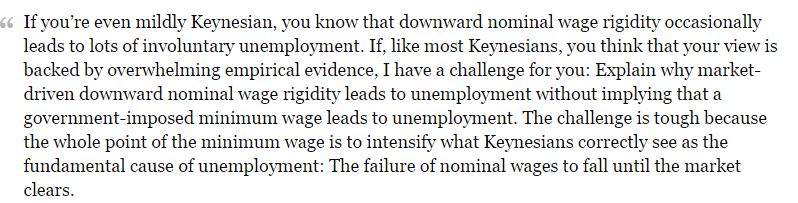
Via If You’re A Keynesian Then You Must Believe The Minimum Wage Increases Unemployment and The Myopic Empiricism of the Minimum Wage, Bryan Caplan | EconLog | Library of Economics and Liberty.
The most important aspect of monetary strategy is timing
28 Mar 2015 Leave a comment
in business cycles, economic growth, economics of information, macroeconomics, Milton Friedman, monetarism, monetary economics, Robert E. Lucas Tags: Keynesian macroeconomics, lags on monetary policy, monetary policy
The simplest statement to make about the lags in monetary policy is they are long and variable. This simple statement is also the key insight to understanding the actual implementation of monetary policy. Hence, how many months or years in advance must a central bank forecast to achieve its monetary goals? In 1994, the Economist said:
But [central banks] cannot afford to wait until inflation is actually rising before they act. Monetary policy does not change the speed of the economy instantly: it can take 18 months or more for a rise in interest rates to have its full impact on inflation. The target of policy ought therefore to be future not current inflation, in order to prevent a surge in 1996. The earlier interest rates are raised, the better the chances of engineering a smooth slowdown to a sustainable rate of growth before slack in the economy is exhausted.
Economists differ about the length of those lags. Uncertainty about the average length of those lags and the variability of those lags makes discretion most difficult. Activist policy can improve welfare only if the information about economic structure and economists’ ability to forecast is sufficiently accurate.

Friedman is the most famous and persuasive critic of Keynesianism on the grounds of lags. He has two main arguments: first, that there are “long and variable lags” between the identification of a problem and the effects of the designed remedy; second, that activist policy often itself becomes a source of instability since policy itself becomes a variable that the market must guess.
Friedman’s critique does not depend on the quantity theory of money. Keynesian policies do not necessarily follow even if the Keynesian theory of the business cycle were conclusively proved.
It must also be demonstrated that the government has the ability and willingness of the government to act as the theory prescribes. We are therefore further assuming that central banks have the incentive to stabilise the economy. If the government lacks the information required to stabilise the economy, issues of public choice incentives become fully redundant. Incentives to pursue an objective do not matter if the objective itself is unattainable.
Competing visions of central banking
25 Mar 2015 1 Comment
in business cycles, economic growth, inflation targeting, macroeconomics, Milton Friedman, monetarism, monetary economics, Robert E. Lucas Tags: Keynesian macroeconomics, monetary policy

The competing visions of central banks over monetary policy have been defined by Franco Modiglani and Milton Friedman respectively. Modiglani considers the Keynesian vision of macroeconomic policy to be:
a market economy is subject to fluctuations which need to be corrected, can be corrected, and therefore should be corrected.
The Keynesian claim implies that central banks have sufficient knowledge of the structure of the economy to be able to choose the policy mix appropriate to a given set of circumstances. It is possible to target unemployment, interest rates and inflation in such a way that they can be maintained (and hence made predictable) by constant adjustment of policy instruments to new shocks.
The Keynesian approach assumes that the economy can slip into recessions for all sorts of reasons (Barro 1989). Business fluctuations result from shocks to aggregate demand. The principal source of these shocks are expectations induced shifts in investment demand. The role of the central bank is to make prompt, frequent policy responses to counteract this instability.
The task of government is to discover the particular monetary and fiscal polices which can eliminate shocks emanating from the private sector. A key finding of recent macroeconomic research is that anticipated monetary policy has very different effects to unanticipated monetary policy.
The Keynesian vision thus presuppose that government can foresee shocks which are invisible to the private sector but at the same time it is unable to reveal this advance information in a credible way and hence defusing the shock because it is no longer unanticipated. In addition, the counter cyclical monetary policies of governments must themselves be unforeseeable by private agents, but at the same time systematically related to the state of the economy (Lucas and Sargent 1979)
Of course, the Keynesian view of central banking is also premised on a goodwill theory of government. Governments pursue policies that are in the public interest. That is a public interest that is well-defined and is free of conflicts over income distribution, electoral success and power the could lead policy-makers to pursue goals other than full employment, stable prices and efficiency. Thus, if the latest forecast is a recession, additional stimulus is the usual prescription. However, since most Keynesian economists accept the permanent income and natural rate hypotheses, more stimulus implies less later at some unknown time.
Friedman’s vision of central banking is far more circumspect:
The central problem is not designing a highly sensitive [monetary] instrument that offsets instability introduced by other factors[in the economy], but preventing monetary arrangements becoming a primary source of instability (Milton Friedman 1959).
Friedman considers that a key element in the case for policy discretion is whether the sufficient information is available that can be used to reduce variability and assist the economy’s adjustment the unforeseen. A well intentioned policy-maker will destabilise if he is mislead by incomplete or incorrect information.

From the monetarist standpoint, price stability can be approximately attained under a well chosen and predictable monetary policy rule. Under this view, the unemployment and interest rates are unpredictable and can manipulated only at a prohibitive cost. The Keynesian and monetarist views are mutually incompatible and lead to very different policy recommendations (Lucas 1981).


Hayek on why Keynesian macroeconomics initially became popular and stayed popular despite eventual empirical failure
31 Jan 2015 8 Comments

More Evidence against Big-Spending Keynesian Economics
17 Jan 2015 3 Comments
in macroeconomics, politics - USA Tags: Keynesian macroeconomics

Keynesian economics is a perpetual-motion machine for statists. The way to boost growth, they argue, is to have governments borrow lots of money from the economy’s productive sector and then spend it on anything and everything.
Even if the money is squandered on global defense against a make-believe alien attack, according to Keynesians like Paul Krugman!
Krugman also has argued that a real war is good would be good for growth since the goal is simply more spending.
Heck, Krugman even asserted the 9-11 attacks were good for the economy because governments then spent more money.
And Nancy Pelosi actually argued that paying people not to work was a great way of creating jobs. I’m not joking.
Amazing. It’s almost as if these people are secret libertarians and they’re saying crazy things to discredit Keynesianism.
But they’re actually serious. This makes it difficult to tell the difference between satire…
View original post 787 more words

Austrian macroeconomics vs. Keynesian macroeconomics in One Chart : The Circle Bastiat
23 Sep 2014 Leave a comment


Keynesian macroeconomics as a form of juvenile real business cycle theory (RBC)
09 Jul 2014 1 Comment
in business cycles, Edward Prescott, macroeconomics Tags: Keynesian macroeconomics, real business cycle theory

Keynesian macroeconomics postulated that the economy slips into recessions for all sorts of reasons such as shifts and turns in the animal spirits and a loss of consumer confidence leading to a fall in autonomous investment and autonomous consumption. A collapse in autonomous investment and autonomous consumption is the Keynesian explanation for the great depression.

Both Keynesian macroeconomics and real business cycle theories, at least at the outset couldn’t explain why there were recessions. Both attributed to them to causes they were yet to explain. Keynesian macroeconomics could not explain what drove the waves of optimism and pessimism that either sharply increased or reduced investment.
Real business cycle theorists attributed recessions and booms to productivity drops in productivity surges, which initially were not explained in themselves. This theory sees productivity shocks as the cause of economic fluctuations. For example, if productivity falls, current returns to working and investing decline, so workers and firms choose to work and invest less and take more leisure. Real business-cycle theory views a recession as the optimal response by households and firms to a shift in productivity.
At least Prescott and other real business cycle theorists accepted that they must eventually unpack productivity drops and name causes that can be explored further and perhaps found persuasive or perhaps wanting.

Keynesian macroeconomics was quite happy to live with the waves of optimism and pessimism of the animal spirits that drove investors to push the economy into recessions. In his General Theory of Employment Interest and Money) Keynes puts it this way,
Most, probably, of our decisions to do something positive, the full consequences of which will be drawn out over many days to come, can only be taken as the result of animal spirits – a spontaneous urge to action rather than inaction, and not as the outcome of a weighted average of quantitative benefits multiplied by quantitative probabilities.
A far better explanation of the animal spirits is there is a productivity drop in one sector of the economy that leads that sector to reduce its demand for inputs supplied by the rest of the economy. This reduction in demand spreads across the economy. The slowdown in the economy is attributed to this reduction in demand, rather than the forces behind it, which is a fall in productivity in one sector of the economy.
Long and Plosser in 1983 wrote a famous article where they were able to generate business cycles in an economy with rational expectations, complete current information, stable preferences, no technical change, no long-lived commodities, no frictions and adjustments cost, no government, no money and no serial dependence in the stochastic elements of the environment.
In response to a productivity disturbance in one sector this economy, consumers will smooth a change in their consumption possibilities and production possibilities over a number of quarters by saving and dissaving and varying the amount of time they devote to work and leisure and they will invest more or less in light of the changing situation.
This consumption smoothing is enough to generate a slowdown in the economy from changes in one sector. Laid-off workers in the sector subject to a disturbance will take time to find jobs in other sectors of the economy and will be unemployed in this interim period of job search. Other workers who were previously employed in the sector subject to the productivity decline might wait for prospects to improve in that sector rather than search for a job in another occupation or location.
As research progressed, real business cycles were viewed as recurrent fluctuations in an economy’s incomes, products, and factor inputs—especially labour—due to changes in technology, tax rates and government spending, tastes, government regulation, terms of trade, and energy prices. In his Nobel lecture Ed Prescott explained that:
We learned that business cycle fluctuations are the optimal response to real shocks.
The cost of a bad shock cannot be avoided, and policies that attempt to do so will be counterproductive, particularly if they reduce production efficiency.
During the 1981 and current oil crises, I was pleased that policies were not instituted that adversely affected the economy by reducing production efficiency. This is in sharp contrast to the oil crisis in 1974 when, rather than letting the economy respond optimally to a bad shock so as to minimize its cost, policies were instituted that adversely affected production efficiency and depressed the economy much more than it would otherwise have been.
By the time Keynesian macroeconomics papered over the flaws mighty exposed by the 1970s stagflation, it rebranded itself New Keynesian macroeconomics. This is no more than becoming monetarist macroeconomists without having to admit all of your previous criticisms of Friedman were wrong.
At bottom, Keynesian macroeconomics makes an unjustified assumption that technological progress unfolds at a relatively smooth rate, and changes in government regulation, terms of trade, and energy prices were not important sources of economic fluctuations. As for tax rates and government spending, Keynesian macroeconomists saw these is a solution to recessions rather than their cause.
In time, real business cycles theory and Schumpeterian theories of business cycles will merge. new inventions and processes that are, by the nature of research and development, stochastically discovered. Part of this randomness in discovery will be that the emergence from time to time of great interventions – general purpose technologies -that result in economy wide changes and a wave of secondary inventions and the retraining of the workforce and reallocation of many workers into new sectors of the economy. These great inventions can be anything from electricity to information and computer technology and the Internet
 Utopia, you are standing in it!
Recent Comments