The footprint of Big Wind and Big Solar
21 Apr 2015 Leave a comment
in energy economics, environmental economics Tags: Big Solar, Big Wind, green rent seeking, land supply, solar power
New Zealand, Australian and US real housing price index, 1975–2014, 2005 base
12 Apr 2015 Leave a comment
in business cycles, global financial crisis (GFC), great recession, macroeconomics, politics - Australia, politics - New Zealand, politics - USA, urban economics Tags: GFC, housing prices, land supply, zoning
The housing spikes in Australia and New Zealand preceded the global financial crisis, starting in about 1999, and were largely unaffected by the GFC. Housing prices in the USA were pretty calm except in the lead up to the GFC, and took a dive with the onset of the global financial crisis and great recession.
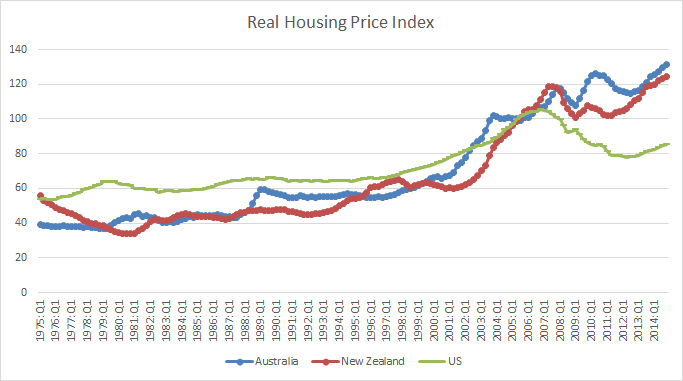
Source: Dallas Fed; Housing prices deflated by personal consumption expenditure (PCE) deflator.
.
Renewable energy may run out of land
07 Apr 2015 Leave a comment
in energy economics, environmental economics, global warming Tags: land supply, renewable energy, solar power, wind power
The causes of housing unaffordability
01 Apr 2015 Leave a comment
in politics - New Zealand, politics - USA, urban economics Tags: Don Brash, land supply, Resource Management Act, zoning
There is no housing bubble in US cities with a flexible land supply
21 Mar 2015 Leave a comment
in applied price theory, economics of regulation, environmental economics, politics - New Zealand, politics - USA, urban economics Tags: land supply, land use regulation, RMA, supply and demand, zoning

In areas with a readily available supply of land on which to construct new homes—either because of geography or few land-use restrictions—builders have been sensitive to increases in local demand and existing-home prices. When existing houses rise in price relative to the cost of new homes, prospective buyers are willing and able to buy new units.
Supply conditions determine how house price and construction react to shifting demand. When housing demand rises—perhaps due to rising incomes, lower mortgage interest rates or easier credit standards—the outward shift in demand produces sharply higher house prices with a small increase in the supply of newly built units in areas with less-plentiful land. By comparison, when there is a more-plentiful land supply, the amount of housing is more supply sensitive and a rise in demand results in a less-pronounced rise in house prices and a greater increase of newly constructed homes.
As a result, house prices rise less in these supply-sensitive areas during booms and they fall less in downturns. Similarly, prices swing more and homebuilding varies less in regions with less-sensitive housing supply.


Edward Glaeser on regulation and housing prices
24 Feb 2015 Leave a comment
in urban economics Tags: Edward Gleaser, housing affordability, land supply, land use regulation, zoning
When fighting child poverty, don’t mention housing costs
22 Feb 2015 Leave a comment
in labour economics, liberalism, politics - New Zealand, poverty and inequality, urban economics, welfare reform Tags: child poverty, housing affordability, land supply, Left-wing hypocrisy, RMA, zoning

The relationship between housing prices and the Wharton Land Use Index
24 Jan 2015 Leave a comment
in rentseeking, urban economics Tags: Edward Gleaser, green rent seeking, land supply, land use regulation, zoning

Note: the Wharton Land Use Index measures the restrictiveness of a metropolitan area’s land use regulations.
Hsieh and Moretti on Allocations across Cities
23 Jan 2015 Leave a comment
in applied price theory, applied welfare economics, economics of regulation, geography, law and economics, politics - New Zealand, politics - USA, rentseeking, urban economics Tags: agglomeration, green rent seeking, land supply, zoning
the implied cost of housing restrictions across the whole U.S., and Chang and Enrico find that aggregate output is lower by about 10-14% because of them.


Last post on the NBER growth session. Chang-Tai Hsieh (Chicago) and Enrico Moretti (Berkeley) presented a paper on wage dispersion across cities in the U.S. Wage dispersion (New Yorkers earn more than people in Cleveland) either represents compensation for living costs (housing in New York is more expensive than in Cleveland), a real difference in productivity (New Yorkers are more productive than Clevelanders), or some combination of the two.
What Chang and Enrico find is that the increase in wage dispersion across cities in the U.S. over the last thirty-ish years is due almost entirely to rising house prices in six cities: NY, DC, Boston, San Fran, San Jose, and Seattle. Wages have gone up rapidly in those cities, but that is basically just compensating their citizens for the higher costs of living.
Now, given the costs of living, the allocation of population across cities in the U.S. is…
View original post 274 more words
The one main cause of rising child poverty in New Zealand since the 1980s
09 Dec 2014 Leave a comment

The people designing your cities don’t care what you want. They’re planning for hipsters. – The Washington Post
19 Aug 2014 Leave a comment
in applied price theory, economics of regulation, income redistribution, rentseeking, urban economics Tags: do gooders, elitism, land supply, new class, rent seeking, the vision of the annointed, zoning

HT: Michael Warby via The people designing your cities don’t care what you want. They’re planning for hipsters. – The Washington Post .


New Zealand is the second most expensive place to put a roof over your head in the OECD area
16 Jun 2014 Leave a comment
in economics of regulation, urban economics Tags: housing affordability, land supply, land use regulation, urban economics

HT: OECD at slideshare.net via Don Brash


Recent Comments