CLASSIC VIDEO: Margaret Thatcher on Socialism in 1990 to the House of Commons https://t.co/iB5O3ejoaC
— Mark J. Perry (@Mark_J_Perry) July 22, 2015
Maggie Thatcher’s Rawlsian critique of socialism on her last day as Prime Minister
22 Jul 2015 Leave a comment
in liberalism, Marxist economics, Rawls and Nozick Tags: Leftover Left, Margaret Thatcher
Fact Checking @Income_Equality – child poverty in 2014 was at 24% compared to 14% in 1982
22 Jul 2015 Leave a comment
in applied welfare economics, economic history, labour economics, politics - New Zealand, population economics, poverty and inequality, urban economics Tags: child poverty, family poverty, green rent seeking, housing prices, land prices, land supply, Leftover Left, NIMBYs, top 1%
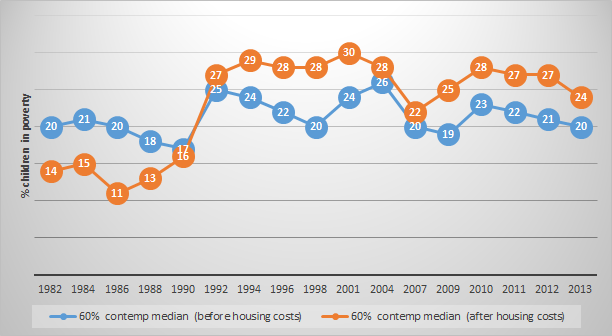
Closing The Gap – The Income Equality Project said today that “child poverty in New Zealand in 2014 was 24% as compared 14% in 1982”. What do they mean by this and what, importantly, does this trend imply for problem definition for child poverty policy?
Figure 1 below shows their numbers, which is child poverty in New Zealand after housing costs for poverty thresholds of 60% relative to a contemporary median as calculated by the Ministry of Social Development’s Brian Perry – the New Zealand expert on these matters.
Figure 1: % child poverty in New Zealand (before and after housing costs), 60% relative to contemporary median, 1982 – 2013
Source: Bryan Perry, Household incomes in New Zealand: Trends in indicators of inequality and hardship 1982 to 2013. Ministry of Social Development (July 2014), Tables F.6 and F.7.
The first thing to notice is, which is important, in figure 1 is before housing costs child poverty under the 60% relative to the contemporary median poverty threshold chosen by Closing The Gap – The Income Equality Project has been pretty stable for 30 years the New Zealand. Crisis, what crisis?
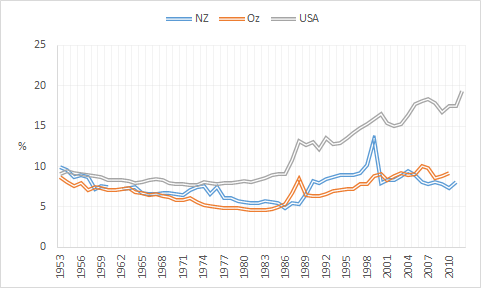
The top 1%’s New Zealand branch has not being doing its job – see figure 2. The New Zealand top 1% has failed miserably in further oppressing the proletariat, extracting more and more of their labour surplus, and grinding working class children into deeper and deeper poverty to increase their already excessive incomes – see figure 2. You’re fired as the until recently registered Democrat Donald Trump would say.
Figure 2: top income shares, New Zealand, Australia and USA
Source: top incomes-parisschoolofeconomics
Before housing costs child poverty has not risen for 30 years as shown in figure 1, which is the chosen threshold of child poverty of the Closing The Gap – The Income Equality Project.
The story about trends in child poverty is very different for child poverty when after housing costs child poverty rates are estimated – see figure 1.
Figure 1 shows a large increase in after housing costs child poverty in New Zealand in the late 1980s when there was a deep recession and double-digit unemployment. Since the early 1990s, as figure 1 shows, after housing costs child poverty has slowly tapered down from the high 30% in the mid-1990s to 24% now and that is despite the global financial crisis, which was the top 1%’s fault if the Left over Left is to be believed.
For before housing costs child poverty – as can be seen from figure 1 – there was an increase in child poverty before housing costs when there was a deep recession at the end of the 1980s. After before housing costs child poverty is now the same as it was both 20 and 30 years ago – see figure 1 .
In the longer run after housing costs child poverty rates in 2013 were close to double what they were in the late 1980s mainly because housing costs in 2013 were much higher relative to income than they were in the late 1980s.
– Bryan Perry, 2014 Household Incomes Report – Key Findings. Ministry of Social Development (July 2014).
Now to the rub. If it is after housing costs child poverty that has risen in New Zealand and stayed high, as it has, the focus should be on what factors are driving up housing costs rather than what factors are driving down wages and incomes of ordinary worker. Before housing costs child poverty is no worse than it was 20 and 30 years ago – see figure 1.
New QV figures show Auckland house prices are up a massive 16.1% on last year, now estimated to reach $1m by Aug '16. http://t.co/DwAU79ozCy—
New Zealand Labour (@nzlabour) June 09, 2015
The cause of the large increase in housing costs and housing prices is abundantly clear. Restrictions on the supply of land that result from the Resource Management Act and policies made under that law such as the Auckland urban limit. That is the proper problem definition for public policy. Restrictions on land supply is driving up child poverty because more and more of the incomes of the poor is housing costs.

Source: Federal Reserve Bank of Dallas.
The most straightforward and fastest way of reducing child poverty and family poverty in New Zealand is lowering housing costs through deregulation of land supply.

Land supply deregulation is well within the realm of public policy choice. Parliament cannot legislate wage increases without accompanying productivity increases, but it can reduce restrictions on the supply of land as a result of the Resource Management Act.

Any discussion of child poverty and family poverty in New Zealand should refer to trends in both before and after housing cost in child poverty.
Will the Govt intervene in Auckland's housing crisis? Or will home ownership become a preserve of the wealthy? http://t.co/CK2AnCeuYB—
Green Party NZ (@NZGreens) February 05, 2015
A comparison of these diverging trends between before housing cost and after housing costs child poverty rates since 1982 gives a much clearer picture of what is increasing child poverty. The cause is housing costs as a result of ever tightening regulation on the supply of new urban land and in particular in Auckland at the behest of the middle-class voters courted by the Greens and Labour Party. It is the left-wing parties in New Zealand which opposed the most practical steps to reduce child poverty, which is land supply deregulation.
The impact of neoliberalism on labour market freedom in Argentina, Brazil, Chile and Venezuela
22 Jul 2015 Leave a comment
in development economics, economic history, economics of regulation, growth disasters, growth miracles, labour economics, labour supply, minimum wage, unions Tags: Argentina, Brazil, Chile, conspiracy theories, employment law, employment regulation, Index of Economic Freedom, Leftover Left, Mont Pelerin Society, neoliberalism, Twitter left, Venezuela
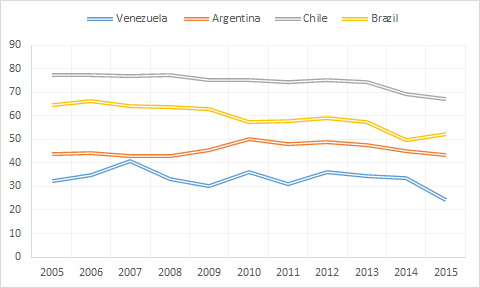
All was quiet on the neoliberalism front in Latin America for the last 20 years. In yet another defeat for the Mont Pelerin Society led transnational conspiracy, labour market freedom has declined in the four countries in figure 1. I’ve always had my doubts about the ability of a transnational conspiracy to be led by a society with such a crappy website.
Figure 1: Index of Economic Freedom, Argentina, Brazil, Chile and Venezuela, 95 – 2015
Source: Index of Economic Freedom 2015.
Labour is incoherent & self-defeating in its opposition to private prisons
21 Jul 2015 Leave a comment
in economics of crime, industrial organisation, law and economics, managerial economics, organisational economics, personnel economics, politics - New Zealand, politics - USA, survivor principle Tags: creative destruction, entrepreneurial alertness, evidence-based policy, Leftover Left, New Zealand Labour Party, prison privatisation, private ownership, private prisons, privatisation, state ownership, Tony Blair
The New Zealand Labour Party would make a lot more progress in its opposition to private prisons if it would drop its ideologically blinkered opposition to privatisation. If it was to do that, it would have a much stronger case against private prisons.
That case would be based on the modern economics of industrial organisation and state and private ownership. In particular, the make or buy decision that any organisation, be they public or private must face when deciding whether to make a particular production input in-house or source it externally.
Labour’s current case against private prisons is a bunch of ideological clichés as it illustrated today in a post on Facebook by Jacinda Ardern. Her post was based on her speech in the House of Representatives:
Yes, part of that opposition is my view that no one should make a profit from incarceration, but it’s also about the complete fallacy that somehow a company like SERCO will do the job better.
The notion that no one should make a profit from incarceration is farcical. There are a whole range of private profit making suppliers of goods and services to prisons and prison officers draw a wage.
The case was state ownership, as well stated by Andrei Shleifer is no different than any other ownership decision taken by an organisation facing the inability to contract fully over hard to measure quality issues with the goods or services supplied to it.
Shleifer in “State versus Private Ownership” argues that you make in-house rather than buy in the market under the following conditions:
- opportunities for cost reductions that lead to non-contractible deterioration of quality are significant;
- innovation is relatively unimportant;
- competition is weak and consumer choice is ineffective; and,
- reputational mechanisms are also weak.
What particularly should focus Labour’s attention on Andrei Shleifer’s State versus Private Ownership is it is a simplified version of Hart, Oliver, Andrei Shleifer, and Robert W Vishny. 1997. “The Proper Scope of Government: Theory and an Application to Prisons.” Quarterly Journal of Economics. The abstract to that longer paper says the following:
When should a government provide a service in-house, and when should it contract out provision? We develop a model in which the provider can invest in improving the quality of service or reducing cost.
If contracts are incomplete, the private provider has a stronger incentive to engage in both quality improvement and cost reduction than a government employee has. However, the private contractor’s incentive to engage in cost reduction is typically too strong because he ignores the adverse effect on non-contractible quality. The model is applied to understanding the costs and benefits of prison privatization.
The privatisation of prisons is at the margin of the case was state versus private provision of a good or service.
Labour forecloses this entire literature to itself and bases its arguments on ideology. Any other argument Labour makes are just talking points to a fixed ideological position.There is no give-and-take. When one argument is knocked down, Labour just looks for other arguments to defend the same fixed position.
The reason Labour forecloses this large economic literature on state versus private ownership and its application to private versus public prisons is embracing that literature would mean admitting that same literature makes a strong case for the privatisation of a number of other government services and state-owned enterprises. As Shleifer says in State versus Private Ownership:
Private ownership should generally be preferred to public ownership when the incentives to innovate and to contain costs must be strong.
The main argument, the best argument, against the privatisation of publicly provided services and state-owned enterprises is the dilution of quality once it is supplied privately. This risk of compromises and quality to enhance profits is higher when the privatisation is contracting back to government. Detailed contracts must be written to assure quality. As Hart, Shleifer and Vishny say:
Critics of private schools fear that such schools, even if paid for by the government (e.g., through vouchers), would find ways to reject expensive-to-educate children, who have learning or behavioural problems, without violating the letter of their contracts. Critics also worry that private schools would replace expensive teachers with cheaper teachers’ aides, thereby jeopardizing the quality of education.
In the discussion of public versus private health care, the pervasive concern is that private hospitals would find ways to save money by shirking on the quality of care or rejecting the extremely sick and expensive-to-treat patients. In the case of prisons, concern that private providers hire unqualified guards to save costs, thereby undermining safety and security of prisoners, is a key objection to privatization.
Our model tries to explain both why private contracting is generally cheaper, and why in some cases it may deliver a higher, while in others a lower, quality level than in-house provision by the government.
By basing the argument on the strengths and weaknesses of contracting over quality for specific services, Labour would have to drop its straight ideological opposition to privatisation and run on a case-by-case basis over the ability to successfully contract to assure quality.
That sounds far too much like becoming a Blairite – the horror, the horror if you are a Labour Party member in the 21st century concerned more about ideological purity than winning office and improving the lot of the people claim to you represent.
If it were to embrace the modern economics of state versus private ownership, Labour would have to agree with Hart, Shleifer and Vishny when they say:
the case for privatization is stronger when quality reducing cost reductions can be controlled through contract or competition, when quality innovations are important, and when patronage and powerful unions are a severe problem inside the government.
When the government cannot fully anticipate, describe, stipulate, regulate and enforce exactly what it wants and prisons are a good case this and has difficulty enforce in any contract with regard to quality assurance, it’s better to make it in-house as Hart, Shleifer and Vishny show.
A call to the barricades is not be very uplifting if based on incomplete contracting over service quality rather than the evils of capitalist profit. It is unfortunate that the Labour Party sacrifice the interests of those incarcerated in the prison system to its unwillingness to be denounced as a Blairite.
The case for private prisons is based on public prisons may have fewer incentives to keep costs down, including keeping costs down by skimming on quality to increase profits as Andre Shleifer explains:
Ironically, the government sometimes becomes the efficient producer precisely because its employees are not motivated to find ways of holding costs down.
The modern case for government ownership can often be seen from precisely this perspective. Advocates of such ownership want to have state prisons so as to avoid untrained low-wage guards, state water utilities to force investment in purification, and state car makers to make them invest in environmentally friendly products.
As it turns out, however, this case for state ownership must be made carefully, and even in most of the situations where cost reduction has adverse consequences for non-contractible quality, private ownership is still superior.
That is the twist in the tale for Labour. The case against privatisation is merely a balancing act requiring detailed scrutiny of the potential to successfully enforce contracts with private providers over quality assurance.
The case against prison privatisation is simply for the public sector as fewer incentives to weaken quality because this increases the bottom line of the contractor or salaries of management. It’s a trade-off between cost control and quality dilution. Publicly run prisons have fewer incentives to control costs, but they also have fewer incentives to deliberately cut corners on quality to increase dividends or managerial salaries .
There’s nothing new about the non-profit provision of goods and services in the marketplace. A whole range of non-profit firms emerged through market competition in situations where contracting over quality or trust was costly.
Most life insurance companies were initially mutually owned by customers. Because they were a non-profit firm, there were fewer avenues to run off with the premiums through excessive dividends.
Many private universities and private schools are run by charitable trusts as a way of quality assurance. Another way of quality assurance is heavy involvement of alumni through giving and sports to police the reputation of the university or school they once attended or want their children to attend.
An arguable case can be made against prison privatisation, based on sound economic principles as long as you’re willing to admit that in many cases privatisation is a good idea based on the same economic principles. That’s a bridge too far from the Labour Party in New Zealand.
Maybe the reason is Labour knows that although they may be able to make an arguable case against prisons privatisation, they may still lose to better arguments and, in particular, successful experiments in prison privatisation at home and abroad. Better to keep the debate away from evidence-based policy. This awkwardness in seeking out the best argument is due to the proclivity of Labour in opposition to repudiate the successes of its last time in office and look for reasons to make themselves even less electable by going left rather than going back into the centre.
The impact of neoliberalism on economic freedom in Argentina, Brazil, Chile and Venezuela since 1995
20 Jul 2015 Leave a comment
in applied price theory, applied welfare economics, comparative institutional analysis, development economics, economic history, economics of regulation, growth disasters, growth miracles Tags: Argentina, Brazil, Chile, conspiracy theories, Index of Economic Freedom, Leftover Left, Mont Pelerin Society, neoliberalism, Twitter left, Venezuela
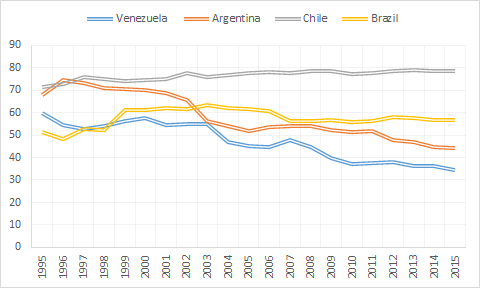
All was quiet on the neoliberalism front in Latin America for the last 20 years. In yet another defeat for the Mont Pelerin Society led transnational conspiracy, economic freedom has been pretty stable in Chile for 20 years and in the serious decline in Venezuela and Argentina – see figure 1. Not much happening in Brazil either on the neoliberalism front – see figure 1. I’ve always had my doubts about the ability of a transnational conspiracy to be led by a society with such a crappy website.
Figure 1: Index of Economic Freedom, Argentina, Brazil, Chile and Venezuela, 95 – 2015
Source: Index of Economic Freedom 2015.

Thomas Macaulay (1830) on the green movement
19 Jul 2015 Leave a comment
in development economics, economic history, economics of media and culture, environmental economics, environmentalism, growth disasters, growth miracles Tags: doomsday prophecies, doomsday prophets, Leftover Left, Thomas Macaulay
“…we see nothing but improvement behind us [yet] expect nothing but deterioration before us” buff.ly/1HscRBL http://t.co/cKILhkKWvr—
HumanProgress.org (@humanprogress) June 30, 2015
Capitalism and The Great Fact in China
17 Jul 2015 Leave a comment
in applied price theory, applied welfare economics, comparative institutional analysis, development economics, economic history, economics of education, economics of regulation, entrepreneurship, environmental economics, growth disasters, growth miracles, history of economic thought, industrial organisation, Marxist economics, Public Choice Tags: capitalism and freedom, China, fall of communism, Leftover Left, transitional economies
As China grew freer economically, its poverty rate fell. buff.ly/1KohOxS http://t.co/OpaxOzNdNs—
HumanProgress.org (@humanprogress) June 29, 2015
How to argue for inequality and neoliberalism when arguing dead set against it
17 Jul 2015 Leave a comment
in economic growth, economic history, human capital, income redistribution, labour economics, labour supply, politics - New Zealand, poverty and inequality, Public Choice, rentseeking Tags: Leftover Left, neoliberalism, top 1%
On 12 August last, Closer Together New Zealand posted a chart showing average hourly wages had been stagnant for 20 years and then started growing again in 1993. Closer Together New Zealand then rounded up the usual suspects of the Left over Left.
Later that month in a comment on that post, a chart was posted showing that inequality had been increasing quite rapidly in the late 1980s and early 1990s in New Zealand. There were a range of economic reforms Closer Together New Zealand didn’t like in the late 1980s and early 1990s.
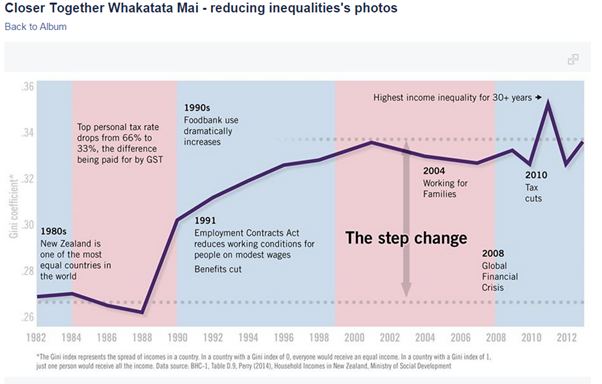
Closer Together New Zealand did not notice their second chart showed there had been a large increase in inequality, and their first chart showed that this was followed by the return of regular average hourly wages after 20 years of stagnation.
I am not so vulgar as to suggest correlation is causation, but it is amusing to watch that one day a chart is posted showing a resumption of wages growth after 20 years of wage stagnation and the next day a chart is posted showing that the major economic developments in the preceding years were a large increase in inequality and substantial economic liberalisation.
To add to my amusement, a companion site Inequality A New Zealand Conversation posted a chart showing the top 1% had not had much at all in income growth for the last 20 years while most everyone else had. This spike in the incomes of the top 1% prior to about 1994 was followed by the resumption in average wages growth after 1994.
The time when the mass kidnappings of principled anti-war activists started has been uncovered
16 Jul 2015 Leave a comment
in politics - USA, Public Choice Tags: activists, anti-war movement, expressive voting, green hypocrisy, Left-wing hypocrisy, Leftover Left, mass kidnappings, peace movement


via What’s Wrong With the U.S. Peace Movement, Bryan Caplan | EconLog | Library of Economics and Liberty.
Voter turnout among voting age people
11 Jul 2015 Leave a comment
Under the shy Labour voter theory, countries with low turnouts should have right-wing governments and countries with high turnouts should have left-wing governments. Do they?
Voter turnout among voting age people
Turkey 86%
Sweden 83
France 71
Mexico 65
UK 61
US 54pewresearch.org/fact-tank/2015… http://t.co/lmMcqqM4JD—
Conrad Hackett (@conradhackett) June 01, 2015
Are the rich getting richer, poor getting poorer as @MaxRashbrooke once again suggests?
08 Jul 2015 Leave a comment
in applied welfare economics, economic history, labour economics, politics - New Zealand, poverty and inequality, technological progress Tags: child poverty, family poverty, Leftover Left, Max Rashbrooke, The Great Enrichment, top 1%
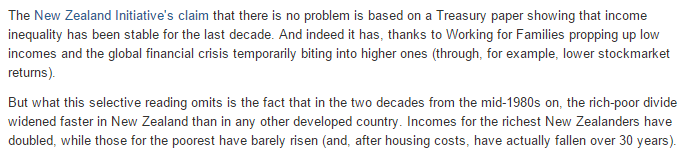
Max Rashbrooke has been at it again in the paper today.

Don’t these graphs show that everyone is richer in New Zealand than 30 years ago and there has been not much change in either child poverty or inequality for coming on for 20 years? The fall in child poverty started before the introduction of Working for Families.
Technological progress in the form of new goods and product upgrades are poorly captured in measures of living standards over time as is increases in life expectancies.
1993 vs 2013: http://t.co/tdnNqmRmcS—
History Pics (@HistoryPixs) January 08, 2014
HT: Suffer the little children – Inequality and child poverty – Closer TogetherCloser Together.
The political bias of psychologists
05 Jul 2015 Leave a comment
in economics of bureaucracy, economics of education, economics of media and culture, politics - Australia, politics - New Zealand, politics - USA, Public Choice, rentseeking Tags: academic bias, bureaucratic bias, expressive voting, Leftover Left, media bias, occupational choice, political bias, rational ignorance, rational irrationality, social psychology, Twitter left
Why is it that the economics profession is the only profession questioned on the grounds of its political diversity?

1) Academic psychology once had considerable political diversity, but has lost nearly all of it in the last 50 years;
2) This lack of political diversity can undermine the validity of social psychological science via mechanisms such as the embedding of liberal values into research questions and methods, steering researchers away from important but politically unpalatable research topics, and producing conclusions that mischaracterize liberals and conservatives alike;
3) Increased political diversity would improve social psychological science by reducing the impact of bias mechanisms such as confirmation bias, and by empowering dissenting minorities to improve the quality of the majority’s thinking; and
4) The underrepresentation of non-liberals in social psychology is most likely due to a combination of self-selection, hostile climate, and discrimination.
via Psychology’s Political Diversity Problem | Psychology Today.
@MaxCRoser only one line in this chart about India matters
05 Jul 2015 Leave a comment
in comparative institutional analysis, constitutional political economy, development economics, economic history, growth disasters, growth miracles, poverty and inequality, Public Choice Tags: capitalism and freedom, extreme poverty, global poverty, India, Leftover Left, The Great Escape, The Great Fact, top 1%
In #India poverty is falling very, very rapidly – while inequality is rising.
More at: bit.ly/1KLT8Lh http://t.co/xTxlW1i06o—
Max Roser (@MaxCRoser) June 29, 2015
 Utopia, you are standing in it!
Recent Comments