
@bryce_edwards New Zealand’s war on the poor – a fact check
15 Dec 2014 Leave a comment
in economic history, income redistribution, labour economics, Marxist economics, politics - USA, technological progress Tags: Bryce Edwards, Leftover Left, poverty and inequality
Bryce Edwards has shown in today’s column that he knows nothing about inequality in New Zealand, despite the statistics being at his fingertips:
Under capitalism there’s always going to be a war against the poor.
The process by which we divide up the resources of any society normally involves exploiting the majority for the benefit of the minority.
It’s called inequality. And this is how it is in New Zealand: those who have the most power look for ways to extract that money for themselves, or at least retain the status quo.
Against this are those who want to have a more equal society. It’s an age-old political issue, and one that has traditionally been at the heart of the left-right political divide.
In 2014 this concern about inequality has been a key feature of politics, underpinning much of what has occur…
Although the rich appear to have been winning for three decades in their ‘war against the poor’, perhaps the tide is turning?
There’s still every indication of severe poverty and inequality in this country.
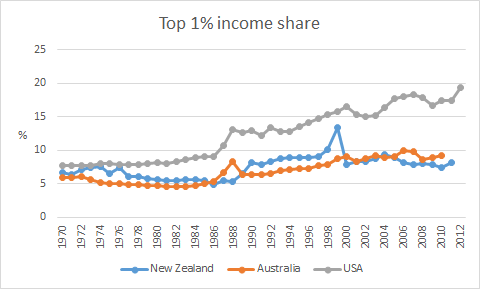
Firstly, inequality has not increased in New Zealand for at least 20 years when either measured in figure 1 by the Gini coefficient or in figure 2, the top 1% income shares. Both the Gini coefficient and the top 1% income shares have not risen for 20 years.
Figure 1: Gini coefficient New Zealand 1980-2015

Source: Bryan Perry, Household incomes in New Zealand: Trends in indicators of inequality and hardship 1982 to 2013. Ministry of Social Development (July 2014).
Figure 2: Top 1% income shares, USA, New Zealand and Australia, 1970-2012
Source: top incomes database
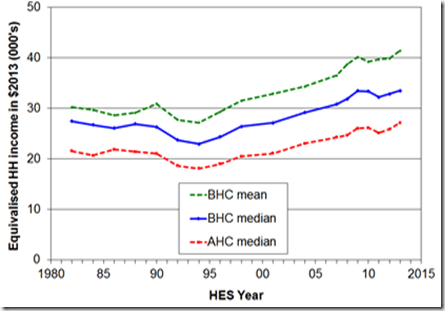
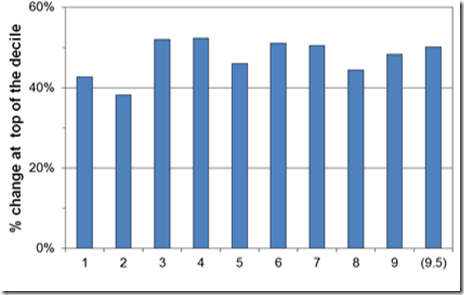
Secondly, the benefits of the economic boom that lasted 15 years from the early 1990s until the onset of the global financial crisis would spread broadly across all sections of the New Zealand community. As shown in figure 3, both before and after housing costs increased. As shown in figure 4, real household incomes increased pretty much evenly across all of the 10 income deciles between 1994 and 2013.
Figure 3: Real household income trends before housing costs (BHC) and after housing costs (AHC), 1982 to 2013 ($2013)
Source: Bryan Perry, Household incomes in New Zealand: Trends in indicators of inequality and hardship 1982 to 2013. Ministry of Social Development (July 2014).
Figure 4: Real household incomes (BHC), changes for top of income deciles, 1994 to 2013
Source: Bryan Perry, Household incomes in New Zealand: Trends in indicators of inequality and hardship 1982 to 2013. Ministry of Social Development (July 2014).
Thirdly, as shown in figure 5, between 1994 and 2010, real equivalised median household income rose 47% from 1994 to 2010; for Māori, this rise was 68%; for Pasifika, the rise was 77%. Median household income increases of nearly 50% in 16 years should be celebrated.
Figure 5: Real equivalised median household income (before housing costs) by ethnicity, 1988 to 2013 ($2013).

Source: Bryan Perry, Household incomes in New Zealand: Trends in indicators of inequality and hardship 1982 to 2013. Ministry of Social Development (July 2014).
The massive improvements in Māori incomes since 1992 were based on rising Māori employment rates, fewer Māori on benefits, more Māori moving into higher paying jobs, and greater Māori educational attainment. Māori unemployment reached a 20-year low of 8 per cent from 2005 to 2008.
Over the last more than two decades in New Zealand, there has been sustained income growth spread across all of New Zealand society contrary to the warmed over Marxism of Bryce Edwards. Perry (2014) reviews the data every year for the Ministry of Social Development. He concluded that:
Overall, there is no evidence of any sustained rise or fall in inequality in the last two decades.
The level of household disposable income inequality in New Zealand is a little above the OECD median.
The share of total income received by the top 1% of individuals is at the low end of the OECD rankings.
Bryce Edwards’ analysis was in the typical Marxist tradition – it had no gender analysis. He failed to mention that New Zealand has the smallest gender wage gap of all the industrialised countries.

As he did not notice these great successes in household incomes, incomes of every decile, Māori economic development and the empowerment of women, Bryce Edwards had nothing to add in terms of either consolidating or improving on them.

The renegade Left and the laws of war
11 Dec 2014 Leave a comment
in International law, laws of war, war and peace Tags: Leftover Left, prisoners of war, renegade Left, Renegade liberals, war criminals, war on terror
The renegade Left is highly selective in its recall of international humanitarian law. On torture, perfect recall, strict construction and may the heavens fall. William Levi in the Yale Law Journal in 2009 argued that
- except for water-boarding, every interrogation technique authorized by the Bush Administration had been authorized before 9/11 and considered to fall within the legal constraints of the Geneva Conventions.
- Techniques such as sleep deprivation, and standing as a stress position that were understood at times before 9/11 to be lawful for use on prisoners of war.
When it comes to the reason for being for international humanitarian law, a stout ignorance infects the renegade Left and may innocent civilians be massacred.

The purpose of international humanitarian law is to ensure strict differentiation between civilians and combatants and to provide for the detention and treatment of those captured.
Humane detention to the end of the armed conflict increases both the incentive to give quarter and to surrender when the position is hopeless.
The requirement to carry weapons openly, dress in some sort of uniform etc. is to ensure that the enemy is easy to distinguish from afar so that troops do not get trigger happy around civilians and refugees. This is the fundamental purpose of international humanitarian law: trying to save civilians from the fighting.

The most severe punishments was allowed for spies, saboteurs, infiltrators, francs-tireurs and guerrillas so that not carrying their weapons openly and not dressing in some sort of recognisable uniform etc., was a self-inflected death sentence upon capture. Combatants who do not wear a uniform that is clearly distinguishable at the distance and do not carry their weapons openly are war criminals.
In the Battle of the Bulge, the Nazi infiltrators in American uniforms lost all interest in their missions once the first few who were captured were court-martialled and shot within 24 hours.

The Hostages Trial at Nuremburg dismissed some murder charges against some German commanders because partisan fighters in Southwest Europe could not be considered lawful belligerents under Article 1 of the 1907 Hague convention. The Tribunal stated:
We are obliged to hold that such guerrillas were francs tireurs who, upon capture, could be subjected to the death penalty.
Consequently, no criminal responsibility attaches to the defendant List because of the execution of captured partisans…
Is the sneer "libertarian" a secret handshake among the Left over Left?
11 Dec 2014 1 Comment
in politics - Australia, politics - New Zealand, politics - USA Tags: Leftover Left
What puzzles me when a commentator denounces the government, a politician or a policy as libertarian, how many in the general media audience know what a libertarian is?
Hardly anyone knows what neoliberalism is apart from the fact they appear to be right wing, or the right wing of the Labour Party, or anyone to the right of you on the left. As for libertarians, they barely register in the polls.
Prior to the presidential runs of Ron Paul and now the prominence of Senator Rand Paul, libertarians were little known in the USA.

As for New Zealand or Australia, libertarians are also seriously unknown.
The Liberal Democratic Party in the Australian Senate and the ACT party in the New Zealand House of Representatives are known as right wing parties to the general public. This is rather than as a classical liberal or libertarian party, even though a number of their members are either classical liberals or libertarians.
Why then do left-wing media commentators insist on using a sustained sneer that is largely unintelligible to most of their media audience?
I surmise that they are signalling to their left-wing audience that are one of us: that the commentator is hard left, far too knowledgeable about the obscure parties of the right, and is an American political junkie to boot.
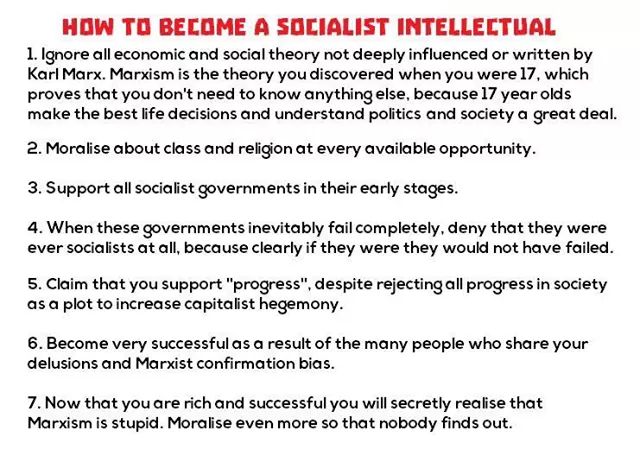
Super-Economy: The class struggle in one picture again
09 Dec 2014 Leave a comment
in applied welfare economics, liberalism, poverty and inequality Tags: Class war, inherent inequality of bargaining power between it, Leftover Left, poverty and inequality

The Guardian review of “Devils’ Alliance” – a response
06 Dec 2014 Leave a comment
in liberalism Tags: Leftover Left, Nazi-Soviet Pact, World War II

The uncomfortable fact for Professor Evans and others on the left is that in those opening two years of World War Two, the Soviet Union was much more practiced than Germany in the sifting, persecution and deportation of subject populations.
We forget perhaps, but at this point the Holocaust had not yet begun.
Hitler may have been an eager student of such matters, but Stalin was very definitely the master.
If there is an “imbalance” in the book therefore, it reflects a historical imbalance, and one with which many on the left are uncomfortable.
via historian at large: The Guardian review of my “Devils’ Alliance” – a response.

Apparently, this is how the Mont Pelerin Society rules the roost!?
05 Dec 2014 Leave a comment
in liberalism, politics - Australia, politics - New Zealand, politics - USA Tags: conspiracy theories, Leftover Left, Mont Pelerin Society, neoliberalism, nutters on the bus, Quacks, vast right-wing conspiracy

Solid lines refer to funding and dashed lines refer to mostly ideological connections
HT: old-rothschild-and-rockefeller-hands-controlled-the-libertarian-communist-dialectic/
The meddlesome preferences of the Green Left
28 Nov 2014 Leave a comment
in liberalism, Marxist economics, politics - Australia, politics - New Zealand, politics - USA Tags: Green Left, Leftover Left, meddlesome preferences

Deirdre McCloskey on the false consciousness of the working class in the Age of Enrichment
25 Nov 2014 Leave a comment


 Utopia, you are standing in it!
Recent Comments