New Zealand’s newspaper chiefs’ views on how the Fair Digital News Bargaining Bill works is somewhat at odds with the text of the Bill. Google today, admirably, said they’ll stop linking to New Zealand news outlets in search if the Bill goes ahead. News Publishers’ Association’s Andrew Holden and Stuff’s Sinead Boucher aren’t happy about that. But…
What planet are they on?
What planet are they on?
09 Oct 2024 Leave a comment
in applied price theory, economics of media and culture, economics of regulation, entrepreneurship, industrial organisation, law and economics, politics - New Zealand, property rights, survivor principle Tags: creative destruction, legacy media
1 page of @DomPost classifieds! Rupert Murdoch once referred to the classifieds as a river of gold.
23 Aug 2018 Leave a comment
in economics of media and culture, industrial organisation, survivor principle Tags: creative destruction, legacy media

Failing firm defence for legacy media mergers
03 May 2017 Leave a comment
in industrial organisation, law and economics, politics - New Zealand Tags: anti-trust law, commerce commission, competition law, creative destruction, failing firm defence, legacy media
There is a large literature on the failing firm defence to merger law. I wrote an Australian Law Journal article about that defence many years ago.
The essence of the argument is that when a firm is to fail, the choice is between a high cost single plant monopoly and a lower cost multi-plant monopoly that absorbs the asset failed firm. For today’s purposes, that would be newspapers that would otherwise close but for the now blocked Fairfax/NZME media merger

Some think allowing mergers of market leaders with failing firms is good for competition.
To get a merger clearance on the basis of the failing firm defence, the merging companies must provide sufficient, compelling evidence that the failing firm will inevitably leave the market without the merger and there is no less anti-competitive alternative.
The basic rationale behind the doctrine is that since the failing firm would have left the market anyway due to its financial collapse, any harm to competition caused by the loss of an independent market player would arise regardless of the merger. Allowing the merger saves scrapping the assets of the failed firm.
Posner and Easterbrook described the failing firm defence as one of the most pernicious doctrines to ever arise in antitrust law. They did not elaborate much.
The existence value of a Kindle library and a real library
24 Dec 2016 Leave a comment
in economics of media and culture Tags: creative destruction, digital libraries, legacy media
I was wondering other day that if we were locked out of our Kindle, which has about 300 books on it, would this be as devastating as if our library of real books was lost such as in a fire. You need to recall a password to sign into a Kindle when upgrading or replacing a damaged unit.

The crux of the matter is you cannot admire your Kindle library from afar, much less show it off to friends when they visit to make yourself look learned.
In common with my Kindle books, I do not plan to reread many of my real books but I would be devastated if they were lost. Knowing that that they are there is a comfort.
I would not be so upset if I lost my Kindle books. Perhaps partly is the Kindle books that I buy I am too cheap to buy unless they are at Kindle prices. I doubt that any of my Kindle books cost more than $10.
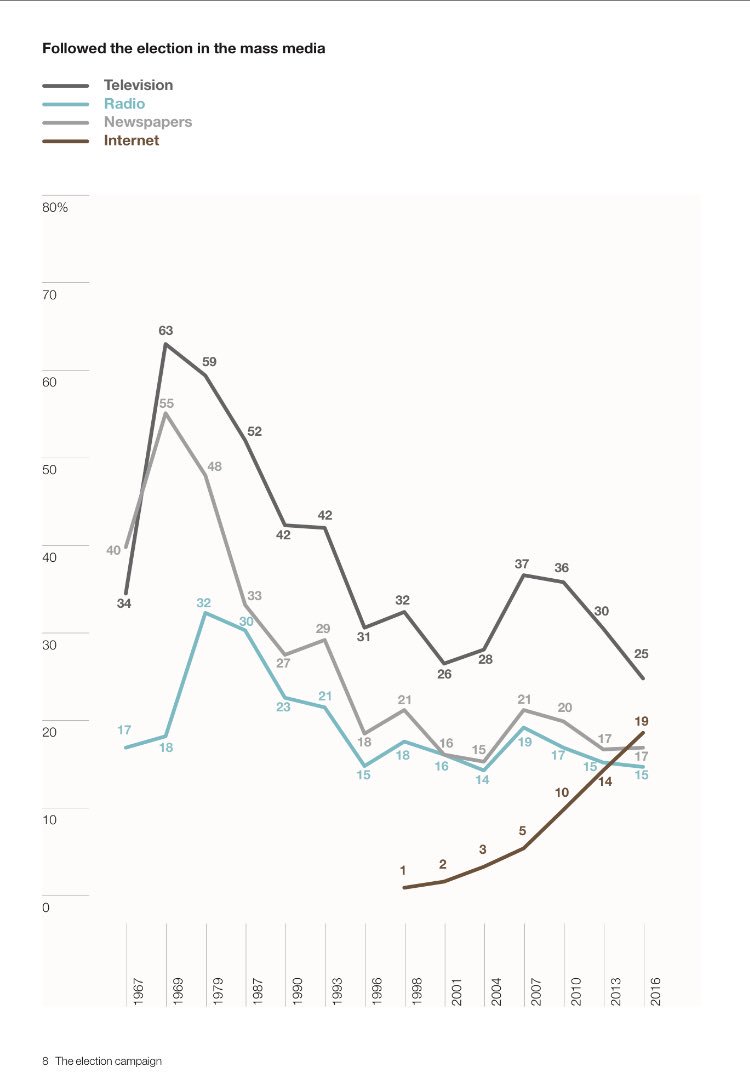
Creative destruction in print media
22 Aug 2016 Leave a comment
in economics of media and culture, industrial organisation, survivor principle Tags: creative destruction, legacy media

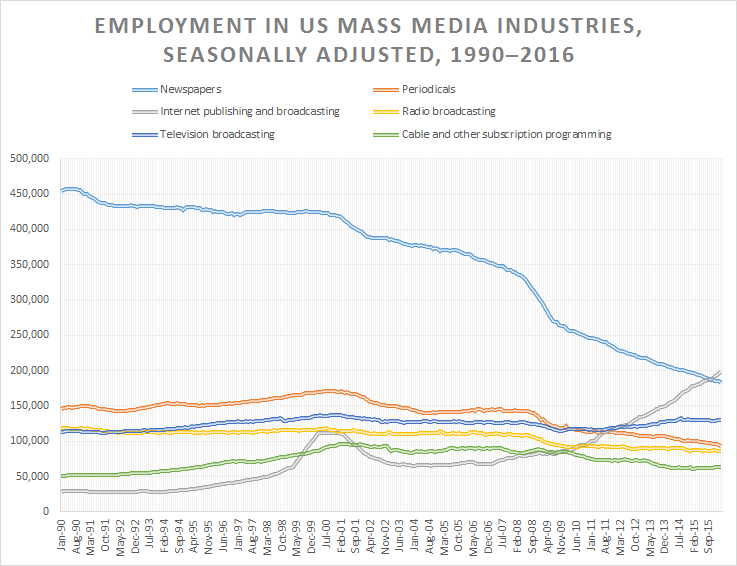
Creative destruction in mass media employment since 1990
09 Jun 2016 Leave a comment
in economic history, economics of media and culture, entrepreneurship, industrial organisation, labour economics, labour supply, occupational choice, survivor principle Tags: entrepreneurial alertness, legacy media, mass media, radio, social media
The Bureau of Labour Statistics chart included books which I took it out along with a few others to confine the information to newspapers and other competitors in the mass media. People still study journalism but more and more go to public relations jobs in government and business.
..
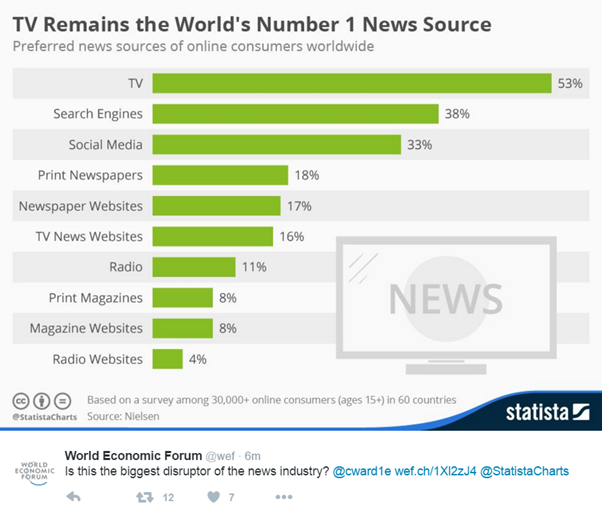

Creative destruction in media share prices
22 Jan 2016 Leave a comment
in economics of media and culture, entrepreneurship, financial economics Tags: creative destruction, legacy media
The ageing of the couch potato
05 Jan 2016 Leave a comment
in economics of media and culture Tags: legacy media
Creative destruction in Ad spending
02 Jan 2016 Leave a comment
in economics of media and culture, industrial organisation, survivor principle Tags: creative destruction, legacy media
 Utopia, you are standing in it!
Recent Comments