Making ends meet on minimum pay – how many working hours are needed to move out of #poverty? oe.cd/12J http://t.co/96g2bUj3Ng—
OECD Publications (@OECD_Pubs) July 09, 2015
Minimum wage scenarios across the OECD
04 Aug 2015 Leave a comment
in labour economics, minimum wage, politics - USA, unemployment Tags: aggressive voting, antimarket bias, living wage, offsetting behaviour, rational ignorance, rational irrationality, The fatal conceit, The pretence to knowledge, unintended consequences
Does a higher minimum wage really reduce employment? econ.st/1gp4Jbs http://t.co/WGMZGLKHmI—
The Economist (@EconBizFin) July 30, 2015
The living wage as an application of Director’s Law
30 Jul 2015 Leave a comment
in income redistribution, labour economics, minimum wage, politics - Australia, politics - New Zealand, politics - USA, population economics, poverty and inequality, Public Choice, rentseeking Tags: British politics, Director's Law, expressive voting, living wage, rational ignorance, rational irrationality
OBR's idea of who will benefit from National Living Wage http://t.co/ztxfW906Gg—
James Bartholomew (@JGBartholomew) July 08, 2015
When I worked at Marxism Today, my desire to earn a living proved to be somewhat déclassé.
26 Jul 2015 Leave a comment
in economics of crime, labour economics, law and economics, Marxist economics, minimum wage, poverty and inequality Tags: far left, Labour standards, Left-wing hypocrisy, Leftover Left, living wage, progressive left

From wisdom to conviction – Paul Krugman on the Card–Kruger study of minimum wages (1998 and now)
18 Jul 2015 1 Comment
in economics of regulation, history of economic thought, labour economics, minimum wage, politics - USA, poverty and inequality Tags: evidence-based policy, living wage, Paul Krugman
This first screenshot is from the New York Times today of Paul Krugman’s current recollection of his interpretation of the Card – Kruger study of minimum wages in restaurants when that study was published all those years ago.
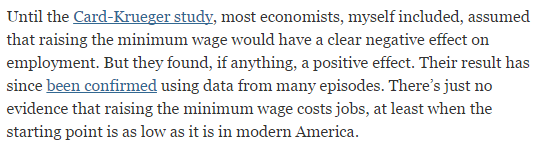
Paul Krugman in his review of Living Wage: What It Is and Why We Need It By Robert Pollin and Stephanie Luce in 1998 was far wiser.
So what are the effects of increasing minimum wages? Any Econ 101 student can tell you the answer: The higher wage reduces the quantity of labour demanded, and hence leads to unemployment. This theoretical prediction has, however, been hard to confirm with actual data.
Indeed, much-cited studies by two well-regarded labour economists, David Card and Alan Krueger, find that where there have been more or less controlled experiments, for example when New Jersey raised minimum wages but Pennsylvania did not, the effects of the increase on employment have been negligible or even positive.
Exactly what to make of this result is a source of great dispute. Card and Krueger offered some complex theoretical rationales, but most of their colleagues are unconvinced; the centrist view is probably that minimum wages “do,” in fact, reduce employment, but that the effects are small and swamped by other forces.
What is remarkable, however, is how this rather iffy result has been seized upon by some liberals as a rationale for making large minimum wage increases a core component of the liberal agenda–for arguing that living wages “can play an important role in reversing the 25-year decline in wages experienced by most working people in America” (as this book’s back cover has it).
Clearly these advocates very much want to believe that the price of labour–unlike that of gasoline, or Manhattan apartments–can be set based on considerations of justice, not supply and demand, without unpleasant side effects.
This will to believe is obvious in this book: The authors not only take the Card-Krueger results as gospel, but advance a number of other arguments that just do not hold up under examination.
The Card– Kruger results have gone from rather iffy in the mind of Paul Krugman to the basis of public policy that, if wrong, costs a lot of low paid workers their jobs. Krugman was well aware in 1998 what a risky path minimum wage increases were:
Now to me, at least, the obvious question is, why take this route? Why increase the cost of labour to employers so sharply, which–Card/Krueger notwithstanding–must pose a significant risk of pricing some workers out of the market, in order to give those workers so little extra income?
Why not give them the money directly, say, via an increase in the tax credit?
Studies of tiny increases in the minimum wage are being used to justify far larger increases in the minimum wage. Krugman was right to be suspect of that in 1998.
Venn Diagram: 1998 Paul Krugman v. 2015 Paul Krugman on the Minimum Wage tinyurl.com/q58ftug @WilliamOccam2 http://t.co/c4DdxqTvwK—
Mark J. Perry (@Mark_J_Perry) July 18, 2015
Krugman’s statements today in the New York Times about the low starting point in modern America for any minimum wage increases is still keeping that slightly cautious tone in his analysis. Few who read his analysis will carry that passing nuance into their own policy advocacy.
Paul Krugman in 1998 was quite astute as to why people want to believe the minimum wage can be increased without any cost to jobs:
One answer is political: What a shift from income supports to living wage legislation does is to move the costs of income redistribution off-budget. And this may be a smart move if you believe that America should do more for its working poor, but that if it comes down to spending money on-budget it won’t.
Indeed, this is a popular view among economists who favour national minimum-wage increases: They will admit to their colleagues that such increases are not the best way to help the poor, but argue that it is the only politically feasible option.
Nor in 1998 was Krugman blind to the expressive politics, the ideological blindness of those who advocate minimum wage increases and living wages:
But I suspect there is another, deeper issue here–namely, that even without political constraints, advocates of a living wage would not be satisfied with any plan that relies on after-market redistribution.
They don’t want people to “have” a decent income, they want them to “earn” it, not be dependent on demeaning hand-outs…
In short, what the living wage is really about is not living standards, or even economics, but morality. Its advocates are basically opposed to the idea that wages are a market price–determined by supply and demand, the same as the price of apples or coal.
It is most unwise to say there is no evidence of minimum wage increases causing unemployment. That sets a low bar of having to find only one or two studies to refute the claim:
1. Taking his claims as true, why do small businesses lobby against raising the minimum wage?
2. Why did Tom Holmes find in his seminal 1999 JPE paper that manufacturing clusters on the Right to Work Side of state borders and avoids the union side of the border?
3. Why did Erin Mansur and I find the same result in our 2013 paper where we build on Holmes’ paper and show that labour intensive manufacturing industries are even more likely to avoid the union side of the border as they are more likely to locate in the adjacent county in the Right to Work State?
4. The Card-Krueger study is certainly important but the variation they used to estimate their effect is tiny relative to the upcoming doubling of the minimum wage up to $15 in cities such as LA and San Fran. How is Dr. Krugman so sure that he can “extrapolate out of sample” to a policy that has never been tried before? Does he have a valid structural model that he can use to conduct such extreme policy counter-factuals?
Karl Popper would be proud of Krugman’s bold and risky prediction that strictly forbids the existence of any studies showing adverse unemployment effects of minimum wage increases.
The thing to remember is, if there is not doubt in the literature, if there are not some mixed results, the econometricians are simply not trying hard enough to win tenure, secure promotion and be published on the top journals.
Low pay across the OECD
18 Jul 2015 Leave a comment
in minimum wage, politics - Australia, politics - New Zealand, politics - USA, poverty and inequality, unions, welfare reform Tags: living wage, low pay, minimum wage
Puerto Rico’s economy can’t handle the federal minimum wage
11 Jul 2015 Leave a comment
in applied price theory, applied welfare economics, Federalism, income redistribution, labour economics, labour supply, minimum wage, politics - USA, Public Choice, rentseeking Tags: federalism, living wage, Puerto Rico, sovereign default
Puerto Rico's economy can't handle the federal minimum wage. bit.ly/1IEJIEi http://t.co/D3mzOmlnJa—
Manhattan Institute (@ManhattanInst) July 07, 2015
A living wage helps well-off households more!
10 Jul 2015 Leave a comment
in applied price theory, applied welfare economics, econometerics, income redistribution, politics - Australia, politics - New Zealand, politics - USA, Public Choice, rentseeking Tags: activists, British economy, British politics, do gooders, expressive voting, living wage, rational ignorance, rational irrationality, The fatal conceit, The pretence to knowledge, unintended consequences
Do Living Wage advocates realise it helps richer households more than poorer ones? My take: telegraph.co.uk/finance/budget… … http://t.co/YPTB6v7tSB—
Fraser Nelson (@FraserNelson) July 10, 2015
Fabian Society and Church of England caught out as hypocrites on London Living Wage of £18,000
06 Jul 2015 Leave a comment
in income redistribution, industrial organisation, labour economics, minimum wage, poverty and inequality, Public Choice, rentseeking, survivor principle Tags: British economy, British politics, Church of England, expressive voting, Fabian Society, hard budget constraints, Left-wing hypocrisy, living wage, market selection


How to argue against employment protection laws while arguing for additional employment regulation
17 Jun 2015 Leave a comment
in human capital, job search and matching, labour economics, labour supply, macroeconomics, minimum wage, unions Tags: climate law, efficiency wage, employment at will, employment protection law, fixed costs of employment, fixed costs of working, flexible working hours, living wage, paid leave, Richard Ebstein
The Centre for American Progress recently published an excellent survey of the costs to employers of hiring and training new recruits. As the paper notes:
it is costly to replace workers because of the productivity losses when someone leaves a job, the costs of hiring and training a new employee, and the slower productivity until the new employee gets up to speed in their new job.
Our analysis reviews 30 case studies in 11 research papers published between 1992 and 2007 that provide estimates of the cost of turnover, finding that businesses spend about one-fifth of an employee’s annual salary to replace that worker.
The purpose of the research published by the Centre for American Progress was to argue there were large costs to employers from replacing even low paid workers and there are a workplace policies such as paid family leave and workplace flexibility will reduce these job turnover costs to employers.
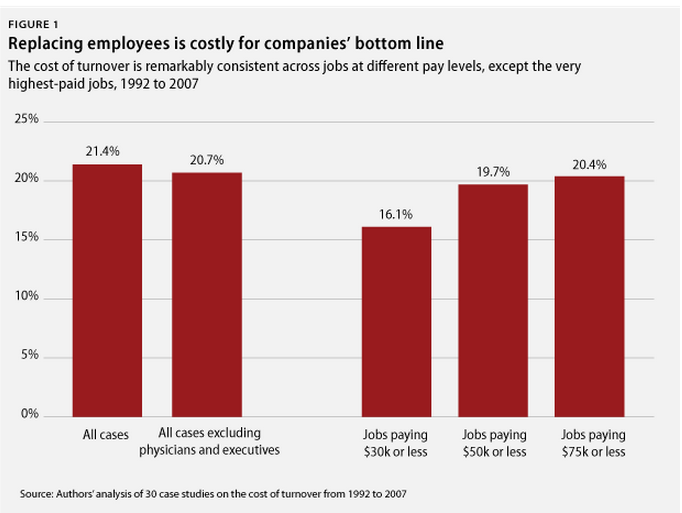
Similar arguments are used to justify a living wage on efficiency grade wage grounds. A living wage would reduce job turnover and therefore the costs to employers of job turnover in the jobs.
The research published by the Centre for American Progress also illustrates the bargaining power of workers. Employers who failed to treat workers fairly and pay them the going wage risk an increase in job quit rates. These large costs of job turnover have been carefully documented by the Centre for American Progress.
Beyond jobs data: Industries w/ better pay have lower worker turnover rates equitablegrowth.org/news/looking-b… http://t.co/gug33EbYy3—
Equitable Growth (@equitablegrowth) July 03, 2015
Employers incur fixed costs of employment when they recruit and train new employees. These recruits must be expected to stay long enough to work sufficient hours for the firm to expect to recover these investments (Oi (1962, 1983a, 1990), Idson and Oi (1999), Hutchens (2010), Hutchens and Grace-Martin (2006)).
These costs are fixed costs because they do not vary with how many hours the employee works or with how long an employee stays with their employer. These fixed employment costs must be recouped over the expected job tenure of the employee with the firm. Employers will not hire an additional worker unless they anticipate recovering the costs of doing do including fixed employment costs and other overheads.
Central to arguments such as by Richard Epstein for employment at will is the threat of the employee to quit imposes a real cost on employers which the employer will seek to avoid by treating their employees well.
The best way to prevent exploitation of workers is to make hiring and firing easy, facilitate new entry by firms into all markets and promote full employment – a worker with other available job opportunities is difficult to exploit.
With large fixed costs of recruitment and training, employers cannot afford to behave whimsically if they wish to survive in competition with the rival firms with more competitive wage and employment policies.
By the same token, the large fixed costs of employment documented by the Centre for American Progress illustrate the large investments employers must risk to recruit a new employee.
If this large investment in recruitment doesn’t turn out well, but is difficult to get out of because of strict employment laws, employers will be more reluctant in the first instance to risk this investment because they are risking several months wages in fixed costs of employment. As Richard Epstein explained:
A second great advantage of the at-will system is that it supplies an informal method of bonding that keeps both sides in line.
The employer who tries to take advantage of the employee by altering working conditions for the worse will be met by the threat to quit, for now the deal is worth less to the employee than the wage received.
So long as markets are competitive the switching costs will be relatively low – lower in fact than they are in a highly regulated world where employers have to think twice before taking on a worker whom they may be unable to fire if things do not work out.
Yet on the other side, the employee who takes it easy on the job is faced with dismissal because he is no longer worth his wages.
But even here management will hesitate to dismiss for good reasons. One is the very substantial costs of recruiting and training a replacement who might or might not turn out to be better than the worker who was dismissed. The second is that unjust dismissals could induce other workers to leave while the going is good, thereby compounding the problem of recruitment and retention.
The Centre for American Progress was good enough to document the very substantial costs of recruiting and training a replacement employee. As the Centre for American Progress explained in their paper, employers have every reason to protect their investments in training and recruitment by minimising job turnover costs.
New Zealand does rather well on many measures of poverty and inequality
05 Jun 2015 Leave a comment
in labour economics, minimum wage, poverty and inequality, welfare reform Tags: child poverty, family poverty, living wage, welfare state
Tough times? On #MayDay, compare % of low-paid #workers in yr country bit.ly/1EFrrV7 #LabourDay http://t.co/jNBrmjcom9—
(@OECD) May 01, 2015
Working for minimum wage? See how your country compares, then read oe.cd/mw2015 ( PDF) #wages http://t.co/DJsLYawtfw—
(@OECD) May 06, 2015
Full-time work on the minimum wage is enough to keep a NZ family out of poverty!
10 May 2015 Leave a comment
in labour economics, minimum wage, politics - Australia, politics - New Zealand, politics - USA, poverty and inequality Tags: capitalism and freedom, child poverty, family poverty, Left-wing hypocrisy, living wage, New Zealand Greens, New Zealand Labour Party, Simon Chapple
Where a 40-hour workweek doesn't lift families from poverty: bloom.bg/1AFOD0q http://t.co/eBoJSz1TkX—
Bloomberg VisualData (@BBGVisualData) May 23, 2015
An OECD chart that shows New Zealand parents only need to work a little over 40 hours a week on the minimum wage to lift a family out of poverty in New Zealand.

The figure above shows that a lone parent with two children needs to work about 25 hours a week stay out of poverty in 2013 in New Zealand Once taxes are taken into account as well as additional family benefits such as in-work tax credits. New Zealand is one of the easiest places in the world to get out of poverty by working part-time for a sole mother.
The figure above from the OECD shows that New Zealand couple with two children needs to work about 40 hours a week to stay out of poverty. Of course, what is poverty depends on the definition of the poverty line and in this case by the OECD, it is defined as 50% of the median wage after taxes and family benefits. Another common definition of poverty is earning less than 60% of the median wage
The minimum wage is $14.75 per hour in New Zealand while proposals for a living wage in New Zealand are now $19.25 an hour. The Labour Party wants to increase the minimum wage to $15 per hour.The Greens want to increase the minimum wage to the living wage.
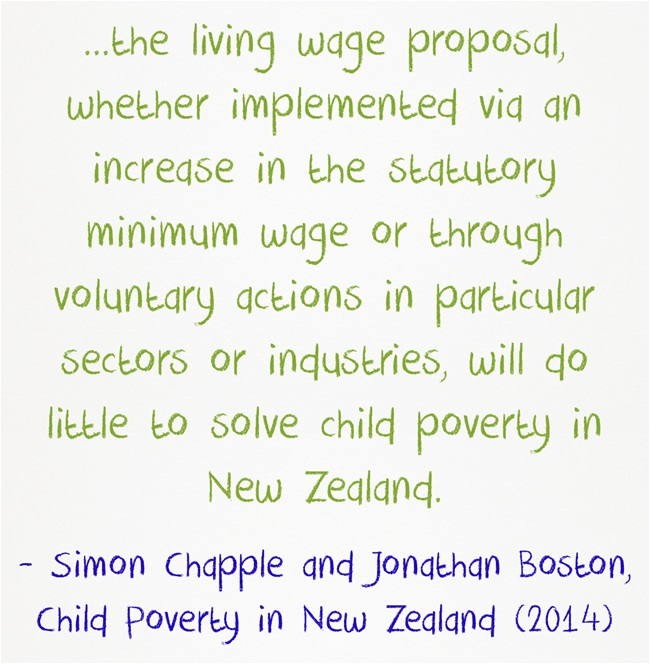
Simon Chapple and Jonathan Boston pointed out in their excellent book last year on child poverty in New Zealand that full-time work by one parent and part-time work by the other in the same household is enough to lift families out of most definitions of poverty:
Sustained full-time employment of sole parents and the fulltime and part-time employment of two parents, even at low wages, are sufficient to pull the majority of children above most poverty lines, given the various existing tax credits and family supports.
The best available analysis, the most credible analysis, the most independent analysis in New Zealand or anywhere else in the world that having a job and marrying the father of your child is the secret to the leaving poverty is recently by the Living Wage movement in New Zealand.
According to the calculations of the Living Wage movement, earning only $19.25 per hour with a second earner working only 20 hours affords their two children, including a teenager, Sky TV, pets, international travel, video games and 10 hours childcare. This analysis of the Living Wage movement shows that finishing school so your job pays something reasonable and marrying the father of your child affords a comfortable family life.
The OECD’s analysis also showed that incentives for New Zealanders to work more and earn more is better than in most countries in terms of what happens if they earn a wage increase.
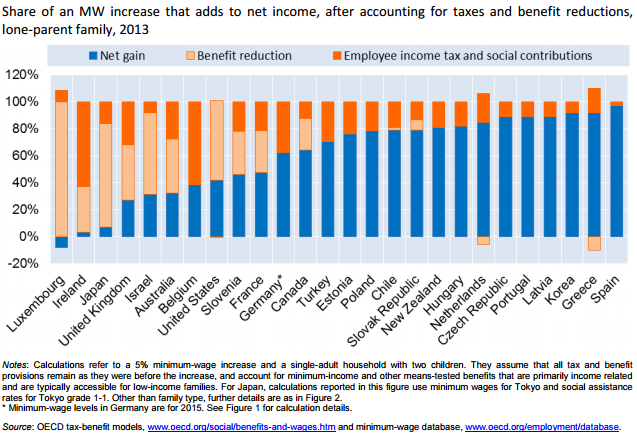
In New Zealand, when there is a 5% minimum wage increase, four percentage points of that wage increase actually stays in the hands of the worker.
In some countries such as Australia, the USA and UK, 60 to 80%of the minimum wage increase is gobbled up in reductions in benefits and taxes. At the same time, the minimum wage increase makes it less profitable for your employer to retain you so your job is more at risk.
The only explanation I have for why the Labour Party, NZ Greens and the living wage movement don’t highlight the success of the existing minimum wage in reducing family poverty in New Zealand is mass kidnappings.
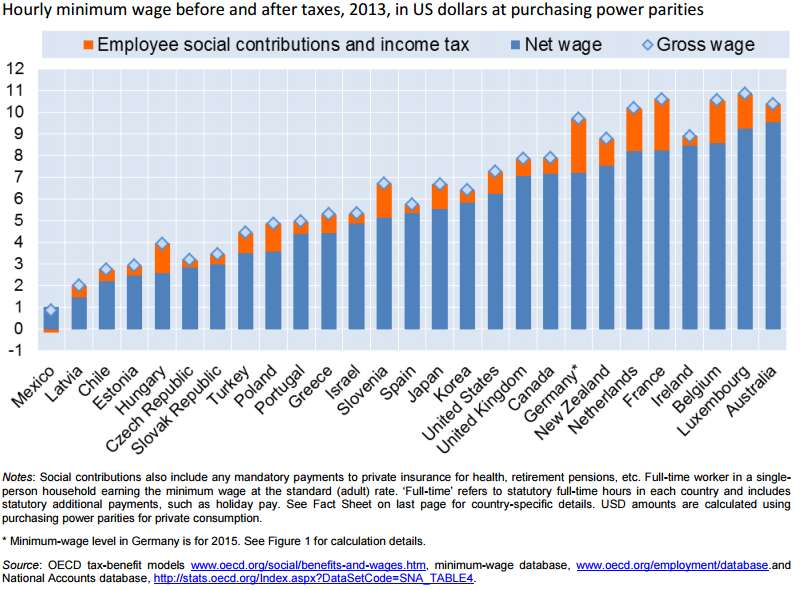
But for these abductions most fowl, I’m sure the Labour Party, NZ Greens and the living wage movement would be dancing in the street celebrating successes of capitalism and freedom in New Zealand in keeping families out of poverty through the minimum wage.
Would a living wage reduce poverty in America?
28 Apr 2015 Leave a comment
in labour economics, minimum wage, politics - Australia, politics - New Zealand, politics - USA, poverty and inequality Tags: labour demographics, living wage, poverty and inequality
 Utopia, you are standing in it!

Recent Comments