Why girls do better at school than boys | The Economist
05 Jun 2018 Leave a comment
in discrimination, economics of education, gender, human capital, labour economics Tags: gender wage gap, lost boys
2015 PISA reverse gender gap in reading, USA, UK, Japan, France, Germany, Canada, Australia and New Zealand
07 Dec 2016 Leave a comment
in economics of education, gender, human capital, labour economics, occupational choice Tags: lost boys, PISA, reverse gender gap
This reading gap is the equal if 6-12 months extra school.for girls.

SOURCE: Organization for Economic Cooperation and Development (OECD), Program for International Student Assessment (PISA), 2015 Reading, Mathematics and Science Assessment.
The reverse gender gap in education is worst at the bottom
24 Dec 2015 Leave a comment
in economics of education Tags: lost boys, reverse gender gap
The trouble with boys
31 Aug 2015 1 Comment
in applied welfare economics, labour economics, politics - Australia, politics - New Zealand, politics - USA, welfare reform Tags: economics of the family, lost boys, reversing gender gap, single mothers, single parents
The Trouble w Boys: U Chicago study: boys fr non-intact homes esp likely to struggle in school nber.org/papers/w17541 http://t.co/31xyA4BVQH—
W Bradford Wilcox (@WilcoxNMP) June 18, 2015
Low performers in maths by gender, USA, UK, Japan, Canada, Australia and New Zealand
17 Jul 2015 Leave a comment
in discrimination, economics of education, gender, human capital, labour economics Tags: cognitive psychology, educational psychology, lost boys, PISA, Psychology, reversing gender gap
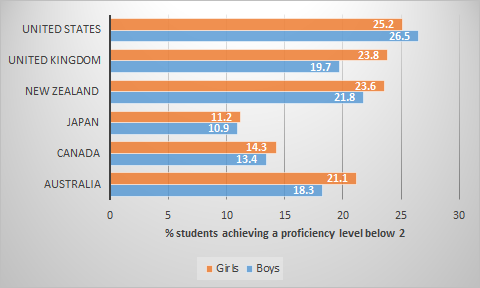
Figure 1: % of students achieving a proficiency level below 2 in maths by gender, USA, UK, New Zealand, Japan, Canada and Australia, 2012
Source: OECD StatExtract.
Share of university degrees conferred to U.S. women since 1970
16 Jul 2015 Leave a comment
in economic history, economics of education, human capital, labour economics, occupational choice, politics - USA Tags: lost boys, reversing gender gap
Share of university degrees conferred to U.S. women since 1970 (via @MaxCRoser) http://t.co/FUGrM7WbJd—
Claire Lehmann (@clairlemon) July 09, 2015
Low performers in science by gender, USA, UK, Japan, Canada, Australia and New Zealand
16 Jul 2015 Leave a comment
in discrimination, economics of education, gender, labour economics, labour supply Tags: cognitive psychology, educational psychology, lost boys, PISA, Psychology, reversing gender gap
Figure 1: % of students achieving a proficiency level below 2 in science by gender, USA, UK, New Zealand, Japan, Canada and Australia, 2012

Source: OECD StatExtract.
Low performers in reading by gender, USA, UK, Japan, Canada, Australia and New Zealand
15 Jul 2015 1 Comment
in discrimination, economics of education, gender, human capital, labour economics Tags: cognitive psychology, education, lost boys, PISA, Psychology, reversing gender gap
Figure 1: % of students achieving a proficiency level below 2 in reading by gender, USA, UK, New Zealand, Japan, Canada and Australia, 2012

Source: OECD StatExtract.
Top performers in science by gender, USA, UK, Japan, Canada, Australia and New Zealand
02 Jul 2015 Leave a comment
in discrimination, economics of education, gender, human capital, labour economics Tags: Australia, British economy, Canada, Japan, lost boys, reversing gender gap
Why are Japanese 15-year-old girls as good at science as teenagers anywhere else in the world?
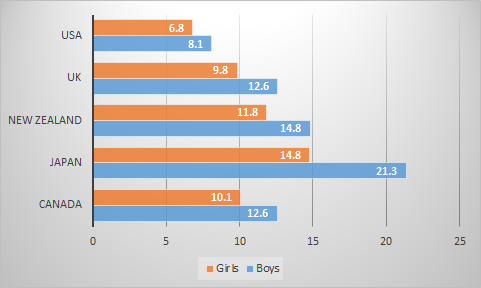
Figure 1: Percentage achieving the proficiency level 5 or higher in sciences by gender, USA, UK, Japan, Canada, Australia, New Zealand, 2012
Source: OECD StatExtract.
Top performers in maths by gender, USA, UK, Japan, Canada, Australia and New Zealand
01 Jul 2015 5 Comments
in economics of education, gender, human capital, labour economics Tags: Australia, British economy, Canada, Japan, lost boys, reversing gender gap
Figure 1: Percentage achieving the proficiency level 5 or higher in mathematics by gender, USA, UK, Japan, Canada, Australia, New Zealand, 2012

Source: OECD StatExtract.
Top performers in reading by gender, USA, UK, Japan, Canada, Australia and New Zealand
30 Jun 2015 Leave a comment
in discrimination, economics of education, gender, human capital, labour economics Tags: Australia, British economy, Canada, Japan, lost boys, reversing gender gap
Figure 1: percentage achieving the proficiency level 5 or higher in reading by gender, USA, UK, Japan, Canada, Australia, New Zealand, 2012

Source: OECD StatExtract.
The reversing gender gap in one chart
11 Jun 2015 Leave a comment
in discrimination, economics of education, gender, human capital, labour economics, labour supply, occupational choice, poverty and inequality Tags: gender wage gap, lost boys, reversing gender gap
Gender gap in bachelor's is 6 percentage points. Men now where women were a decade ago.
nces.ed.gov/programs/diges… http://t.co/u9rAsIcfY0—
S Dynarski (@dynarski) June 01, 2015
But why would girls want to sit in a corner playing chess?
20 Apr 2015 Leave a comment
in economics of education, human capital, labour economics, occupational choice Tags: chess, economics of personality traits, lost boys, reversing gender gap
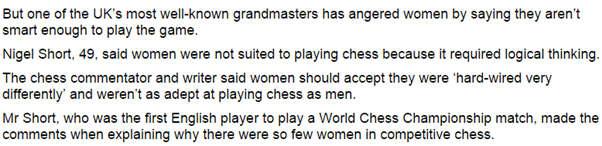
For a logical thinker, chess grandmaster Nigel Short missed the obvious move. Teenage girls have better things to do with their talents and in particular their superior reading skills than gaze over a chess board.
The 30 point advantage that 15-year-old girls have in reading scores in the PISA test – see the chart below – is equal to an extra six months schooling. Six months extra schooling explains many a gender and ethnic wage gap.

Having being a member of a few chess clubs, and run chess clubs and large chess tournaments, there are an unusual number of oddballs, eccentrics and mentally ill people who play chess.

The systematic evidence of a greater incidence of learning disorders, Asperger’s syndrome as well is bipolar disorders among teenage boys all encourage teenage boys to focus on chess if only to give an outlet to their obsessive behaviours.

It is for the same reason that socially awkward teenage boys may be attracted to computer programming if they have various obsessional disorders.
Who-d a-Thunk It? The new OECD Report on 15-Year Olds in 60+ Countries Finds Significant Gender Differences? http://t.co/X2rGVygPwF—
Mark J. Perry (@Mark_J_Perry) March 11, 2015
 Utopia, you are standing in it!
Recent Comments