The political proclivities of different occupations

popup-v2

via popup-v2 » Sociological Images.

What does the media and Left give top athletes a pass on their membership of the top 0.1%?

Charles Krauthammer on what conservatives and liberals think of each other

HT: Charles Krauthammer

New low for economic analysis of NZ opposition leader and Dominion Post editorial on housing affordability

The editorial in today’s Dominion Post about the proposed reforms in New Zealand to the Resource Management Act to increase of urban land supply and make housing more affordable actually supported some absolute nonsense economic analysis by the Leader of the Opposition, Andrew Little:

Labour leader Andrew Little says part of the problem is in fact low and in many areas stagnating wages.

That is correct, but this merely points to a huge problem that successive governments have failed to solve. Nor is this Government likely to do much by way of living wage reforms or other non-market solutions.

The alleged professional journalist who wrote this editorial is ignorant of the most basic workings of the economy which he could pick up as an ordinary consumer and home owner.

If consumers become wealthier because of higher wages, they will use this increased income to demand more housing and land.

If the supply of land is fixed or otherwise constrained from expanding much, the only thing that will happen is that the price will go up with more money chasing the same amount of land and housing.

This will benefit the existing home owners in New Zealand. Workers who don’t own homes will simply have to pay more of their now higher wages to buy houses. Once again, the Labour Party betrays the interests of the working class to win middle-class home owner votes.

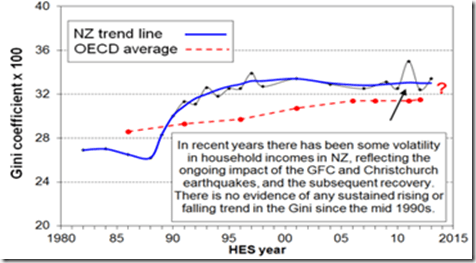
Media completely missed this report in the lead-up to 2014 election: Rich-poor gap not growing in New Zealand and hasn’t for 20 years

Figure 1: Gini coefficient New Zealand 1980-2015
clip_image004

Source: Bryan Perry, Household incomes in New Zealand: Trends in indicators of inequality and hardship 1982 to 2013. Ministry of Social Development (July 2014).

Figure 2: Real household incomes (BHC), changes for top of income deciles, 1994 to 2013

clip_image002[7]

Source: (Perry 2014).

Figure 3: Real equivalised median household income (before housing costs) by ethnicity, 1988 to 2013 ($2013).

clip_image002[9]

Source: (Perry 2014).

Figure1A

HT: http://www.listener.co.nz/current-affairs/new-deal-for-kids/

HT: http://i.stuff.co.nz/business/industries/10244667/Rich-poor-gap-not-growing-report

The political bias of selected professions

These graphs show the contributions by individual donors in each industry to political candidates

via http://blog.crowdpac.com/post/101785128940/the-political-bias-of-each-profession

UK’s Sky News Loses It After Charlie Hebdo Writer Holds Up Mohammed Cover On-Air | National Review Online

UK’s Sky News Loses It After Charlie Hebdo Writer Holds Up Mohammed Cover On-Air | National Review Online.

Media bias and audience bias

Image

Who is watching which American media?

Ideological Composition of News Sources’ Audiences

Image

The perennial gale of creative destruction at work: those all-powerful television networks

hickey-datalab-emmy-1


hickey-datalab-emmy-4

Media conspiracies versus cartel theory

Media conspiracy theories suggest someone is in control; that dark, all-powerful cabals of men in cultish robes control the world. The truth is no one is in control. What about 57 channels, nothing on!

Newspapers, TV and cable, are not a monopoly. A monopoly is a single seller of as product with a legal right to bar new entry. It is an exclusive right to sell something.

At best, newspapers, TV and cable, are a large and unwieldy cartel under pressure from costs and new entry. The Internet makes electronic news competition global.

There are many different Australian news outlets and media types, three national networks, plus many cable news networks and 9 media owners. That is more than enough to destabilise any cartel.

Why is the mass media special? A supply-side model of media ownership suggesting that media outlets weigh the rewards of bias—political influence or personal pleasure—against the cost of bias—lost circulation from providing faulty news.

The mass media is a big business, and they increase readership and revenue by presenting factual and informative news.

The most likely to turn-off are women, and women vote to the Left more often than do men. The media is perhaps pandering to this centre-left marginal buyer.

A news cartel is like any other cartel. All cartels break-down and only some get back together.

Cartels contain seeds of their own destruction. Cartel members are reducing their output below their existing potential production capacity, and once the market price increases, each member of the cartel has the capacity to raise output relatively easily.

All cartels must decide how to allocate the reduction of output that follows the price increases across members with different costs structures and spare capacity.:

  • The tendency is for cartel members to cheat on their production quotas, increasing supply to meet market demand and lowering their price.
  • Most cartel agreements are unstable and at the slightest incentive they will quickly disband, and returning the market to competitive conditions.

One sign of a cartel that was developed by Aaron Director is periods of stable prices, despite cost fluctuations, followed by sudden price changes when the cartel collapses or decide to increase prices.

For a news cartel, this means toeing the line and then periods of truth, and then a sudden return to the party line when the cartel starts-up again.

The exercise of collective market power will not be stable unless sellers agree on prices and production shares; on how to divide the profits; on how to enforce the agreement; on how to deal with cheating; and on how to prevent new entry.

A cartel is in the unenviable position of having to satisfy everyone, for one dissatisfied producer can bring about the feared price competition and the disintegration of the cartel.

Thus a successful cartel must follow a policy of continual compromise. Little wonder that John. S McGee wrote that:

The history of cartels is the history of double crossing

Competition as a force for media accuracy or infotainment

Limiting the number of TV stations has unusual effects on media slant and muckraking.

Tyler Cowen argues that competition by itself is not a powerful force for media accuracy.

In the traditional conception of the demand for news, audiences read, watch, and listen to the news in order to get information. The quality of news is its accuracy.

But when there are many media outlets, competition results in a common slanting of news towards reader biases in the audience niche each network are serving. The market is very good are serving up what the customer wants.

Competition forces news outlets to cater to their customer’s niche preferences.

  • Realised profit is the criterion by which the market process selects survivors: those who realise positive profits survive; those who suffer losses disappear.
  • Positive profits accrue to those news outlets who are better than their competitors. These lesser rivals will exhaust their retained earnings and fail to attract further new investor support.

On topics where reader beliefs diverge on politically divisive issues, media outlets profit from segmenting the market and slanting reports to the biases of their niche audiences.

There is less bland truth-telling and more of the polemics that each market niche wants.

This means that left-wing and right-wing media outlets will hound the political enemies of their readers to cater to the preferences of their audience niche.

The clearest illustration of infotainment is the Lewinsky affair:

  • The left wing press presented information designed to excuse Clinton’s sins; and
  • The right wing press dug out details pointing to his culpability.

When there are only a few media outlets, the networks instead go for the median viewer/reader and offer more sedate and less scandal driven coverage.

More media competition increases the chances of the muckraking that brings down ministers and governments.

Those subservient press barons

Both political parties used television licensing and the threat of cable TV to manipulate Murdoch, Packer and the other press barons. They were victims of Fred McChesney’s concept of rent extraction:

  • Rent extraction is the politician’s pastime of threatening harmful legislation to extract political support and contributions from well-heeled private institutions.
  • Payments to politicians are often made not for political favours, but to avoid political disfavour, that is, as part of a system of political extortion or rent extraction.

Rent extraction is money for nothing – money paid in exchange for politicians’ inaction.

The politician is paid, not for rent creation, but for withholding legislative and regulatory action that would destroy existing private rents.

McChesney establishes the conditions under which of rent creation or extraction will occur. The relative attractiveness of the two strategies depends on the elasticities of demand and supply.

  • If demand is relatively inelastic, rent creation will occur; and
  • If supply is relatively inelastic, rent extraction will occur.

The existence of an organization or a large established firm lowers transaction costs for the politicians negotiating and collecting donations and support, making rent expropriation threats easier.

It is hard to extort rents from those with little in the way of organisation. A cost of being an established lobbying organisation or a large firm with high fixed costs is a greater potential for rent extraction.

The print and electronic media are ripe for rent extraction because of their immobile assets and heavy regulation.

Investors in heavily regulated capital intensive industries such as the mass media, digital and print, do not bite the hand the feeds them.

Little wonder that the media barons were honoured supplicants to whomever is in power in Canberra. They are soon Labor’s business mates whenever Labor was in power.

Threatening to allow cable TV was the big stick in every Australian government’s hand until the 1990s to extract support or at least subservience from the media.

Rupert Murdoch has unashamedly backed political winners, only to dump them when he was convinced that they were washed up or that his newspapers might be left stranded on the losing side of politics.

Murdoch’s see-sawing political stances are entirely pragmatic. He has always been prepared to back winners just before they win, and to shift allegiances on non-ideological grounds.

How biased is the Australian media?

Camped firmly over the middle-ground. Sorry to disappoint.


Leigh and Gans in "How Partisan is the Press? Multiple Measures of Media Slant" in The Economic Record 2012 employed several different approaches to find that the Australian media are quite centrist, with very few outlets being statistically distinguishable from the middle of Australian politics.

The minor exceptions were ABC Channel 2 and perhaps the Melbourne Age in its news slant in the 2004 election. Their media slants were small.

Australian newspapers tended to endorse the Liberal-National coalition in the federal elections from 1996 to 2007 although The Australian, right-wing rag that it is, backed the Labor Party in 2007! I agree that this was a serious lapse of judgement.

Another lapse is the editorial of April 6, 1995, where the Australian said: "The scientific consensus that global warming is occurring unnaturally, primarily as a result of industrial development and deforestation, is no longer seriously disputed in the world." Murdoch’s paper supports global action on climate change based on science.

The editorial endorsements series should have been longer in the analysis of Leigh and Gans because some newspapers back winners just before they become winners and oppose the re-election of tired and smelly governments that have being there too long no matter what their party.

The results of Leigh and Gans should come as no surprise. Newspapers that are out of tune with their readers lose sales and risk going broke. Plenty of newspapers are losing money these days because of the digital revolution in media. There is no scope left to indulge the political preferences of the owners at the expense of circulation. Margaret Simons got it right when she said:

The market is too small to support newspapers that don’t play to the centre ground … In a marketplace full of bland centrist publications and carefully mixed stables of commentators, small deviations can look extreme.

For links discussing the quality of the analysis of Leigh and Gans, see http://offsettingbehaviour.blogspot.co.nz/2009/09/measuring-media-bias-in-oz.html and http://economics.com.au/?p=4226 for Gans’ rely to http://andrewnorton.info/2009/09/02/can-public-intellectuals-be-used-to-assess-partisan-media-slant/

Is there media bias?

A leading characteristic of media bias is that people agree on its existence, but disagree on its manifestation.

The print media is under dire threats to its existence at the moment. A newspaper that ignores what its readers want does so only at great peril.

Armen Alchian and George Stigler both argued that realised profits are the criterion by which the market process selects survivors: those who realise positive profits survive and will grow their market share; those who suffer losses will eventually disappear unless they improve themselves. The surviving media outlets will be those firms that anticipated or adapted fastest to the current and future demands of their readers and viewers.

Any media bias is likely to be slightly to the centre-left for the following reasons:

  1. Young women tend to be one of the most marginal groups of news consumers (i.e., they are the most willing to switch to activities besides reading or watching the news).
  2. Young women often make more of the consumption decisions for the household so advertisers will pay more to reach this group.
  3. Since young women tend to be more centre-left, on average, a news outlet may want to slant its coverage that way. Media sell space to advertisers and tailor the way they cover politics to gain more readers and viewers.

Puglisi and Snyder found that:

  • Using endorsements of state-level initiatives and referendums, newspapers are located almost exactly with the median voter – the average voter – in their home states.
  • Newspapers are moderate relative to interest groups and political parties.
  • Although newspapers exhibit some variation in their ideological position, they tend to be much closer to the median voter than most interest groups.
  • Newspapers appear to be more liberal than voters on social and cultural issues such as gay marriage, but tend to be more conservative on economic issues such as the minimum wage.
  • On average, the news and editorial sections have almost identical partisan positions.

Positive profits accrue to media outlets that are better at serving their readers and viewers than their competitors. Their lesser rivals will lose money, exhaust their retained earnings and fail to attract further investor support.

There is no best practice on measuring media bias. The literature is too young. Milton Friedman put up robustness as his test. Hit the hypothesis with as many tests as possible with many different data sets.

Most studies using many different data sets and methodologies suggest that the media reflects the politics of the market they serve. Newspapers and TV stations are big businesses, and they increased readership, ratings and revenue by presenting factual and informative news with a dose of ‘infotainment’. 

Competition forces news media outlets, just like any other firm, to cater to their customers’ preferences. Why did anyone think the media industry was any different from any other?

Next Newer Entries

Bassett, Brash & Hide

Celebrating humanity's flourishing through the spread of capitalism and the rule of law

Truth on the Market

Scholarly commentary on law, economics, and more

The Undercover Historian

Beatrice Cherrier's blog

Matua Kahurangi

Celebrating humanity's flourishing through the spread of capitalism and the rule of law

Temple of Sociology

Celebrating humanity's flourishing through the spread of capitalism and the rule of law

Velvet Glove, Iron Fist

Celebrating humanity's flourishing through the spread of capitalism and the rule of law

Why Evolution Is True

Why Evolution is True is a blog written by Jerry Coyne, centered on evolution and biology but also dealing with diverse topics like politics, culture, and cats.

Down to Earth Kiwi

Celebrating humanity's flourishing through the spread of capitalism and the rule of law

NoTricksZone

Celebrating humanity's flourishing through the spread of capitalism and the rule of law

Homepaddock

A rural perspective with a blue tint by Ele Ludemann

Kiwiblog

DPF's Kiwiblog - Fomenting Happy Mischief since 2003

The Dangerous Economist

Celebrating humanity's flourishing through the spread of capitalism and the rule of law

Watts Up With That?

The world's most viewed site on global warming and climate change

The Logical Place

Tim Harding's writings on rationality, informal logic and skepticism

Doc's Books

A window into Doc Freiberger's library

The Risk-Monger

Let's examine hard decisions!

Uneasy Money

Commentary on monetary policy in the spirit of R. G. Hawtrey

Barrie Saunders

Thoughts on public policy and the media

Liberty Scott

Celebrating humanity's flourishing through the spread of capitalism and the rule of law

Point of Order

Politics and the economy

James Bowden's Blog

A blog (primarily) on Canadian and Commonwealth political history and institutions

Science Matters

Reading between the lines, and underneath the hype.

Peter Winsley

Economics, and such stuff as dreams are made on

A Venerable Puzzle

"The British constitution has always been puzzling, and always will be." --Queen Elizabeth II

The Antiplanner

Celebrating humanity's flourishing through the spread of capitalism and the rule of law

Bet On It

Celebrating humanity's flourishing through the spread of capitalism and the rule of law

History of Sorts

WORLD WAR II, MUSIC, HISTORY, HOLOCAUST

Roger Pielke Jr.

Undisciplined scholar, recovering academic

Offsetting Behaviour

Celebrating humanity's flourishing through the spread of capitalism and the rule of law

JONATHAN TURLEY

Res ipsa loquitur - The thing itself speaks

Conversable Economist

Celebrating humanity's flourishing through the spread of capitalism and the rule of law

The Victorian Commons

Researching the House of Commons, 1832-1868

The History of Parliament

Articles and research from the History of Parliament Trust

Books & Boots

Reflections on books and art

Legal History Miscellany

Posts on the History of Law, Crime, and Justice

Sex, Drugs and Economics

Celebrating humanity's flourishing through the spread of capitalism and the rule of law

European Royal History

Exploring the Monarchs of Europe

Tallbloke's Talkshop

Cutting edge science you can dice with

Marginal REVOLUTION

Small Steps Toward A Much Better World

NOT A LOT OF PEOPLE KNOW THAT

“We do not believe any group of men adequate enough or wise enough to operate without scrutiny or without criticism. We know that the only way to avoid error is to detect it, that the only way to detect it is to be free to inquire. We know that in secrecy error undetected will flourish and subvert”. - J Robert Oppenheimer.

STOP THESE THINGS

The truth about the great wind power fraud - we're not here to debate the wind industry, we're here to destroy it.

Lindsay Mitchell

Celebrating humanity's flourishing through the spread of capitalism and the rule of law

Alt-M

Celebrating humanity's flourishing through the spread of capitalism and the rule of law

croaking cassandra

Economics, public policy, monetary policy, financial regulation, with a New Zealand perspective

The Grumpy Economist

Celebrating humanity's flourishing through the spread of capitalism and the rule of law

International Liberty

Restraining Government in America and Around the World