
In the good old days, everyone agreed on the employment effects of minimum wage laws, even their supporters
28 Nov 2014 Leave a comment
How to argue against the minimum wage when genuinely trying to argue for it – OECD edition
08 Nov 2014 Leave a comment
in labour economics, minimum wage, Public Choice Tags: living wage, minimum wage, social cost of the minimum wage, The fatal conceit, The pretence to knowledge

The 2014 OECD employment outlook argued for modest minimum wage increases while at the same time setting out all the steps necessary to manage the unintended consequences of minimum wage regulation:
Mandatory minimum wages, which now exist – or are being implemented – in 26 OECD countries and a number of emerging economies, can help underpin the wages of low-paid workers.
Evidence suggests that, when set at an appropriate level, minimum wages tend to have only a small adverse effect on employment.
Sensible minimum-wage design includes: taking account of differences by region according to the average income level, as well as by age in experience and productivity; ensuring that the level and adjustments of the minimum wage involve independent commissions; and reducing social security contributions to lower non-wage labour costs at the minimum wage (Emphasis mine).
George Stigler made very similar criticisms of the impracticality of a single minimum wage in 1946:
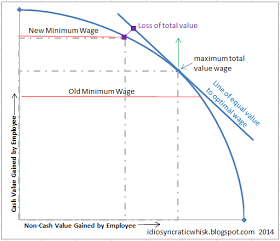
If an employer has a significant degree of control over the wage rate he pays for a given quality of labour, a skilfully-set minimum wage may increase his employment and wage rate and, because the wage is brought closer to the value of the marginal product, at the same time increase aggregate output…
This arithmetic is quite valid but it is not very relevant to the question of a national minimum wage. The minimum wage which achieves these desirable ends has several requisites:
1. It must be chosen correctly… the optimum minimum wage can be set only if the demand and supply schedules are known over a considerable range…
2. The optimum wage varies with occupation (and, within an occupation, with the quality of worker).
3. The optimum wage varies among firms (and plants).
4. The optimum wage varies, often rapidly, through time.
A uniform national minimum wage, infrequently changed, is wholly unsuited to these diversities of conditions
Modest minimum wage increases must varying in their modesty by individual worker quality, occupation, region, firm and plant and the extent to which this modesty can be excessively immodest can change rapidly through time. Little wonder that the OECD refers to minimum wage regulation as a careful balancing act.

In sum, to avoid throwing a good number of low paid, low skilled workers onto the scrapheap of society for the sake of their more employable co-workers, the minimum wage pretty much be set separately for each individual worker. The labour market does that now.
The Best Minimum Wage Story Of The Day, Or, Yes, Wage Rises Really Do Kill Jobs
30 Oct 2014 Leave a comment
in labour economics, minimum wage, unemployment, unions Tags: living wage, minimum wage

Coalition Celebrating Equal Pay Case Outcome
29 Oct 2014 Leave a comment
in applied price theory, applied welfare economics, economics of regulation, gender, income redistribution, minimum wage, politics - New Zealand, rentseeking Tags: gender wage gap, living wage, minimum wage, pay equity
I wonder who will pay for this? Caregiver wages are funded out of a fixed budget allocated by the government.
A higher wage will change the type of worker that the caregiving sector will seek to recruit, as happened after increases in the teenage went minimum wage.
When the teenage minimum wage went up in New Zealand, employment of 17 and 18-year-olds fell, while the employment of 18 to 19-year-olds increased because the latter were more mature and reliable than the younger contemporaries.

Media release: Pay Equity Challenge Coalition
28 October 2014
Coalition Celebrating Equal Pay Case Outcome
“The Court of Appeal’s decision declining the employers’ appeal in the Kristine Bartlett case is a huge victory for women workers” said Pay Equity Coalition Challenge spokesperson Angela McLeod.
“The Courts’ decision that equal pay may be determined across industries in female-dominated occupations revitalises the Equal Pay Act 1972 and will be a major factor in closing New Zealand’s stubborn 14 percent gender pay gap”.
The judgement by the Court of Appeal upholding the Employment Court decision again validates the work of caregivers and that they are underpaid, she said.
“We commend the Service and Food Workers Union Nga Ringa Tota in taking this case and exposing the underpayment and undervaluation of aged care workers. And the decision is a victory for all the women’s organisations who have never given up fighting for equal pay,”…
View original post 92 more words
Not too long ago, the left promoted the pointlessness of minimum wage – Whale Oil Beef Hooked
29 Oct 2014 Leave a comment
in applied price theory, applied welfare economics, economics of regulation, labour economics, Marxist economics, minimum wage Tags: minimum wage

Paul Krugman (1998) on the fiscal politics of the minimum wage/living wage movement
19 Oct 2014 Leave a comment

The labour demographics of a NZ living wage
17 Oct 2014 Leave a comment
in labour economics, minimum wage, politics - New Zealand Tags: living wage, minimum wage
Distribution of families earning below the Living Wage
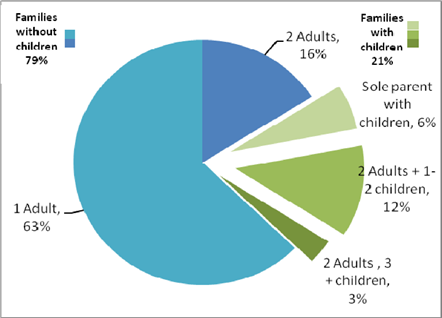
Source: Taxwell
The wage rates of people of different ages
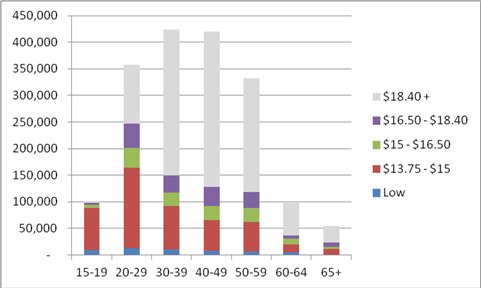
Source: Taxwell
The distribution of wages by industry
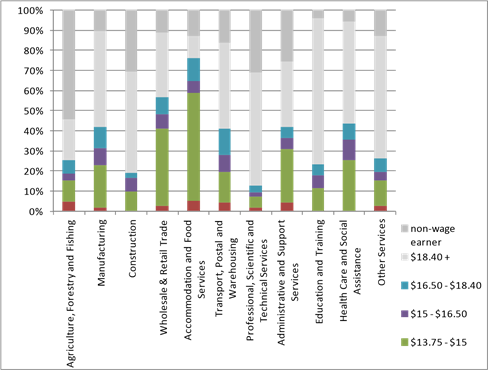
Non-wage earners is mainly self employed. Source: Taxwell
NZ’s proposed Living Wage compared to other Living Wage proposals
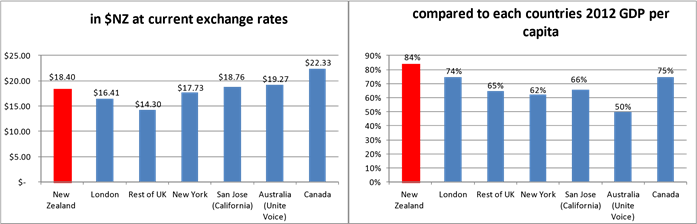
Source: Living Wage campaign websites, and exchange rates as at 20 September 2013
- The Living Wage proposal is an ineffective way to help families with low incomes, because:
- Many low income earners are people below the age of 30 who are single or part of a childless couple;
- The extra earnings by parents would result in reduced tax credits or benefit payments (as they abate with higher income).
- If adopted as a minimum wage, New Zealand would be out of line with other countries, and it is likely to reduce employment, particularly of younger people trying to enter the labour market.
- The overall impact on poverty levels is likely to be small, but it would represent a change of focus from supporting families with children towards supporting young, single people.
General source: The Treasury Living Wage Information Release
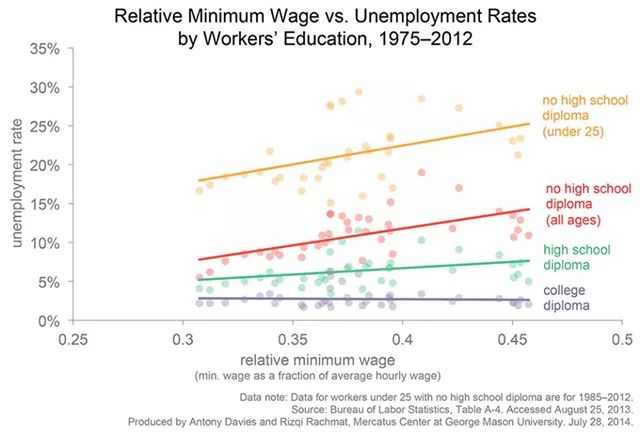
@arindube Paul Krugman on the minimum/living wage in 1998
17 Oct 2014 1 Comment
in applied price theory, applied welfare economics, labour economics, minimum wage Tags: minimum wage, Paul Krugman

A response to Judith Sloan on monopsony
11 Oct 2014 Leave a comment
in economics, labour economics, minimum wage Tags: Alan Manning, minimum wage, monopsony, search and matching
In the monopsony view view, search frictions in the labour market generate upward sloping labour supply curves to individual firms even when firms are small relative to the labour market.
Peter Kuhn in a great review of monopsony in motion pointed out the correct title was search fictions with wage posting and random matching in motion.This precision is important because, as Kuhn goes on to say:
“Manning clearly recognizes this weakness of search-based monopsony models, and does his best to address it in his discussion of ‘random’ vs. ‘balanced’ matching on pages 284–96. Manning’s basic general-equilibrium monopsony model, set out in chapter 2, assumes ‘random matching’, which means that, regardless of its size, every firm—from the local bakery to Microsoft—receives the same absolute number of job applications per period. The only way for a firm to expand its scale of operations in this model is to offer a higher wage… it is absolutely critical to the search-based monopsony model at the core of this book that there be diminishing returns to scale in the technology for recruiting new workers. In other words, for the theory to apply, firms must find it harder to recruit a single new worker the larger the absolute number of workers they currently employ.”
The evidence in favour of the monopoly view of minimum wage is is not as good as people think.
Under this monopsony view of minimum wages – an upward sloping supply curve of labour – an increase in the minimum wage increases both wages and employment.
That is, there is a very specific joint hypothesis of both more employment and more wages and as there are more workers in the workplace, higher output which the employer can only sell by cutting their prices.
David Henderson made very good points along this line when he reviewed David Card’s book back in 1994:
Interestingly, Card’s and Krueger’s own data on price contradict one of the implications of monopsony. If monopsony is present, a minimum wage can increase employment. These added employees produce more output. For a given demand, therefore, a minimum wage should reduce the price of the output. But Card and Krueger find the opposite. They write: ‘[P]retax prices rose 4 percent faster as a result of the minimum-wage increase in New Jersey…’ (p. 54). If their data on price are to be believed, they have presented evidenceagainst the existence of monopsony. David R. Henderson, “Rush to Judgment,”MANAGERIAL AND DECISION ECONOMICS, VOL. 17, 339-344 (1996)

Minimum Wage Hikes Hurt Job-Keepers
29 Sep 2014 Leave a comment
in labour economics, minimum wage, occupational choice Tags: compensating differentials, minimum wage
Idiosyncratic Whisk: Teen Employment and the Minimum Wage, 60 years of experience
27 Sep 2014 Leave a comment
in applied price theory, applied welfare economics, labour economics, minimum wage, unemployment Tags: minimum wage

Is there any other issue where the data conforms so strongly to basic economic intuition, and yet is widely written off as a coincidence?
via Idiosyncratic Whisk: Teen Employment and the Minimum Wage, 60 years of experience.

 Utopia, you are standing in it!
Recent Comments