
Alan Manning explains how inserting the language of market power into labour markets doesn’t mean worker exploitation at all
24 Jul 2019 Leave a comment
Alan Manning does his best to argue that monopsony is not a pejorative word nor grounds for minimum wage rises
23 Jul 2019 Leave a comment

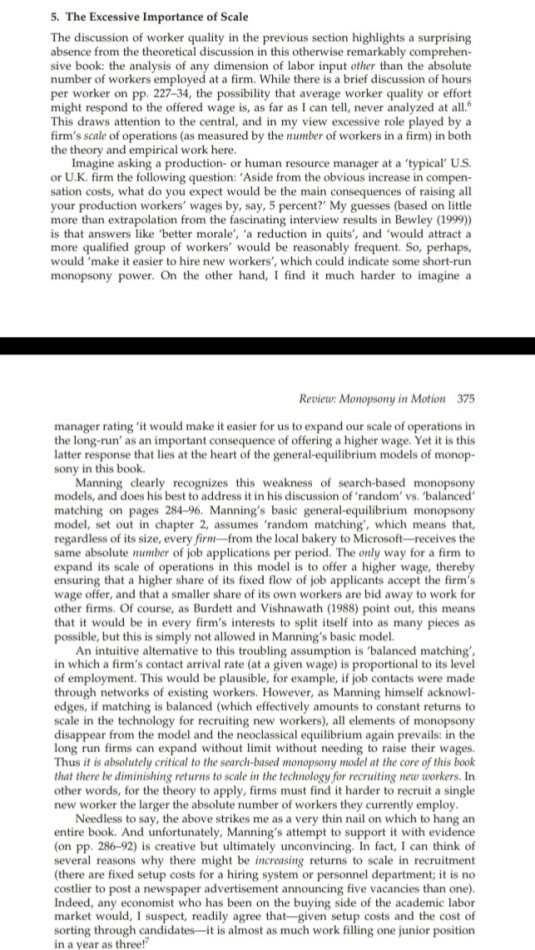
Monopsony has a monopoly on ambiguity and sexing up search frictions as exploitation too
17 Jul 2019 Leave a comment
in applied price theory, applied welfare economics, comparative institutional analysis, economic history, labour economics, labour supply, managerial economics, organisational economics, personnel economics Tags: job search, labour market search, monopsony, search and matching
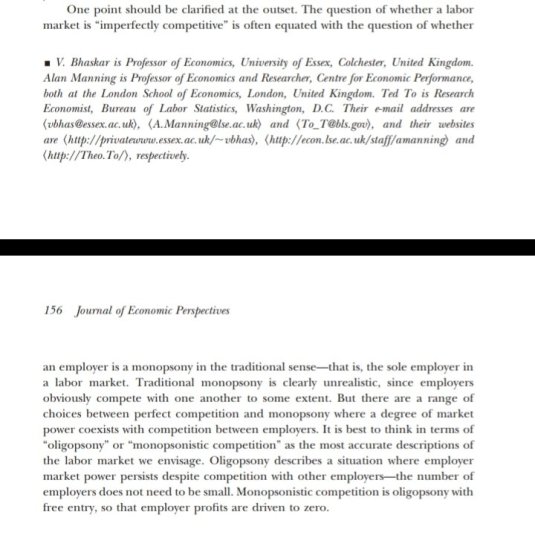
I’d go beyond Kuhn to argue Manning’s excellent book should be titled “Random matching with ex-ante wage posting in motion”
17 Jul 2019 Leave a comment
in labour economics, labour supply Tags: job search, labour market search, monopsony, search and matching
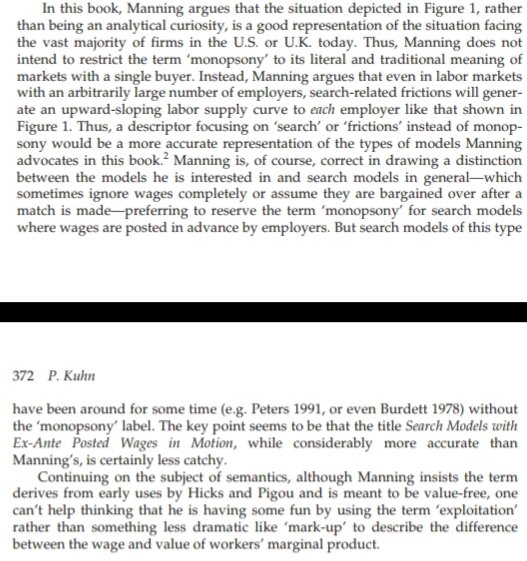
My @DomPost op-ed on the equilibrium effects of pay transparency
12 Jun 2018 Leave a comment
in applied price theory, discrimination, gender, labour economics, labour supply, managerial economics, organisational economics, personnel economics Tags: gender wage gap, monopsony, wage bargaining, wage posting

Information costs in the labour market
31 Jan 2017 Leave a comment
in job search and matching, labour economics, labour supply, minimum wage, unions Tags: inequality of bargaining power, job matching, job search, monopsony

Every worker, even the low-paid worker, is alert to their opportunities and take the best jobs that come to their notice but it is gaps in their information is the sand in the wheels of this search. As Manning (2005) observed in his superb Monopsony in Motion:
That important frictions exist in the labor market seems undeniable: people go to the pub to celebrate when they get a job rather than greeting the news with the shrug of the shoulders that we might expect if labor markets were frictionless. And people go to the pub to drown their sorrows when they lose their job rather than picking up another one straight away. The importance of frictions has been recognized since at least the work of Stigler (1961, 1962) (Manning 2005, p. 4).
The left has a certain view of how the labour market works and how to best move workers into better paying jobs. Standing against this are arguments that it is a want of information rather than weak bargaining power is what slows workers down from moving to a better job. As Stigler (1961, 1962) argued, information is costly to obtain in the labour market:
No worker, unless his degree of specialization is pathological, will ever be able to become informed on the prospective earnings which would be obtained from every one of these potential employers at any given time, let alone keep this information up to date. He faces the problem of how to acquire information on the wage rates, stability of employment, conditions of employment, and other determinants of job choice, and how to keep this information current (Stigler 1962, p. 94).
The left accepts that low-paid workers respond actively to news of better paying job opportunities. They do this by arguing that a living wage improves the quality of recruitment pools. More workers apply for the living wage vacancies on the news of a living wage policy. Fewer employees quit and they work harder in response to a living wage.
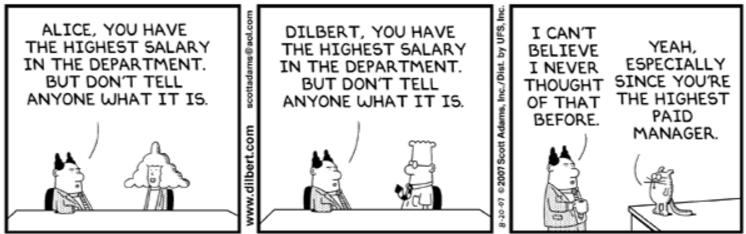
Activists should mind how they go by stressing an inequality of bargaining power but also letting through the door even one market discipline such as a sensitivity of wage offers and profits to job turnover rates:
Let us consider the extreme case of highly specialized, non-versatile labor. If we consider (a) the continuous replacement of personnel who gradually leave through competing employment openings, retirement and death, and (b) (in an expanding industry) the recruitment needed for expansion, we must recognize that the probability of the workers’ exploitation is remote. The observable labor turnover between firms suggests indeed that collusive action to reduce the price of labor has virtually never been regarded as profitable (Hutt 1973, p. 4).
But not every worker knows there are better paying options which may be even just a few steps away from their current job. Information costs are a better explanation than pinning everything on an inequality in bargaining power. This is because information costs have a profound impact on labour market workings (Stigler 1962; Alchian 1969; Alchian and Allen 1967, 1983). For unequal bargaining power to keep the wages of the low-paid down, collusion must succeed between a great many employers recruiting across many industry and occupational labour markets (Hutt 1973, Alchian and Allen 1983).

More insight is gleaned from the fact that job seekers do not initially know the location of suitable vacancies, the wages for various skills, differences in job security and other factors. They must find this knowledge, keep it current and forecast whether better vacancies may open soon. Employers must learn the location, availability and asking wages of suitable applicants.
Long-term contracts arise to share risks and curb opportunism over sunken investments in specialised human capital. These factors lead to queues, unemployment, spare capacity, layoffs, shortages, inventories and non-price rationing in conjunction with wage rigidity (Alchian 1969; Alchian and Allen 1967, 1983). Labour market analysis must stay within McCloskey’s maxim that
Every piece of economic analysis is not complete until everyone is earning only normal profits, or at least the analyst can identify a reason why not (McCloskey 1985).
The labour market has good and bad jobs, the jobs that can pay more than or less than the going rate, resulting from the costs of job search and matching. These good and bad jobs arise from the element of chance in every job search and job match rather than betting it all on an enduring employer conspiracy to keep wages down. Some workers are paid less than the going rate because they are down on their luck rather than under the thumb.
The old and new theories of monopsony have clashing predictions
06 Dec 2016 Leave a comment
in applied price theory, labour economics, minimum wage Tags: job search and matching, monopsony
Robinson’s (1933) theory of monopsony, of employer market power, is about fewness in the number of employers allow them to pay below-market wages. This means a minimum wage will raise wages, employment and, importantly, output. Her’s is a joint hypothesis. Employers will hire more workers and will produce more which means the firm must cut its prices to sell this additional output.

The new theories of monopsony such as in Manning’s Monopsony in Motion: Imperfect Competition in the Labour Market have ambiguous predictions about output and employment because they arise out of how the surplus from job matching is split. They acknowledge the possibility that some firms will close because they cannot afford the higher minimum wage rate.
The old monopoly monopsony theories are vindicated if output rises and prices fall as they must to sell the additional output. The new monopsony theories are vindicated if some firms close but employment does not fall much.
Because the new monopsony theories arise from a specific hypothesis about the labour market that it more difficult for larger employers to recruit, Kuhn (2005) argued that the title “Search Models with Ex-Ante Posted Wages in Motion, while considerably more accurate than Monopsony on Motion, is less catchy”.
A Mall divided by different city minimum wage laws @SueMoroney @GreenCatherine
26 Apr 2016 1 Comment
in applied price theory, applied welfare economics, economics of regulation, labour economics, minimum wage, politics - New Zealand, politics - USA, Robert E. Lucas Tags: Alan Manning, city minimum wage laws, living wage, monopsony
The Westfield Valley Fair Mall is half in San Jose city and half in Santa Clara city. In 2012, San Jose raised its minimum wage from $8 to $10 per hour.
National Public Radio in 2014 had a brilliant broadcast on the implications of this new city minimum wage law on the Westfield Valley Fair Mall. As the broadcast said:
This change created two economic worlds within a single, large building. Employees doing more or less the same work, just steps away from each other, started making different wages.
The radio show discussed what happened on the $8 side of the Mall and then on the $10 side through interviews with employers and workers.
On the then $8 per hour minimum wage side of the Mall, employers quickly noticed that many of their employees quit to jobs elsewhere in the same Mall. These same employees found that the quality of job applicants also fell away seriously. There were noticeable differences in the personalities traits and dress standards presented by the $8 an hour job applicants and $10 an hour job applicants.
As is to be expected because information about job opportunities is costly, some of the minimum wage employees did not know that other parts of the Mall paid more.
(This change in job turnover rates and applicant pool quality subsequent to the minimum wage increase in San Jose has implications for the inequality of bargaining power between workers and employers. Minimum wage workers do keep an eye on competing opportunities and take them up when better options arise – JR aside).
Since 2012, the minimum wage rates in the Mall have changed again: Santa Clara’s minimum wage initially increased to $9 an hour – the state-wide minimum wage, which had increased from $8 per hour; San Jose’s $10.15 per hour.
Those city minimum wages were increased further this year to $11 in Santa Clara city and $10.30 in San Jose city respectively by the respective city councils.
The state-wide minimum wage in California is to increase to $15 per hour by 2020 under a law just passed. California’s current $10-per-hour minimum wage is already among the highest in the country — only Washington, DC, has a higher minimum wage at $10.50 per hour.
Getting back to what was said in the National Public Radio broadcast, the show then moved on to the Gap Store, which straddled the two city boundaries.

Source: Episode 562: A Mall Divided : Planet Money : NPR.
The Gap Store had the option of keeping a record of how much time employees spent in each city within its store and pay accordingly under each city law. The Gap raised everybody’s wage to $10.
There was then a fascinating interview with a Pretzels store owner. The question she asked herself every time she bought anything was how many pretzels se had to sell to cover the cost. She quickly concluded that she could not sell enough additional pretzels to cover the wage rise.
There is another Pretzels store just around the corner from her in the same mall but in the other city so she could not raise her prices by that much. She had a picture of that day’s menu and price list of the competing Pretzels store on her smart phone.
She instead took a cut in her profit. This flowed back to her employers because they received an annual bonus based on 15% of each year’s profit. They did not like that reduction in their bonus.
In a delicious irony, this same entrepreneur owned another Pretzels store in a different part of the Mall but which was in the other city subject to the lower minimum wage law. She owned two of the three pretzels stores in that Mall.
She solved the problem in staff morale by rotating her staff in alternate weeks between her two stores in the same Mall but different cities and paying them accordingly.
In my opinion, this NPR story is pretty much a vindication of standard microeconomics of minimum wage laws. Minimum wage workers are alert to their opportunities and take the best ones available to them but this is not perfect because of cost of information. As Manning observed in his superb book Monopsony in Motion:
That important frictions exist in the labor market seems undeniable: people go to the pub to celebrate when they get a job rather than greeting the news with the shrug of the shoulders that we might expect if labor markets were frictionless.
And people go to the pub to drown their sorrows when they lose their job rather than picking up another one straight away. The importance of frictions has been recognized since at least the work of Stigler (1961, 1962).
As George Stigler argued, information is costly to obtain in the labour market and this leads to price and wage dispersion with this variance related to the cost of searching for information. He concluded that the one-price (one-wage) market will occur only where the cost of information about the prices (wages) offered by buyers and sellers is zero.
Finally, minimum wages rises threaten the profitability of businesses and therefore their survival. That puts low-pay jobs at risk. As Bhaskar, Manning and To (2002) explain in their survey paper on monopsony:
Notice also that because a binding minimum wage reduces employers’ profits when there is free entry into and exit out of the labor market, some employers will be forced to exit. Employer exit has a negative effect on total employment through the loss of exiting employer payrolls.
That is, although establishments that remain after the imposition of a minimum wage increase their employment, some employers are forced out of business.
Thus, minimum wages have two opposing effects: the employment-increasing “oligopsony” effect and the employment-reducing “exit” effect. The overall effect of a minimum wage depends on which effect dominates.
An increase in the family tax credit puts no jobs at risk and is a superior alternative to minimum wage laws. Minimum wage increases throw some low page workers onto the social scrapheap.
Some look upon these large minimum state and city wage increases as worthwhile policy experiments. As Dube said:
… 30 to 40 percent of the California workforce will get a raise … This will be a big experiment. It’s far outside of our evidence base… If you’re risk-averse, this would not be the scale at which to try things.
On the other hand, if you think that wages are really low and they’ve been low for a really long time and we can afford to take some risks, doing things at this scale will get us more evidence.
“Big experiments” to use Dube’s words such as these with state and city minimum wages laws are wrong as Robert Lucas explained in 1988:
I want to understand the connection between in the money supply and economic depressions.
One way to demonstrate that I understand this connection–I think the only really convincing way–would be for me to engineer a depression in the United States by manipulating the U.S. money supply.
I think I know how to do this, though I’m not absolutely sure, but a real virtue of the democratic system is that we do not look kindly on people who want to use our lives as a laboratory. So I will try to make my depression somewhere else.
A response to Judith Sloan on monopsony
11 Oct 2014 Leave a comment
in economics, labour economics, minimum wage Tags: Alan Manning, minimum wage, monopsony, search and matching
In the monopsony view view, search frictions in the labour market generate upward sloping labour supply curves to individual firms even when firms are small relative to the labour market.
Peter Kuhn in a great review of monopsony in motion pointed out the correct title was search fictions with wage posting and random matching in motion.This precision is important because, as Kuhn goes on to say:
“Manning clearly recognizes this weakness of search-based monopsony models, and does his best to address it in his discussion of ‘random’ vs. ‘balanced’ matching on pages 284–96. Manning’s basic general-equilibrium monopsony model, set out in chapter 2, assumes ‘random matching’, which means that, regardless of its size, every firm—from the local bakery to Microsoft—receives the same absolute number of job applications per period. The only way for a firm to expand its scale of operations in this model is to offer a higher wage… it is absolutely critical to the search-based monopsony model at the core of this book that there be diminishing returns to scale in the technology for recruiting new workers. In other words, for the theory to apply, firms must find it harder to recruit a single new worker the larger the absolute number of workers they currently employ.”
The evidence in favour of the monopoly view of minimum wage is is not as good as people think.
Under this monopsony view of minimum wages – an upward sloping supply curve of labour – an increase in the minimum wage increases both wages and employment.
That is, there is a very specific joint hypothesis of both more employment and more wages and as there are more workers in the workplace, higher output which the employer can only sell by cutting their prices.
David Henderson made very good points along this line when he reviewed David Card’s book back in 1994:
Interestingly, Card’s and Krueger’s own data on price contradict one of the implications of monopsony. If monopsony is present, a minimum wage can increase employment. These added employees produce more output. For a given demand, therefore, a minimum wage should reduce the price of the output. But Card and Krueger find the opposite. They write: ‘[P]retax prices rose 4 percent faster as a result of the minimum-wage increase in New Jersey…’ (p. 54). If their data on price are to be believed, they have presented evidenceagainst the existence of monopsony. David R. Henderson, “Rush to Judgment,”MANAGERIAL AND DECISION ECONOMICS, VOL. 17, 339-344 (1996)
How to refute the case for a minimum wage when genuinely calling for a smarter federal minimum wage
30 Jun 2014 1 Comment
in applied price theory, applied welfare economics, labour economics, minimum wage Tags: federalism, george stigler, minimum wage, monopsony

What if minimum wage rates could somehow be tied to specific locations as suggested by former White House economist Jared Bernstein puts it in an essay in the New York Times:
When we adjust a national minimum wage of $10.10 for regional differences, these are the amounts you’d need to have the same buying power: $11.94 in Washington, D.C., and $11.40 in California, but only $8.90 in Alabama and $9.08 in Kansas.
And of course, prices vary within states as well. In the New York City area, it would take $12.34 to meet the national buying power of $10.10; upstate around Buffalo, you’d need only $9.47. In the Los Angeles area, it would take $11.94; go up north a bit to Bakersfield, where prices are closer to the national average, and it’s $9.83.
To repeat what George Stigler said on the unsuitability of a nation-wide minimum wage in 1946 when there was monopsony, and therefore a small minimum wage increase is less likely to result in a reduction in employment:
If an employer has a significant degree of control over the wage rate he pays for a given quality of labour, a skilfully-set minimum wage may increase his employment and wage rate and, because the wage is brought closer to the value of the marginal product, at the same time increase aggregate output…
This arithmetic is quite valid but it is not very relevant to the question of a national minimum wage. The minimum wage which achieves these desirable ends has several requisites:
1. It must be chosen correctly… the optimum minimum wage can be set only if the demand and supply schedules are known over a considerable range…
2. The optimum wage varies with occupation (and, within an occupation, with the quality of worker).
3. The optimum wage varies among firms (and plants).
4. The optimum wage varies, often rapidly, through time.
A uniform national minimum wage, infrequently changed, is wholly unsuited to these diversities of conditions
A smarter federal minimum wage is a federal minimum wage of zero. Let each state and city set a minimum wage in accordance with its own economic conditions and the blackboard economics of monopsony and competition in the labour market.

As soon as you concede that there is not one single national labour market, other concessions must be made. This slippery slope includes that the monopsony power of employers might vary from state to state, city to city, and local labour market from local labour market.
Even a state or city minimum wage regulator would have to pretend to know an immense amount of information about the labour market with most of this information in a tacit form that cannot be summarised in statistics or other decision aids for regulators. As Hayek reminded in his classic in 1945 on The Use of Knowledge in Society:
the fact that the sort of knowledge with which I have been concerned is knowledge of the kind which by its nature cannot enter into statistics and therefore cannot be conveyed to any central authority in statistical form.
The statistics which such a central authority would have to use would have to be arrived at precisely by abstracting from minor differences between the things, by lumping together, as resources of one kind, items which differ as regards location, quality, and other particulars, in a way which may be very significant for the specific decision.
It follows from this that central planning based on statistical information by its nature cannot take direct account of these circumstances of time and place and that the central planner will have to find some way or other in which the decisions depending on them can be left to the "man on the spot."
 Utopia, you are standing in it!
Recent Comments