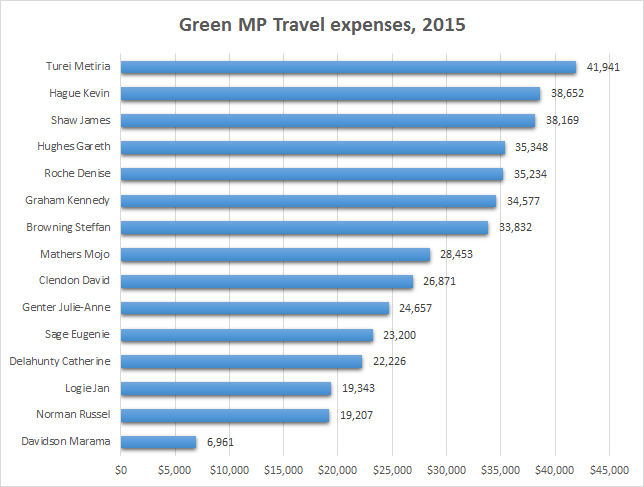
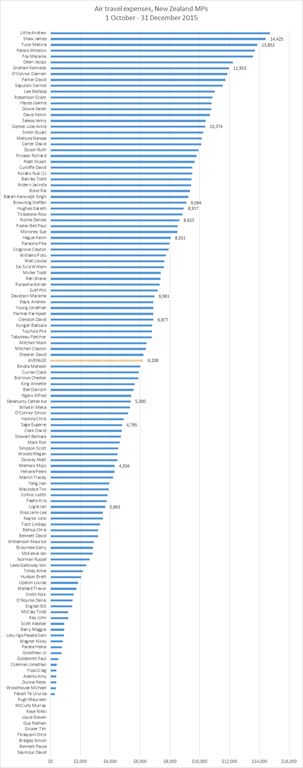
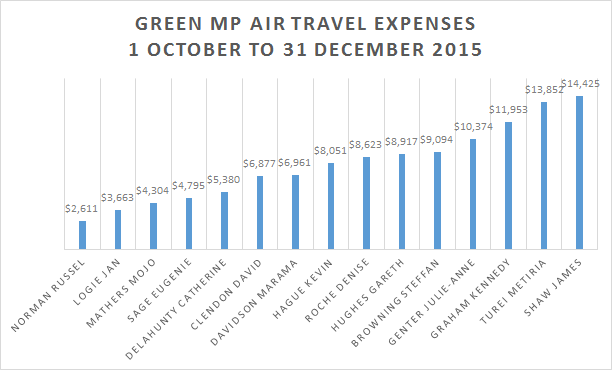
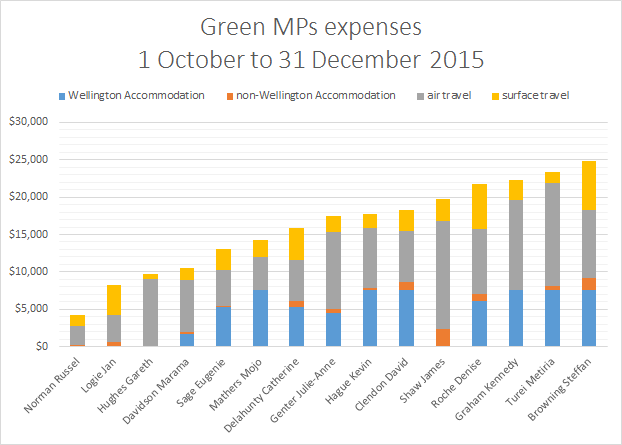
Living the clean, green lifestyle means more than just buying carbon-offs in the same way that indulgences for sins were sold by the mediaeval Catholic Church. Russell Norman was an MP for 9 of the 12 months covered by this chart. He consistently had one of the smallest carbon footprints of a Green MP even when he was still co-leader of the Greens and not just a backbench MP.
10 of the 14 green MPs have above-average air travel expenses – have an above average carbon footprint for a member of the New Zealand Parliament. It is not easy to be Green.
Green MP Gareth Hughes today nailed the case as to why governments should never run businesses. Too many MPs simply do not understand what dividends represent and what the profits from asset sales represent.
Data out today shows the asset sales so far have cost $1 billion. https://t.co/HeDndEjINg – double blow for Kiwis facing rising power bills
Hughes was reported today saying that taxpayers lost nearly $1 billion in dividends since the recent privatisations of power companies. He is the Green party spokesman on state owned enterprises.
Does the Green Party understand that an asset sells for a price equal to its risk-adjusted discounted net present value of the stream of dividends. When you sell a financial asset, you cash out the net present value of the stream of dividends that might have come from those assets.
The Greens, who are prissy about government transparency and dishonesty of their opponents, did not mention the $4.7 billion in revenue from the asset sale. Taxpayers now receiving more in dividends as a part owner of the privatised power companies than they did as a full owner.
Hughes had the cheek to complain about the politicisation of those privatisations such as favourable terms for small share buyers. That inability of governments to even sell an asset competently is a strong reason why governments should never run businesses in the first place.
If an asset cannot be sold in the full light of day – a major issue in an election campaign and a referendum – without the sale price that is politicised, what is the chance of good management of any state-owned enterprise when it is not the central focus of opposition scrutiny?
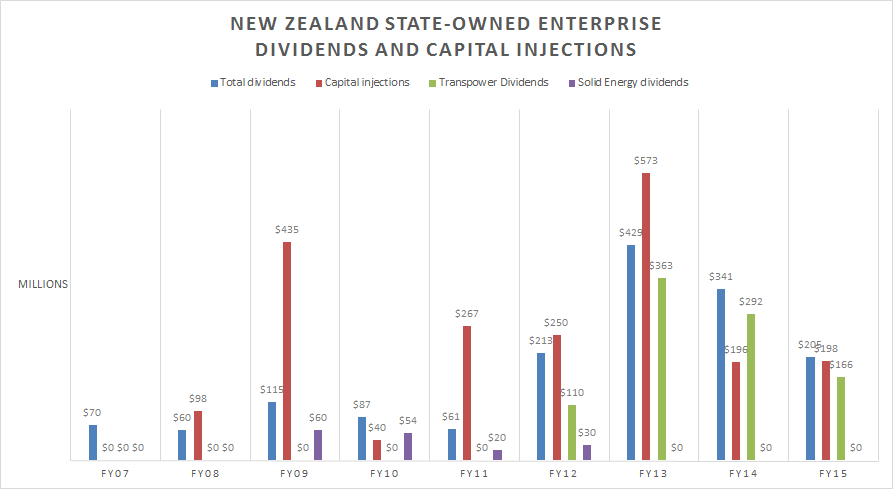
It is been many years since dividends from the state-owned enterprise portfolio has been a net positive cash flow for the taxpayer, as the chart below shows.
Source: New Zealand Treasury – data released under the Official Information Act.
KiwiRail and Solid Energy gobbled up whatever dividends came out of the power companies. Aside from power companies, state-owned enterprises not really offer much in the way of dividends to the taxpayer as the chart again shows.
Fascinating. Yawning chasm between why Labour members think they lost and why voters think they did. From @thetimeshttp://t.co/MvhZYI2CTr— Joe Watts (@JoeWatts_) July 23, 2015
Left-wingers do whinge about voters not understanding; about how if only the voters understood better their arguments than they do now. The Left thinks voters just keep getting it wrong.
The evidence—most notably, the results of the 1996 Survey of Americans and Economists on the Economy—shows that the general public’s views on economics not only are different from those of professional economists but are less accurate, and in predictable ways.
The public really does generally hold, for starters, that prices are not governed by supply and demand, that protectionism helps the economy, that saving labour is a bad idea, and that living standards are falling.
Politicians mindful of re-election must pander to these four biases.
Fortunately, for the New Zealand Labour Party and the Green Party of Aotearoa New Zealand, voters have no rational reason to correct these four biases. Voters are rationally irrational. As each individual counts so little, why spend any time correcting biased political beliefs?
Anti-market bias: The tendency to underestimate the benefits of the market mechanism. The typical voter equates market phenomena such as profitability and interest as examples of unbridled monetary confiscations by ‘greedy’ businesses. This biased against the market, despite all its successes, is a rich field to till for both Labour and the Greens
Anti-foreign bias: The tendency to underestimate the economic benefits of interaction with foreigners. This antagonism towards such trends as outsourcing employment overseas, or selling raw materials to faraway traders, is reminiscent of the mercantilism Adam Smith so brilliantly demolished but it still lives on today in the hearts of the voting citizenry. Labour and the Greens play to that bias shamelessly.
Make-work bias: The tendency to underestimate the economic benefits from conserving labour. Those who look to the visible face of job losses overlook the job gains (often by those who lost their jobs) to be made tomorrow in emerging industries. The Greens and Labour are sure-fire enemies of creative destruction.
Pessimistic bias: The tendency to overestimate the severity of economic problems, and to underestimate the recent past, present and future performance of the economy. In The Progress Paradox (2003), Gregg Easterbrook ridicules abundance denial:
Our forebears, who worked and sacrificed tirelessly in the hopes their descendants would someday be free, comfortable, healthy, and educated, might be dismayed to observe how acidly we deny we now are these things.
Many average voters seem to feel that Malthus was correct in diagnosing the allegedly poor prospects for the market economy.
CLASSIC VIDEO: Margaret Thatcher on Socialism in 1990 to the House of Commons https://t.co/iB5O3ejoaC
Where would the voting base of the Greens be without a pessimism bias? They are professional pessimists and doomsday prophets from their earliest days. Labour assumes working class Tories are dupes of what is left of fading media barons such as Rupert Murdoch.
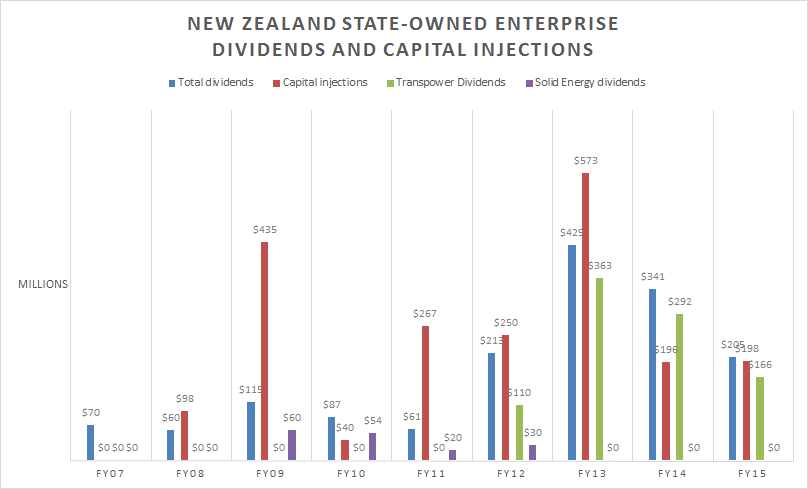
With a straight face, the Labour Party and the Greens claim that state-owned enterprises should not be sold because taxpayers give up the future dividend stream.
Source: New Zealand Treasury – data released under the Official Information Act.
Leaving to one side what the sale price is the net present value of, for as far back as I could obtain data from the Treasury, it is a rare year in which the taxpayers does not pour more money into state-owned enterprises than they get back in dividends.
Transpower is carrying the entire state-owned enterprise portfolio. Earlier on, Solid Energy – a now bankrupt coal mining company– was carrying the portfolio in terms of cash flow to the taxpayer.
Paris was a tremendous defeat for the climate alarmists. Now that they have their treaty – a non-binding treaty – their ability to stir up political momentum to do more is undermined. If the environmental movement already has their agreement to save the world, why is anything more necessary. Especially anything that is costly to the hip-pocket such as a carbon tax.
The Greens, rarely for them, have settled for half measures. That was unwise considering these half measures are nothing at all apart from climate aid. Few like to remember that the Republicans still control the U.S. Congress. Centre-right parties control most governments in Europe.
Japanese Americans interned during World War II jumped at the chance to volunteer to fight. They saw it as their last chance to prove their undivided loyalty to their country.
One Japanese father, when saying goodbye to his son, stressed that showing his loyalty to his country, if necessary through the last full measure of devotion was far more important that his returning safely to his family.
The 442nd Combat Regiment Team was the most decorated unit in World War II. Its motto was “Go for Broke”. The 4,000 Nisei soldiers in April 1943 had to be replaced nearly 2.5 times. In total, about 14,000 men served, earning 9,486 Purple Hearts.
Pearl Harbor was attacked 74 years ago today. Also, Roosevelt signed an executive order 75 days later that did this: pic.twitter.com/y4FhR5nMEC
Migrants are a cut above regarding initiative and judgement. They pass many of these traits on to their children. These Japanese Americans, both migrants and native born knew that counter-signalling was required. They had to go out of their way to show their loyalty no matter how unfair any suspicions of disloyalty among Japanese Americans might have been at the time.
This is a really important article to understand what is driving recruitment to ISIS. https://t.co/QamGhL6U0K
I am reminded of that counter-signalling by Japanese Americans during the darkest days of World War II when I read the remarks of Julie Anne Genter and Jeremy Corbyn. Both focused their pleas on the need to be inclusive and understanding why people join violent, radical groups. They and the rest of the Twitter Left had nothing to contribute regarding strategies to deter the next attack and disrupt those that are in the planning stage, but that is not new.
The notion that bad behaviour towards minority communities leads to more recruitment to the terrorists is overrated. There will be a few wind-bags who say harsh things after each terrorist attack, but if they cross the line, they will be dealt with by the police and courts in a democracy governed by the rule of law.
Acrimony towards your community following the latest terrorist attacks has little to do with the level of recruitment to these terrorist groups either now or in the past. As Alan Krueger explains:
One of the conclusions from the work of Laurence Iannaccone—whose paper, “The Market for Martyrs,” is supported by my own research—is that it is very difficult to effect change on the supply side. People who are willing to sacrifice themselves for a cause have diverse motivations. Some are motivated by nationalism, some by religious fanaticism, some by historical grievances, and so on. If we address one motivation and thus reduce one source on the supply side, there remain other motivations that will incite other people to terror.
Malcontents join the jihadists today for the same reasons they joined the Red Brigade, the Japanese Red Army Faction and Baader-Meinhof gang in the 1970s and 1980s.
Plenty of young people were attracted to communism in previous generations as a way of sticking it to the man. Now as then economic conditions were good as were political freedoms. Italy, Japan and Germany were all at the peak of recoveries from war. Japanese incomes are doubled in the previous decade. Germany and Italy were rich countries. As Alan Krueger explains:
Despite these pronouncements, however, the available evidence is nearly unanimous in rejecting either material deprivation or inadequate education as important causes of support for terrorism or participation in terrorist activities. Such explanations have been embraced almost entirely on faith, not scientific evidence.
Each generation has its defining oppositional identity. Radical Islam is the oppositional identity of choice for today’s angry young men and women. Mind you, they have to buy Islam for dummies to understand what they’re signing up for.
In previous generations, it was communism, weird Christian sects, eco-terrorism, animal liberationist terrorism and a variety of domestic terrorists of the left and right with conspiratorial motivations. Look at the level of diversity of the angry young men and women on the domestic terrorists list of the FBI. One jihadists when interviewed said that 30 years ago he would probably have become a Communist as his vehicle for venting his frustrations.
There is always an ample supply of troubled and angry people so trying to redress their grievances is overrated as Alan Krueger explains:
…it makes sense to focus on the demand side, such as by degrading terrorist organizations’ financial and technical capabilities, and by vigorously protecting and promoting peaceful means of protest, so there is less demand for pursuing grievances through violent means. Policies intended to dampen the flow of people willing to join terrorist organizations, by contrast, strike me as less likely to succeed.
The current appeal of radical Islam rests on what psychologists call personal significance. The quest for personal significance by these angry young men and women is the desire to matter, to be respected, to be somebody in one’s own eyes and in the eyes of others.
A person’s sense of significance may be lost for many reasons, including economic conditions. The anger can grow out of a sense of disparagement and discrimination; it can come from a sense that one’s brethren in faith are being humiliated and disgraced around the world.
Extremist ideologies, be they communism, fascism or extreme religions are effective in such circumstances because it offers a quick-fix to a perceived loss of significance and an assured way to regain it. It accomplishes this by exploiting primordial instincts for aggression, sex and revenge. MI5’s behavioural science unit found that
“far from being religious zealots, a large number of those involved in terrorism do not practise their faith regularly. Many lack religious literacy and could… be regarded as religious novices.” The analysts concluded that “a well-established religious identity actually protects against violent radicalisation”
Most evidence point to moral outrage, disaffection, peer pressure, the search for a new identity, for a sense of belonging and purpose as drivers of radicalisation. Anthropologist Scott Atran pointed out in testimony to the US Senate in March 2010:
“. . . what inspires the most lethal terrorists in the world today is not so much the Quran or religious teachings as a thrilling cause and call to action that promises glory and esteem in the eyes of friends, and through friends, eternal respect and remembrance in the wider world”. He described wannabe jihadists as “bored, underemployed, overqualified and underwhelmed” young men for whom “jihad is an egalitarian, equal-opportunity employer . . . thrilling, glorious and cool”.
Chris Morris, the writer and director of the 2010 black comedy Four Lions – which satirised the ignorance, incompetence and sheer banality of British Muslim jihadists – said “Terrorism is about ideology, but it’s also about berks”.
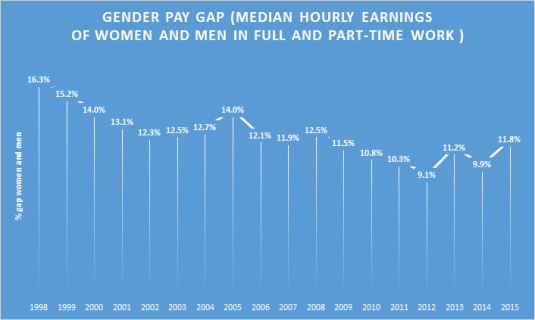
The unadjusted gender pay gap has been in a long-term decline for generations. The unadjusted gender wage gap in 2015 is 11.8% as shown in the above chart and in the second New Zealand Green’s Facebook link above but not first of their Facebook links above where it is claimed to be 14%.
To sex-up their numbers, the Labour Party and Greens used the gap between the average wages of men and women. This was rather than the median wage to make their gender wage gap comparisons despite the pious commitment of the Greens to use median wage in their gender wage gap calculations in the recent past.
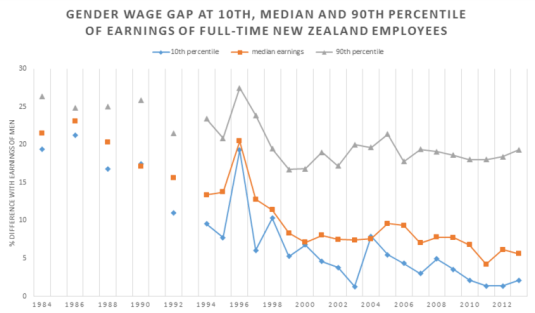
The unadjusted gender pay gap has all but disappeared at the bottom of the labour market as the chart below shows. The gender wage gap remains stubbornly high at the high end of the wage market at 20% because of compensating differentials. Professional women are balancing families and careers in choosing the occupations that best suits each individual woman.
The Gaza Strip has two borders: both Egypt and Israel restrict trade with the Gaza. The Egyptian blockade of the Gaza Strip is biting much more than the Israeli blockade.
Hamas derived 40% of its tax revenue from tariffs on goods that flow through those tunnels. One estimate puts the economic losses at nearly a fifth of Gaza’s GDP. This blockade by Egypt of the Gaza Strip has been regularly reported in the Guardian, so BDS activists must know of it.
No peace convoy has been launched to break this Egyptian blockade. Plenty were launched against Israel. One reason may be the Egyptians are a lot rougher customers. There is rule of law in Israel, none in the Egypt.
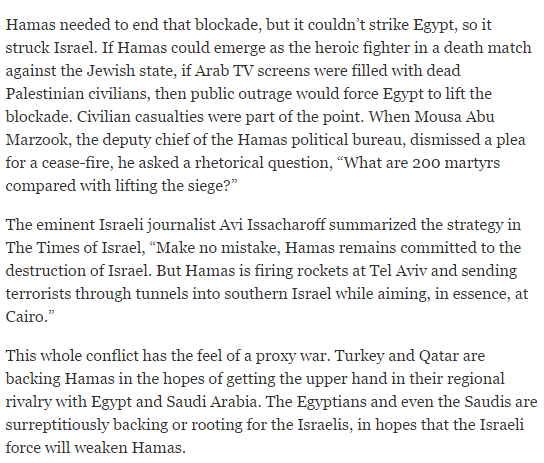
David Brooks argues that Egypt is the real target of the Hamas missiles. After the military coup in Egypt, its military leaders closed roughly 95% of the tunnels that connected Egypt to Gaza which were used to smuggle food, weapons and other goods into Gaza.
Why Evolution is True is a blog written by Jerry Coyne, centered on evolution and biology but also dealing with diverse topics like politics, culture, and cats.
“We do not believe any group of men adequate enough or wise enough to operate without scrutiny or without criticism. We know that the only way to avoid error is to detect it, that the only way to detect it is to be free to inquire. We know that in secrecy error undetected will flourish and subvert”. - J Robert Oppenheimer.





 Utopia, you are standing in it!

Recent Comments