Parliament debates the Sustainable Development Goals today. But how did the MDGs fare? bit.ly/1gbcH6W http://t.co/r12PKVmPzK—
Commons Library (@commonslibrary) September 10, 2015
How did the MDGs fare?
27 Sep 2015 Leave a comment
in comparative institutional analysis, constitutional political economy, development economics, economic history, growth disasters, growth miracles Tags: do gooders, MDG, ODA, overseas aid, United Nations
Some of the kidnapped ODA activists have been freed and can speak out at last!
23 Jul 2015 Leave a comment
in development economics, economic history, growth disasters, growth miracles, Marxist economics Tags: activists, anticapitalist mentality, antiforeign bias, antimarket bias, do gooders, expressive voting, Left-wing hypocrisy, Leftover Left, mass kidnappings, ODA, overseas aid, rational ignorance, rational irrationality, The Guardian
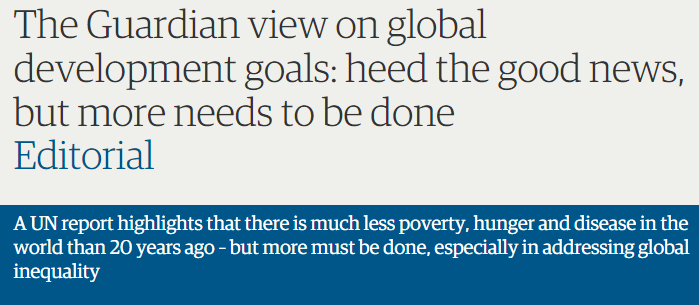
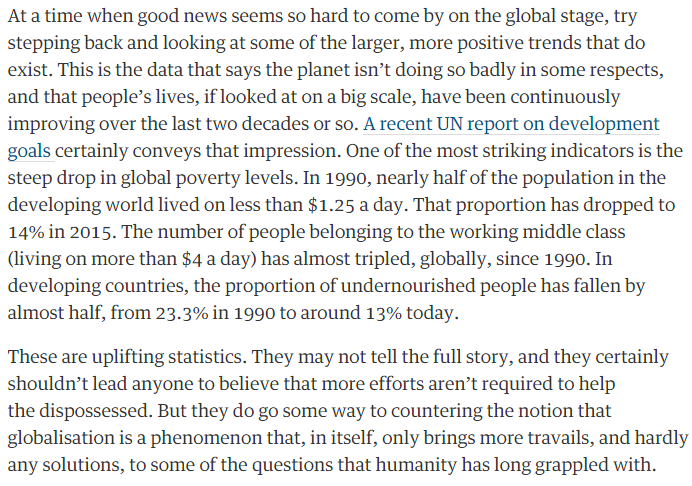
The role of the spread of capitalism and globalisation in massively reducing extreme poverty just gets a mention, begrudgingly, but it’s better than nothing From a newspaper of record of the Left over Left.
Evidence grows of mass kidnappings of Oxfam activists – how else could they have been silenced?
15 Jul 2015 Leave a comment
in development economics, growth disasters, growth miracles, health economics, technological progress Tags: activists, do gooders, extreme poverty, global poverty, infant mortality, Left-wing hypocrisy, life expectancies, mass kidnappings, ODA, overseas aid, Oxfam, The Great Escape, The Great Fact
https://twitter.com/MaxCRoser/status/621132860657897472/photo/1
The biggest success of our time: Child mortality is decreasing rapidly. Everywhere!
More at: OurWorldInData.org/data/populatio… http://t.co/FhdbQeheUd—
Max Roser (@MaxCRoser) July 13, 2015
Staggering #inequality: top 1% will own 50% of world's wealth by 2016. Help #EvenitUp! act.oxfam.org/new-zealand/ev… http://t.co/KX9GR2VSo5—
Oxfam New Zealand (@oxfamnz) January 19, 2015
Fossil fuel companies get more subsidies than all the public health spending globally. It's time to #GoCoalFree http://t.co/gsDIocxAq9—
Oxfam New Zealand (@oxfamnz) June 08, 2015
Global poverty is in free fall – what does Oxfam have to say about what caused this?
14 Jul 2015 Leave a comment
in applied welfare economics, comparative institutional analysis, constitutional political economy, development economics, economic history, economics of bureaucracy, growth disasters, growth miracles, liberalism, Marxist economics, Public Choice Tags: extreme poverty, global poverty, ODA, overseas aid, Oxfam, professional activists, professional do-gooders, The Great Escape, The Great Fact
The world is getting better all the time, in 11 maps and charts vox.com/2015/7/13/8908… http://t.co/cBbN4L0dqF—
Vox (@voxdotcom) July 13, 2015
William Easterly on the Tyranny of Experts and the Forgotten Rights of the Poor
13 Jul 2015 Leave a comment


The development economics of Bono
04 May 2015 Leave a comment
in development economics, growth disasters, growth miracles, Music Tags: Bono, ODA, overseas aid, U2
Does vertical political integration reduce corruption in government?
01 May 2015 Leave a comment
in economics of crime, industrial organisation, law and economics Tags: bribery and corruption, chain of monopolies problem, Japan, ODA, overseas aid, Pakistani
Anti-Dismal blogged today on how vertical integration can reduce the double mark-up problem of monopolies. The one thing worse than a monopoly is dealing with a chain of monopolies. Buyers must pay a monopoly price to each step in the chain.
If these monopolies were to merge into one single monopoly, the monopolist would charge a lower single monopoly price. The vertical integration captures the deadweight social loss of the chain of monopoly prices. Monopoly profits are higher, yet the monopoly price paid by buyers is lower.
This blog post reminded me of a particularly astute short article in the Economist 15 or so years ago analysing Benazir Bhutto’s husband as a solution to the chain of monopolies problem.
When Benazir Bhutto became Prime Minister of Pakistan for the first, she appointed her husband Minister of Investments. He became known as Mr 10%.

The welfare gain for the downtrodden Pakistani’s was that if you paid Benazir Bhutto’s husband is 10%, you got what you pay for. No further bribes of more junior and petty officials were required if you paid Benazir Bhutto’s husband his 10%. Many investments and business that otherwise would have been blocked but for countless bribes to a chain of corrupt politicians and bureaucrats at every turn went ahead.
When Benazir Bhutto became Prime Minister of Pakistan for the second time, not only was her husband again appointed Minister of Investments, he had better economic advisers. He became Mr 40%. Benazir Bhutto’s husband wanted to capture the economic gains of single-stop bribery and corruption for his family.
My experience with Japanese overseas development assistance confirms the same. They budget 10% for bribes. Their main interest is effective bribery. If they pay a bribe, the Japanese ODA agency expects to get what they pay and not have to pay a chain of more junior officials as well for the same thing.
Managerial Econ: Markets vs. Mother Theresa: who has done more for the world’s poor?
05 Nov 2014 Leave a comment
in applied welfare economics, development economics, growth disasters, growth miracles Tags: growth disasters, overseas aid, overseas development assistance, The Great Escape, The Great Fact

 Utopia, you are standing in it!
Recent Comments