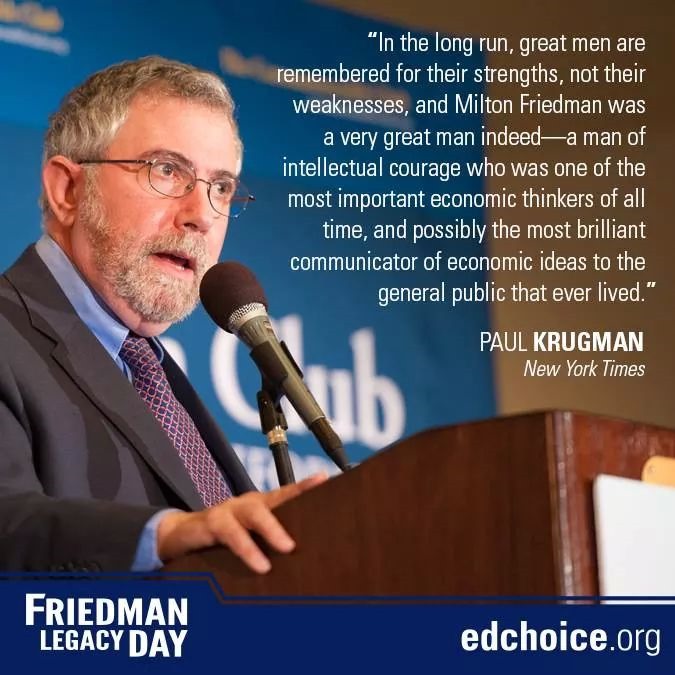
Paul Krugman was a consultant to Enron
14 Jul 2014 Leave a comment
in financial economics Tags: Enron, Paul Krugman

In 1999, Paul Krugman was paid $50,000 by Enron to act as a consultant and hold seminars. Krugman wrote a glowing article about Enron for Fortune magazine. After the collapse of Enron, he was a stern critic of that company.
In his columns, Krugman worked hard to link Enron to the Bush administration, and in one blamed Enron’s consultants for the company’s collapse. Krugman neglected to mention that he had been an Enron consultant:
Enron sold lots of things, but above all it sold itself: it crafted a self-portrait that business gurus loved. Like a schematic diagram from The McKinsey Quarterly or The Harvard Business Review, Enron’s business plan made a perfect PowerPoint presentation.
Other companies hired business gurus as consultants; Enron, in effect, put the gurus in charge. (Jeff Skilling, who made Enron what it is today, is a former McKinsey consultant.) What they created was a company so trendy that investors were dazzled. And that let executives get away with financial murder.
Paul Krugman on the nonsense thinking behind trade negotiations
01 Jul 2014 Leave a comment
in international economics Tags: mercantilism, Paul Krugman, preferential trade agreements, rent seeking, trade negotiations

HT: Alan Moran
Jacob Viner and the ambiguous welfare effects of preferential trade agreements
17 Jun 2014 1 Comment
in applied price theory, applied welfare economics, international economic law, international economics Tags: Jacob Viner, Paul Krugman, preferential trade agreements, trade creation, trade diversion
The world trade system is a growing assortment of discriminatory trade agreements known as the ‘spaghetti bowl’ for reasons that the diagram of regional trade agreements (RTAs) in the Western Hemisphere makes clear.

Preferential trade agreements are the correct name for the political spin masters call free trade agreements or regional trade agreements.
- A preferential trade agreement is a trading bloc that gives preferential access to certain products from the participating countries. This is done by reducing or abolishing tariffs and other trade restrictions for the members of the trade bloc.
- A customs union is a type of trade bloc which is composed of a free trade area with a common external tariff.
Everything you need to know about trade blocs, preferential trading agreements, and customs union is in a book written by Jacob Viner in 1951. His book The Customs Union Issue introduced the distinction between the trade-creating and the trade-diverting effects of customs unions:
Trade diversion occurs if the common tariff around a customs union and the absence of tariffs within the union lead one of the members to purchase products from another member rather than from a “cheaper” producer in the outside world.
The classic example of this is the entry of Britain into the European Common market in 1973. It started sourcing dairy and wool imports from within the common market rather than from New Zealand as was the case for the past hundred years.
Assume the most efficient producer of lamb in the world is New Zealand. Before joining a customs union the UK will place an identical tariff on lamb imported from any country, this is shown on the diagram below. Before the customs union, French lamb is more expensive than New Zealand lamb once the tariff was paid. There are no imports from France. After joining the EU the tariff on French lamb will be removed.

The formation of the customs union between Britain and France reduces the price of lamb imports from PNZ+t to PFrance. Trade diversion now takes place as consumption switches from the low cost New Zealand farmers to the higher cost French lamb. Lower cost imports from outside the customs union have been replaced by high cost imports from within the customs union.
The welfare analysis analysis is tricky because consumer prices fall, but some of the tariff revenue is now converted into higher import prices because the lamb is sourced with the inefficient French farmers. This is shown in the multiple graphs below where some government tariff revenue is lost and is instead converted into payments to the higher-cost French farmers.

On the diagram below it is possible to highlight the gains and losses in welfare:
- There has been an increase in consumer surplus of areas 1 + 2 + 3 + 4.
- There has been a reduction in the producer surplus of UK lamb producers of area 1.
- There will be a loss of government tariff revenue of 3 + 5.

The will be a net loss in UK welfare if 2 + 4 < 5. It is possible that trade diversion will lead to an increase in UK welfare if 2 + 4 > 5. All in all this situation is full of ambiguity rather than the glories of straight out free trade were a country simply abolish the tariffs and buy from the cheapest supplier. As Paul Krugman explains:
If economists ruled the world, there would be no need for a World Trade Organization. The economist’s case for free trade is essentially a unilateral case – that is, it says that a country serves its own interests by pursuing free trade regardless of what other countries may do.
Or as Frederic Bastiat put it, it makes no more sense to be protectionist because other countries have tariffs than it would to block up our harbours because other countries have rocky coasts. So if our theories really held sway, there would be no need for trade treaties: global free trade would emerge spontaneously from the unrestricted pursuit of national interest.
Trade creation occurs if the abolition of tariffs between members of the customs union leads a member country to purchase products from another member country rather than producing it at higher cost itself.

Whether the trade creation of seats that trade to version requires very careful calculations such as those above . Whether there is a net loss or net gain will depend upon how the elasticity of domestic demand and the size of the initial tariff.
It doesn’t take much trade diversion to offset any trade creation. The trade diversion must be to a supplier within the trade bloc that is not much more expensive than the global cheapest price.

Source: http://www.mhhe.com/economics/pugel12e/keygraph/graphkey10h.html
Viner noted that the greater the similarity of the production mixes of the member countries, the greater the scope for trade creation relative to trade diversion; the more different the production mixes, the greater the scope for trade diversion!
Viner recognized that countries forming a customs union would in fact not be likely to permit the extensive relocation and reorganization of industry required to realize the potential benefits from the finer division of labour. This led him to regard customs unions as:
“unlikely to prove a practicable and suitable remedy for today’s economic ills” but rather “a psychological barrier to the realization of the more desirable but less desired objectives of … the balanced multilateral reduction of trade barriers on a non-discriminatory basis”
The expansion of trade after the signing of preferential trading agreements such as the common market and the many that followed including those signed by New Zealand, Australia and NAFTA are consistent with both trade creation and trade diversion.
The quality of arguments mounted against preferential trade agreements are surprisingly poor.There are good economic arguments against them based on the trade diversion cancelling out the trade creation.
By introducing discriminatory treatment into the trading system, the proliferation of preferential trade agreements promote costly trade diversion, interfere with the efficient operation of global business and allow great powers to extract unjustified concessions from weaker countries. These concessions can be in areas such as intellectual property rights, the purchasing pharmaceuticals by government agencies and social clauses on issues such as environmental and labour standards. Krugman again:
Fortunately or unfortunately, however, the world is not ruled by economists. The compelling economic case for unilateral free trade carries hardly any weight among people who really matter.
If we nonetheless have a fairly liberal world trading system, it is only because countries have been persuaded to open their markets in return for comparable market-opening on the part of their trading partners.
Never mind that the “concessions” trade negotiators are so proud of wresting from other nations are almost always actions these nations should have taken in their own interest anyway; in practice countries seem willing to do themselves good only if others promise to do the same.
The last time a world trade agreement was negotiated Clinton was President, cell phones were as heavy as a brick and no one had heard of email.
In Praise of Cheap Labor | Paul Krugman (1997)
09 Jun 2014 Leave a comment
in development economics, growth miracles, international economics, labour economics, labour supply Tags: Paul Krugman, Sweatshop labour, The Great Enrichment, The Great Fact

The lofty moral tone of the opponents of globalization is possible only because they have chosen not to think their position through.
While fat-cat capitalists might benefit from globalization, the biggest beneficiaries are, yes, Third World workers.
After all, global poverty is not something recently invented for the benefit of multinational corporations…
wherever the new export industries have grown, there has been measurable improvement in the lives of ordinary people.
Partly this is because a growing industry must offer a somewhat higher wage than workers could get elsewhere in order to get them to move.
More importantly, however, the growth of manufacturing–and of the penumbra of other jobs that the new export sector creates–has a ripple effect throughout the economy. The pressure on the land becomes less intense, so rural wages rise; the pool of unemployed urban dwellers always anxious for work shrinks, so factories start to compete with each other for workers, and urban wages also begin to rise.
Paul Krugman, Tom Sargent and Me
22 Apr 2014 Leave a comment
in macroeconomics, politics - USA Tags: Karl Popper, Paul Krugman, Thomas Sargent, vast right-wing conspiracy, Yes Minister
Paul Krugman seems to be implying that I am the double-secret ring-leader of a vast right-wing conspiracy.
Today in his blog at the New York Times, Krugman said:
…why the sudden attention to Sargent’s 2007 speech?
I think it’s fairly obvious: it’s essentially stealth anti-Keynesian propaganda, cloaked in the form of a widely respected and liked economist uttering what sound like eternal truths.
But they aren’t, and the real goal here is to undermine the case for fighting unemployment in the here and now. There are virtues to that 2007 talk, but right now is no time for 2007 Sargent.
In my reply at his blog, I said that I originally posted the link to Sargent’s speech to make a point that most economic analysis is free of politics because the average economist is a moderate Democrat. Tom Sargent is a life-long Democrat.
To add to my reply at Krugman’s blog, Krugman said earlier in his blog that:
It’s not so much that what Sargent said is wrong, although some of his principles are by no means universally agreed upon, even in normal times.
What’s so striking about Sargent’s points is that it’s hard to think of a worse time to cite them.
And the people citing that old speech clearly have ulterior motives.
I live in New Zealand. Not everything is about U.S. domestic politics.
I rather prophetical said on Marginal Revolution on the 20th that “Too many on social media such as Reddit responded by smearing Sargent as a right-winger and neo-liberal. He is a life-long Democrat.”
My conspiratorial minions span the globe to include initially Newmark’s Door and then Marginal Revolution, Stephen Williamson, Vox.com, the American Enterprise Institute, Catallaxyfiles and the Business Insider to name but a few. There are other unindicted co-conspirators.
Karl Popper argued that conspiracy theories overlook the pervasive unintended consequences of political and social action; conspiracy theorists assume that all consequences must have been intended by someone.
Krugman agrees that Sargent’s 12-points are not that controversial in themselves. Krugman then plays the man rather than the ball:
“How to discredit an unwelcome report:
… Stage Four: Discredit the person who produced the report. Explain (off the record) that
1. He is harbouring a grudge against the Department.
2. He is a publicity seeker.
3. He is trying to get a Knighthood/Chair/Vice Chancellorship.
4. He used to be a consultant to a multinational.
5. He wants to be a consultant to a multinational.Sir Humphrey, The Greasy Pole
 Utopia, you are standing in it!
Recent Comments