Yes, the World is Getting Better. Here’s Why.
05 Jun 2016 Leave a comment
in applied welfare economics, development economics, economic growth, economic history Tags: pessimism bias, The Great Enrichment
Are the Poor Getting Poorer?
28 May 2016 Leave a comment
in applied price theory, applied welfare economics, economic history, economics, labour economics, poverty and inequality Tags: pessimism bias, The Great Enrichment
One of the rich countries so glum
28 May 2016 Leave a comment
in development economics, economic history, economics, economics of information, economics of media and culture, growth miracles Tags: pessimism bias, The Great Escape, The Great Fact
Bryan Bruce’s boy’s own memories of pre-neoliberal #NewZealand @Child_PovertyNZ
23 May 2016 Leave a comment
in applied welfare economics, comparative institutional analysis, economic history, economics of regulation, income redistribution, industrial organisation, politics - New Zealand, poverty and inequality, Public Choice, rentseeking Tags: child poverty, conspiracy theories, expressive voting, family poverty, Leftover Left, living standards, neoliberalism, Old Left, pessimism bias, rational irrationality, reactionary left, top 1%
New work by Chris Ball and John Creedy shows substantial *declines* in NZ inequality.
initiativeblog.com/2015/06/24/ine… http://t.co/f94fw4Bhae—
Eric Crampton (@EricCrampton) June 24, 2015
You really are still fighting the 1990 New Zealand general election if Max Rashbrooke makes more sense than you on the good old days before the virus of neoliberalism beset New Zealand from 1984 onwards.
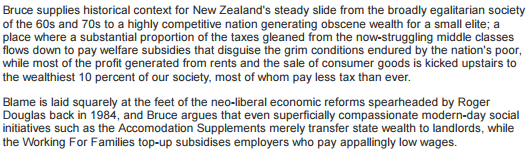
Source: Mind the Gap: Why most of us are poor | Stuff.co.nz.
Bryan Bruce in the caption looks upon the New Zealand of the 1960s and 70s as “broadly egalitarian”. Even Max Rashbrooke had to admit that was not so if you were Maori or female.
The present rate of technology adoption is nearly a vertical line —@blackrock https://t.co/3oS3YAI4ld—
Vala Afshar (@ValaAfshar) January 22, 2016
Maybe 65% of the population of those good old days before the virus of neoliberalism. were missing out on that broadly egalitarian society championed by Bryan Bruce.
As is typical for the embittered left, the reactionary left, gender analysis and the sociology of race is not for their memories of their good old days. New Zealand has the smallest gender wage gap of any of the industrialised countries.
The 20 years of wage stagnation that proceeded the passage of the Employment Contracts Act and the wages boom also goes down the reactionary left memory hole.
That wage stagnation in New Zealand in the 1970s and early 80s coincided with a decline in the incomes of the top 10%. When their income share started growing again, so did the wages of everybody after 20 years of stagnation. The top 10% in New Zealand managed to restore their income share of the early 1970s and indeed the 1960s. That it is hardly the rich getting richer.
President Obama’s Best and Deepest Argument Against His Critics on the Left
19 May 2016 Leave a comment
in liberalism, politics - USA Tags: pessimism bias, racial discrimination

Household penetration of major electrical appliances, 1963, USA, Western Europe and Down Under
10 May 2016 Leave a comment
in applied welfare economics, economic history, technological progress Tags: good old days, pessimism bias, the standards
Michael Reddell stumbled across a fascinating 1965 research paper in an old bookshop. In addition to re-blogging his post, I charted the data he found on household penetration of major electrical appliances in the good old days of the regressive left when everyone was equal, in a union and happy.
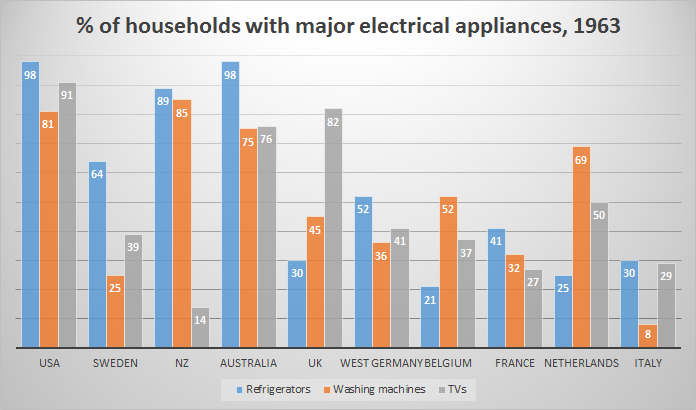
Source: New Zealand Institute of Economic Research (1965), Electric Household Durable Goods: Economic Aspects of their Manufacture in New Zealand via Twenty companies manufacturing TVs | croaking cassandra.
In the early 1960s, there were really big differences not only the number of TV sets, but much more basic appliances we take for granted such as refrigerators and washing machine.
The three indicators in the chart above suggest that life was much better in the USA, Australia and New Zealand than in Western Europe. Television aside, New Zealand seemed to be better off than Australia.
Watch the video by Hans Rosling about what happened when a washing machine first came to his parent’s house. Truly insightful about how living standards are so much better than those of our parents and grandparents.
Common response to new technology: "Commercial Use In Doubt"
08 May 2016 Leave a comment
in economic history, industrial organisation, survivor principle, technological progress Tags: creative destruction, economics of television, entrepreneurial alertness, pessimism bias
John Sculley on the ‘myth’ of home computer market “it doesn’t exist”
08 May 2016 Leave a comment
in economic history, entrepreneurship, industrial organisation, survivor principle Tags: creative destruction, pessimism bias

What are rich countries so grumpy?
07 May 2016 Leave a comment
in applied welfare economics, development economics, growth disasters, growth miracles Tags: compensating differentials, pessimism bias, The Great Enrichment, The Great Fact
Are We Running Out of Resources? #peakoil @greenpeace
04 May 2016 Leave a comment
in economics of media and culture, energy economics, environmental economics Tags: peak oil, pessimism bias
@Economicpolicy shows that top CEO pay has been a miserable rollercoaster for 15 years
25 Apr 2016 Leave a comment
Environmentalists are the biggest science deniers of all #EarthDay
24 Apr 2016 Leave a comment
in economics of regulation, energy economics, environmental economics, global warming, Public Choice, rentseeking Tags: antimarket bias, antiscience left, green rent seeking, Greenpeace, nuclear power, pessimism bias, rational irrationality, wind power

Will the population bomb prevent the great stagnation?
16 Apr 2016 Leave a comment
in applied price theory, development economics, economic growth, industrial organisation, P.T. Bauer, population economics Tags: doomsday prophecies, endogenous growth theory, pessimism bias, population bomb

If only Paul Ehrlich had been right! Population explosion would have meant an explosion in people who could invent new technologies and populate in much larger markets to provide an incentive to invent new products.

Among Paul Ehrlich’s many analytical errors, he did not take into account that more people meant more inventors and more untapped markets.
Jones argued that in the very long run the only way to have further innovation is to have more people. If there are more people undertaking R&D and more people to populate the markets for those inventions, there will be further growth because the decreasing returns to knowledge creation will be overcome by having more R&D workers.
Jones attributes much of the growth in the 20th century to one-off effects that cannot be repeated such as putting more people into higher education:
… growth in educational attainment, developed-economy R&D intensity, and population are all likely to be slower in the future than in the past. These factors point to slower growth in US living standards.
Second, a counterbalancing factor is the rise of China, India, and other emerging economies, which likely implies rapid growth in world researchers for at least the next several decades.
Third, and more speculatively, the shape of the idea production function introduces a fundamental uncertainty into the future of growth. For example, the possibility that artificial intelligence will allow machines to replace workers to some extent could lead to higher growth in the future.
A larger population increases the rate of technological progress by increasing the number of geniuses and other creative people.The doomsday prophecies about the population bomb never took that into account. That is why they are wrong.
 Utopia, you are standing in it!
Recent Comments