1967 Mini Cooper S Police Cars
27 Aug 2015 Leave a comment
in economics of media and culture Tags: police
@radleybalko @thecounted 156 killed by police 1 July-11 August. How did they die?
13 Aug 2015 2 Comments
in economics of crime, law and economics, politics - USA Tags: common law, crime and punishment, criminal deterrence, law enforcement, police

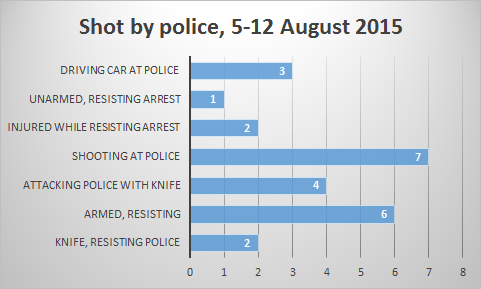
@radleybalko @thecounted 25 killed by police 5-12 August. How did they die? @PoliticalLine
12 Aug 2015 Leave a comment
in economics of crime, law and economics, politics - USA Tags: common law, crime and punishment, criminal deterrence, law enforcement, police
The death toll in high-speed police chases
30 Jul 2015 1 Comment
in economics of crime, law and economics, transport economics Tags: crime and punishment, law and order, law enforcement, police, trade-offs, unintended consequences
High-speed police chases kill 330 people per year, one-third of whom are innocent bystanders: priceonomics.com/the-case-for-b… http://t.co/uFmzxgcplk—
Zachary Crockett (@zzcrockett) July 22, 2015
How to make the case for arming British police when attacking American police shootings
26 Jul 2015 Leave a comment
in economics of crime, health and safety, labour economics, law and economics, politics - USA Tags: common law, crime and punishment, law enforcement, occupational health and safety, police, rule of law
More British English, Scottish and Welsh police (68) have been murdered by gunfire than British police have shot people dead (52) in over a century.
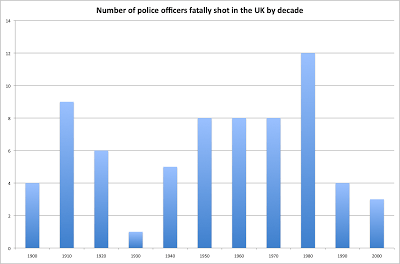
Source: Number of police officers shot dead in the UK by decade | John Graham-Cumming.
This suggests to me that the ledger is in the wrong direction. This list does not include British police stabbed or beaten to death nor are Northern Ireland deaths.
According to the FBI, from 1980–2014, an average of 55 law enforcement officers are feloniously killed per year in the USA. Those killed in accidents in the line of duty are not included in this number.
More law enforcement officers are murdered every year in the USA than ever murdered by gunfire in Britain. Police have the same common law right as any other to defend their own lives and the lives of others.
/cdn0.vox-cdn.com/uploads/chorus_asset/file/2849636/Screen_Shot_2014-12-21_at_1.42.15_PM.0.png)
Entrepreneurial alertness in filming police brutality
25 Jul 2015 1 Comment
in economics of crime, entrepreneurship, law and economics, managerial economics, market efficiency, organisational economics, personnel economics Tags: crime and punishment, criminal deterrence, entrepreneurial alertness, law enforcement, police, police brutality
Personal cameras as evidence that criminal deterrence works and works well
16 Jul 2015 1 Comment
in economics of crime, law and economics, managerial economics, organisational economics, personnel economics, politics - New Zealand, politics - USA Tags: body cameras, crime and punishment, criminal deterrence, police, prisons
Hutt City Council parking wardens are the latest in a long line of frontline staff to wear lapel cameras to deter assaults and verbal abuse. These lapel cameras are another illustration about how criminals and miscreants respond to incentives and are deterred by a greater prospect of being caught, convicted and punished. In the case of lapel cameras, there is a greater prospect of been identified and recorded for later proceedings.

The introduction of personal cameras in New Zealand prisons in high risk areas lead to a large reduction in the number of incidents of violence and abuse towards prison staff. Chief custodial officer Neil Beales said:
The use of on body cameras has led to a 15 to 20 per cent reduction in disruptive incidents (which can range from very minor to more serious) in units where cameras were used, compared with units where they were not used.
Even hardened prison inmates respond to incentives and a greater prospect of being caught and punished.

The introduction of personal cameras is not a priority for the New Zealand police. Mention was made of a six year long budget freeze as one of the reasons.
The first randomized controlled trial of police body cameras in the USA showed that cameras sharply reduce the use of force by police and the number of citizen complaints.

In Seattle, where a dozen officers started wearing body cameras in a pilot program in December, the police department has set up its own YouTube channel, broadcasting a stream of blurred images to protect privacy.
Kids Create Cafeteria Black Market To Bypass Food Nannies
30 Jun 2015 Leave a comment
in economics of crime, economics of education, economics of regulation, entrepreneurship, health economics, industrial organisation, law and economics, survivor principle Tags: black markets, economics of prohibition, entrepreneurial alertness, food, nanny state, police, The fatal conceit, unintended consequences
Public confidence in the police in America
14 May 2015 Leave a comment
in economics of bureaucracy, economics of crime, politics - USA Tags: crime and punishment, law and order, police, voter demographics
Swedish cops on vacation break up NY subway fight
26 Apr 2015 Leave a comment
in economics of crime, law and economics Tags: crime and punishment, law enforcement, New York City, police, Sweden
“We’re no heroes, just tourists.” nyp.st/1PnVhkt http://t.co/EIGtwlajzQ—
New York Post (@nypost) April 23, 2015
via Swedish cops on vacation break up subway fight | New York Post.
Police Officer Runs into Burning House to Rescue Child
28 Mar 2015 Leave a comment
in politics - USA Tags: police
The Effect of Police Body-Worn Cameras on Use of Force and Citizens’ Complaints Against the Police
26 Feb 2015 Leave a comment
in economics of crime, law and economics, managerial economics, organisational economics, personnel economics Tags: camera surveillance, crime and punishment, moral hazard, police
The results are no surprise. There is a 50% drop in the use of force by police when they are required to wear body cameras.
We conducted a randomized controlled trial, where nearly 1,000 officer shifts were randomized over a 12-month period to treatment and control conditions.
During ‘‘treatment shifts’’ officers were required to wear and use body-worn-cameras when interacting with members of the public, while during ‘‘control shifts’’ officers were instructed not to carry or use the devices in any way.
We observed the number of complaints, incidents of use-of-force, and the number of contacts between police officers and the public, in the years and months preceding the trial (in order to establish a baseline) and during the 12 months of the
experiment.
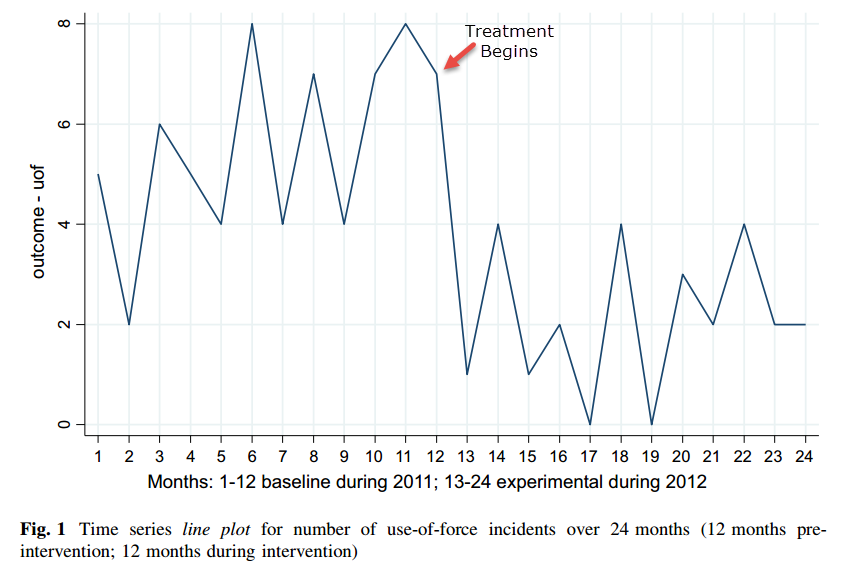
Police use of force reports halved on shifts when police wore cameras. It is not known whether this reduction in the use of force is because members of the public were now aware that any misbehaviour by them to be caught on camera and used as evidence against them or police were aware that any excessive force by them would be caught on camera as well.

 Utopia, you are standing in it!
Recent Comments