Bruce Yandle discusses the concept of Bootleggers and Baptists
15 Nov 2015 Leave a comment
in applied price theory, economics of bureaucracy, Public Choice, rentseeking Tags: bootleggers and baptists, Bruce Shanley, pressure groups
@NaomiAKlein agrees with #MiltonFriedman on Mancur Olson’s theory of how nations escape institutional sclerosis
25 Oct 2015 Leave a comment
in comparative institutional analysis, constitutional political economy, development economics, economic history, economics of bureaucracy, income redistribution, Marxist economics, Milton Friedman, Public Choice, rentseeking, technological progress Tags: expressive voting, interest groups, Leftover Left, logic of collective action, Mancur Olson, Naomi Klein, pressure groups, rational ignorance, rational irrationality, rise and decline of nations, Twitter left

Source: quoted by Naomi Klein in “The Shock Doctrine”.
LA premiere tonight @NaomiAKlein @avilewis @mrdannyglover in person Q&A 7.30pm sundancecinemas.com http://t.co/wRkPFbnUHu—
Changes Everything (@thischanges) October 16, 2015
1. There will be no countries that attain symmetrical organization of all groups with a common interest and thereby attain optimal outcomes through comprehensive bargaining.
2. Stable societies with unchanged boundaries tend to accumulate more collusions and organizations for collective action over time.
3. Members of “small” groups have disproportionate organizational power for collective action, and this disproportion diminishes but does not disappear over time in stable societies.
4. On balance, special-interest organizations and collusions reduce efficiency and aggregate income in the societies in which they operate and make political life more divisive.
5. Encompassing organizations have some incentive to make the society in which they operate more prosperous, and an incentive to redistribute income to their members with as little excess burden as possible, and to cease such redistribution unless the amount redistributed is substantial in relation to the social cost of the redistribution.
6. Distributional coalitions make decisions more slowly than the individuals and firms of which they are comprised, tend to have crowded agendas and bargaining tables, and more often fix prices than quantities.
7. Distributional coalitions slow down a society’s capacity to adopt new technologies and to reallocate resources in response to changing conditions, and thereby to reduce the rate of economic growth.
8. Distributional coalitions, once big enough to succeed, are exclusive, and seek to limit the diversity of incomes and values of their membership.
9. The accumulation of distributional coalitions increases the complexity of regulation, the role of government, and the complexity of understandings, and changes the direction of social evolution.
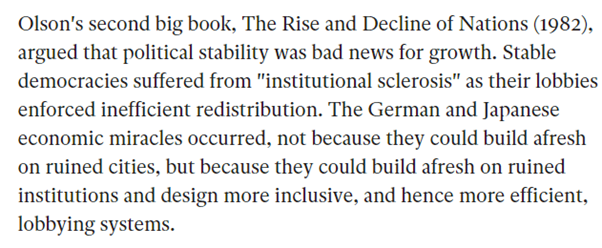
Source: Obituary: Professor Mancur Olson | Obituaries | News | The Independent

The Bootleggers and Baptists alliance between big tobacco and anti-smoking lobbyists on e-cigarettes
25 Aug 2015 Leave a comment
in applied price theory, applied welfare economics, economics of regulation, health economics, politics - Australia, politics - New Zealand, politics - USA, Public Choice, rentseeking Tags: bootleggers and baptists, economics of smoking, meddlesome preferences, nanny state, pressure groups, special interests

Political donors back winners just before they start winning
01 Jul 2015 Leave a comment
in constitutional political economy, economics of bureaucracy, politics - USA, Public Choice, rentseeking Tags: campaign finance reform, campaign finance regulation, political lobbyists, pressure groups, voter demographics
Several major industries have shifted their political donations to Republicans from Democrats: nytimes.com/interactive/20… http://t.co/qYgOdbeZAp—
NYT Graphics (@nytgraphics) June 29, 2015
 Utopia, you are standing in it!
Recent Comments