Psychology has been experiencing a renaissance, not replication crisis, argue Nelson, Simmons, & Simonsohn https://t.co/SPKk8UV0tF pic.twitter.com/2j2H5NSi0C
— Dr. David Miller 🏳️🌈 (@davidimiller) November 1, 2017
Admitting to the problem is progress
28 Dec 2017 Leave a comment
in econometerics Tags: data mining, Psychology
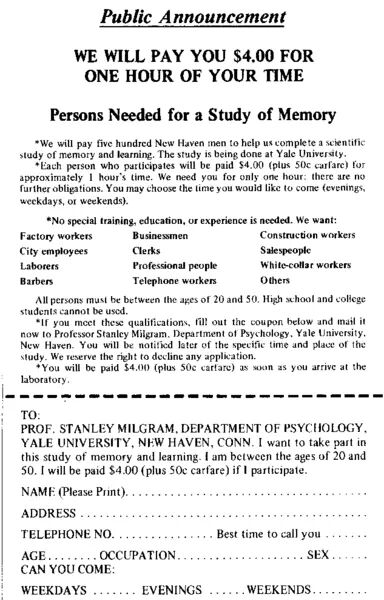
Original recruitment flier for 1963 obedience experiment by Stanley Milgram.
04 Mar 2017 Leave a comment
Why Does Running Water Make You Want To Pee?
17 May 2016 Leave a comment
in economics, economics of media and culture Tags: Psychology
Low performers in maths by gender, USA, UK, Japan, Canada, Australia and New Zealand
17 Jul 2015 Leave a comment
in discrimination, economics of education, gender, human capital, labour economics Tags: cognitive psychology, educational psychology, lost boys, PISA, Psychology, reversing gender gap
Figure 1: % of students achieving a proficiency level below 2 in maths by gender, USA, UK, New Zealand, Japan, Canada and Australia, 2012
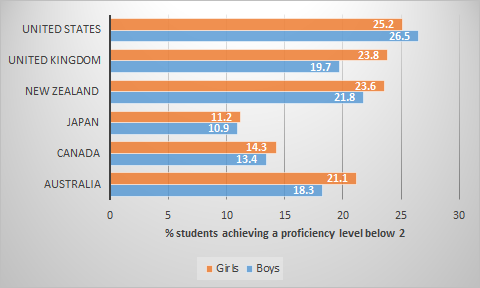
Source: OECD StatExtract.
Low performers in science by gender, USA, UK, Japan, Canada, Australia and New Zealand
16 Jul 2015 Leave a comment
in discrimination, economics of education, gender, labour economics, labour supply Tags: cognitive psychology, educational psychology, lost boys, PISA, Psychology, reversing gender gap
Figure 1: % of students achieving a proficiency level below 2 in science by gender, USA, UK, New Zealand, Japan, Canada and Australia, 2012

Source: OECD StatExtract.
Low performers in reading by gender, USA, UK, Japan, Canada, Australia and New Zealand
15 Jul 2015 1 Comment
in discrimination, economics of education, gender, human capital, labour economics Tags: cognitive psychology, education, lost boys, PISA, Psychology, reversing gender gap
Figure 1: % of students achieving a proficiency level below 2 in reading by gender, USA, UK, New Zealand, Japan, Canada and Australia, 2012

Source: OECD StatExtract.
BBC – How to survive a disaster
05 Mar 2015 Leave a comment
in economics of natural disasters Tags: Dad's army, disasters, panic, Psychology
Rather than madness, or an animalistic stampede for the exits, it is often people’s disinclination to panic that puts them at higher risk…
The prevailing psychological explanation for these kinds of behaviours – passivity, mental paralysis or simply carrying on as normal in the face of a crisis – is that they are caused by a failure to adapt to a sudden change in the environment.
Survival involves goal-directed behaviour: you feel hungry, you look for food; you feel isolated, you seek companionship. Normally, this is straightforward (we know how to find food or companions).
But in a new, unfamiliar environment, particularly a stressful one such as a sinking ship or a burning aircraft, establishing survival goals – where the exit is and how to get to it – requires a lot more conscious effort…
But it’s a good idea to imagine that you will: to be aware that there are threats out there, and that you can prepare for them, without sliding into paranoia.
“All you have to do is ask yourself one simple question,” says Leach. “If something happens, what is my first response? Once you can answer that, everything else will fall into place. It’s that simple.”


 Utopia, you are standing in it!
Recent Comments