Socialism is destroying the Amazon basin
19 Sep 2015 Leave a comment
in applied price theory, property rights, resource economics Tags: Amazon basin, deforestation, privatisation, public ownership
Hopeless KiwiRail bailout reporting by Radio New Zealand
10 Jul 2015 Leave a comment
in applied welfare economics, economics of bureaucracy, economics of media and culture, politics - New Zealand, rentseeking, transport economics Tags: corporate welfare, KiwiRail, media bias, privatisation, public ownership, Radio New Zealand, state owned enterprises
This morning on 9 to noon on Radio New Zealand, Kathryn Ryan, the compere of the program, repeatedly claimed that the government pumped $1 billion into the KiwiRail Turnaround Plan between 2010 and 2014. I was so annoyed by this that I made a broadcasting standards complaint while the program was still being broadcast on my mobile as a one finger typist.
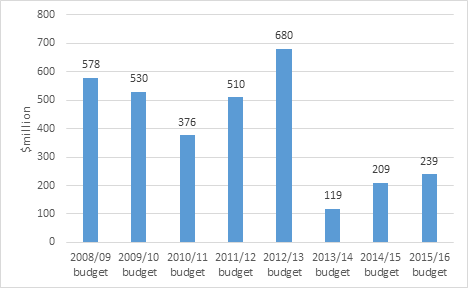
The report on 9 to Noon was in response to the government putting KiwiRail on notice, giving it two years to identify savings and reduce Crown funding required or risk the possibility of closure. Since KiwiRail was acquired in 2008 for $665 million as a commercial investment, Crown investments (taxpayers bailout) totalled $3.4 billion – see Figure 1.
Figure 1: State-owned enterprise welfare, Vote Transport and Vote Finance (KiwiRail), Budgets 08/09 to 15/16
Source: New Zealand budget papers, various years.
Table 1 shows that the KiwiRail Turnaround plan of $1.272 billion since the 2009-10 Budget is only a small part of the bailout of KiwiRail. 9 to Noon simply ignored the $210 million in the 2015 budget for KiwiRail for no explicable reason and instead talked about a $1 billion Turnaround plan rather than the $1.272 billion Turnaround plan.
Table 1: State-Owned Enterprise welfare, Vote Transport and Vote Finance (KiwiRail), Budgets 2008/09 to 2015/16, $million
| 08/09 |
09/10 |
10/11 |
11/12 |
12/13 |
13/14 |
14/15 |
15/16 |
|
|
New Zealand Railways Corporation Loans |
405 |
55 |
250 |
108 |
11 |
|||
|
KiwiRail Turnaround Plan |
20 |
250 |
250 |
250 |
94 |
198 |
210 |
|
|
KiwiRail Equity Injection |
323 |
25 |
29 |
|||||
|
Rail Network and Rolling Stock Upgrade |
105 |
71 |
10 |
|||||
|
New Zealand Railways Corporation Loans |
55 |
|||||||
|
New Zealand Railways Corporation Increase in Capital for the Purchase of Crown Rail |
376 |
|||||||
|
Crown Rail Operator Loans |
140 |
|||||||
|
Crown Rail Operator Equity Injection |
7 |
|||||||
|
Total |
578 |
530 |
376 |
510 |
680 |
119 |
209 |
239 |
Source: New Zealand budget papers, various years.
Other parts of the bailout of KiwiRail include $405 million in loans to the New Zealand Railways Corporation in the 2009-10 budge – see table 1. There was a $323 million equity injection in the 2012-13 Budget – see table 1. KiwiRail has also caused write-downs in the Crown balance sheet of an incredible $9.8 billion since it was repurchased in 2008.
9 to Noon ignored at least two thirds of the cost to the taxpayer of bailing out KiwiRail by only limiting its reporting to part of the KiwiRail Turnaround Plan. It ignored the contribution in the most recent budget to that plan. That does not meet broadcasting standards of accuracy or professional responsibility.
Any reasonable listener will infer, as I did when listening, that the entire cost of the bailout of KiwiRail is represented by the Turnaround Plan of about $1 billion. If listeners were left with that impression, they were misled by 9 to Noon and Radio New Zealand.
It’s Time to Name a Price on KiwiRail – how much more in losses before committing to shutting it down?
09 Jul 2015 1 Comment
in economics of bureaucracy, politics - New Zealand, Public Choice, public economics, rentseeking, transport economics Tags: corporate welfare, hard budget constraints, KiwiRail, privatisation, public ownership, state owned enterprises, state-owned enterprise welfare
In the finest public service traditions of free and frank advice, the New Zealand Treasury in its budget advice this year advised ministers to contemplate shutting down KiwiRail.
Treasury recommended the Government fund KiwiRail for one more year and undertake a comprehensive public study to look into closing the company. The study is public so that people were informed of the costs of running the rail network compared with any benefits it provided. The Government rejected the idea.
Figure 1: State-owned enterprise welfare, Vote Transport and Vote Finance (KiwiRail), Budgets 08/09 to 15/16
Source: New Zealand budget papers, various years.
KiwiRail has been a constant thorn in the taxpayers’ side. Since this rail business was acquired in 2008 for $665 million as a commercial investment, Crown investments have totalled $3.4 billion – see Figure 1.
Fortunately in the 2015 budget, the Minister of Finance signalled that the government’s patience with the KiwiRail deficits is not unlimited. KiwiRail has a 10-year Turnaround Plan to make its freight business commercially viable. The current network of 4,000 km must be reduced to 2,300 km for the company to even breakeven. The Treasury advised, to no avail, that this massive and painful restructuring was required before KiwiRail was purchased. The purchase went through.
The latest developments where Treasury advised ministers to contemplate shutting the network down is an opportunity for ministers, and the opposition spokesmen on finance and transport both to say how much is too much in accumulated KiwiRail losses.
The Minister of Finance and his Cabinet colleagues must say after the public review that there is only so much more left in the cupboard to bailout KiwiRail losses. After that fiscal cap is reached, KiwiRail is on its own. If that means bankruptcy and network closure, so be it.
In the interim, on the side of every KiwiRail train there should be advertising billboards with the following disclosure statements:
- KiwiRail losses adds one percentage point to the company tax rate each year;
- KiwiRail losses takes deny sick taxpayers X number of elective surgeries per year; and
- X number of doctors, nurses, and teachers could have been hired but for last year’s KiwiRail losses!
 Utopia, you are standing in it!
Recent Comments