Why did global warming become climate change?
29 Jun 2015 Leave a comment
in environmental economics, global warming Tags: climate alarmism, expressive voting, global warming, green rent seeking, rational ignorance, rational irrationality
The different types of authoritarian personalities
28 Jun 2015 Leave a comment
in comparative institutional analysis, constitutional political economy, politics - Australia, politics - New Zealand, politics - USA, Public Choice Tags: antiforeign bias, antimarket bias, economics of personality traits, expressive voting, Leftover Left, makework bias, political psychology, rational ignorance, rational irrationality
Millennials’ Political Views Don’t Make Any Sense
22 Jun 2015 Leave a comment
in applied price theory, comparative institutional analysis, constitutional political economy, economics of information, economics of media and culture, income redistribution, politics - USA, Public Choice, rentseeking Tags: antiforeign bias, antimarket bias, expressive voting, make-work bias, rational ignorance, rational irrationality, voter demographics
Millennial politics is simple, really. Young people support big government, unless it costs any more money. They’re for smaller government, unless budget cuts scratch a program they’ve heard of. They’d like Washington to fix everything, just so long as it doesn’t run anything.

Young people lean way left on issues like gay marriage, pot, and immigration. On abortion and gun control, they swim closer to the rest of the electorate.
But on economics, they’re all over the map. You get the sense, reading the Reason Foundation and Pew studies, that a savvy pollster could trick a young person into supporting basically any economic policy in the world with the right combination of triggers. Conservative and liberal partisans can cherry-pick this survey to paint Millennials as whatever ideology they want.

On spending:
Conservatives can say: 65 percent of Millennials would like to cut spending.
Liberals can say: 62 percent would like to spend more on infrastructure and jobs.On taxes:
Conservatives can say: 58 percent of Millennials want to cut taxes overall.
Liberals can say: 66 percent want to raise taxes on the wealthy.On government’s role in our lives:
Conservatives can say: 66 percent of Millennials say that “when something is funded by the government, it is usually inefficient and wasteful.”
Liberals can say: More than two-thirds think the government should guarantee food, shelter, and a living wage.On government size:
Conservatives can say: 57 percent want smaller government with fewer services (if you mention the magic word “taxes”).
Liberals can say: 54 percent want larger government with more services (if you don’t mention “taxes”).

via Millennials’ Political Views Don’t Make Any Sense – The Atlantic and This poll proves that millennials have totally incoherent political views – Vox.
Green parties score 2/3 on this test?
21 Jun 2015 Leave a comment
in economics of regulation, health economics, politics - Australia, politics - New Zealand, politics - USA, technological progress Tags: 9/11, anti-vaccination movement, antiscience left, conspiracy theories, expressive voting, GMOs, inspiriting theorists, rational ignorance, rational irrationality, risk risk trade-offs, vaccines
The GMO food die-hard GMO opponents love (and oppose a label for)
20 Jun 2015 Leave a comment
in economics of information, economics of media and culture, economics of regulation, environmental economics, health economics, law and economics, politics - USA Tags: antiscience left, expressive voting, food labelling, GMOs, product labelling, rational ignorance, rational irrationality
Ben Elton on the fraying of the Left
19 Jun 2015 Leave a comment
in economics of media and culture, politics - Australia, politics - New Zealand, politics - USA Tags: Ben Elton, expressive voting, Green Left, Leftover Left, rational ignorance, rational irrationality, The fatal conceit, The pretence to knowledge
Every 20 years we worry about losing jobs to technology
17 Jun 2015 Leave a comment
in economics of education, entrepreneurship, human capital, industrial organisation, labour economics, labour supply, occupational choice, Public Choice, rentseeking, survivor principle Tags: antimarket bias, creative distraction, expressive voting, make-work bias, rational ignorance, rational irrationality, technological unemployment
Every 20 years we worry about losing jobs to tech. books.google.com/ngrams/graph?c… http://t.co/KW47Iwzsp9—
James Bessen (@JamesBessen) August 10, 2014
Mises on why economics analysis is so unpopular
14 Jun 2015 Leave a comment
in applied price theory, applied welfare economics, comparative institutional analysis, constitutional political economy, economics of bureaucracy, income redistribution, Ludwig von Mises, Public Choice, rentseeking Tags: antiforeign bias, antimarket bias, expressive voting, green rent seeking, makework bias, NIMBYs, rational ignorance, rational irrationality
Irrational nonsense mapped
12 Jun 2015 Leave a comment
in health economics, liberalism, politics - Australia, politics - New Zealand, politics - USA Tags: anti-vaccination movement, antifluoridation movement, antiscience left, BlackBerry, conjecture and refutation, conspiracy theories, conspiracy theorists, expressive voting, infotopia, rational ignorance, rational irrationality
What it would take for the US to run on 100% renewable energy
10 Jun 2015 Leave a comment
in energy economics, environmental economics, global warming, politics - USA Tags: expressive voting, geothermal power, hydroelectric power, rational ignorance, rational irrationality, renewable energy, solar power, tidal power, wind power
/cdn0.vox-cdn.com/uploads/chorus_asset/file/3768834/jacobson-us-renewables-2015.png)
How do presidential candidates spend $1 billion?
10 Jun 2015 Leave a comment
in politics - USA, Public Choice Tags: campaign finance regulation, expressive voting, rational ignorance, rational irrationality

The price, output and acreage effects of a GMO ban
08 Jun 2015 Leave a comment
in development economics, economics of regulation, environmental economics, growth disasters, growth miracles, health economics, politics - Australia, politics - New Zealand, politics - USA, population economics, technological progress Tags: agricultural economics, expressive voting, extreme poverty, global hunger, global poverty, GMOs, Left-wing hypocrisy, rational ignorance, rational irrationality, The Great Fact
Organic farming is a gift….
facebook.com/welovegv http://t.co/iu8Jq0KcHD—
C. S. Prakash (@AgBioWorld) June 05, 2015
Projected increases in corn and soy prices in a world without GMOs
ageconsearch.umn.edu/bitstream/2049… http://t.co/PNydjpl59K—
C. S. Prakash (@AgBioWorld) June 08, 2015
If you outlaw GMOs, be prepared to bring millions of acres of forest land, cropland & pasture under farming http://t.co/H9ftkxhXYe—
C. S. Prakash (@AgBioWorld) June 08, 2015
If GMOs are banned today in the US, what would be the crop yield reduction? http://t.co/pEn73PODcR—
C. S. Prakash (@AgBioWorld) June 08, 2015
Deranged conspiracy theories versus the domestic political reality of the Indonesian resumption of executions
05 Jun 2015 Leave a comment
in development economics, economics of crime, law and economics, politics - Australia Tags: Australia, capital punishment, conspiracy theories, crime and punishment, expressive voting, Indonesia, left-wing condescension, Left-wing hypocrisy, Leftover Left, rational ignorance, rational irrationality
The Australian human rights commissioner has put forward a bizarre conspiracy theory linking the recent execution of two drug traffickers in Indonesia to the Australian policy of turning back refugee boats.

Ignorance and condescension of Indonesian domestic politics is prevalent among the left wing elite in Australia.
Indonesia started executions again under the new president after a long hiatus and in particular for death sentences for narcotics drug trafficking. Indonesia had an unofficial moratorium on the death penalty between 2008 and 2012 but resumed executions in 2013. Executions were infrequent.
The new president was recently elected on a platform of being tough on crime and in particular on drug trafficking and the 64 drug traffickers currently on death row:
[The clemency requests] are not on my table yet. But I guarantee that there will be no clemency for convicts who committed narcotics-related crimes
Secondly, making concessions to Australia does not win votes in Indonesia which is a democracy. Thirdly, a range of foreigners are on death row in Indonesia. The best way to have kept those two Australians alive was to say nothing so hopefully they are not moved up in the queue to spite Australia to win domestic political points.
Fourthly, someone of her legal training should be better at spinning conspiratorially yarns than this particularly weak work of imagination.
The Green vote can only head south under James Shaw or why he must win Wellington Central
30 May 2015 Leave a comment
in politics - New Zealand, Public Choice Tags: expressive voting, James Shaw, New Zealand Greens, New Zealand Labour Party, rational ignorance, rational irrationality, swinging voter, tactical voting, vote parking
The New Zealand Greens have elected a new male co-leader. James Shaw is a first term MP who is supposed to consolidate and build the green vote from 10%. At the last election, the Greens were targeting a 15% party vote. Their vote fell from 11.1% to 10.7%.
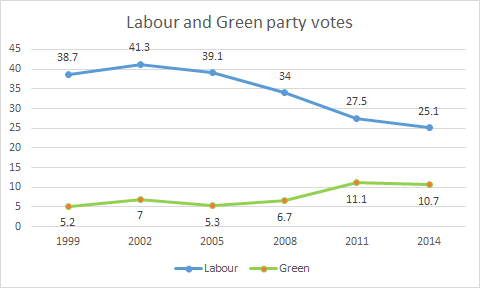
I doubt that he can do it because much of the improvement of the Green vote since the 2005 election has been an expense of the Labour Party.
The Green vote was pretty sickly at 5-7% when the Labour Party was popular in government between 1999 and 2005. In the 2005 election, the Greens failed to reach the 5% party vote threshold necessary to win seats in Parliament on election night. It was only saved by absentee and postal votes that pushed its party vote up to 5.3%.
Maybe 30% of the Green vote, perhaps more, is made up of disgruntled Labour Party voters awaiting the call home. These disgruntled Labour voters will vote for the Labour Party again when it is fit for government.
Once there is a Labour–Green government in New Zealand, the Green vote faces the recurring theme that green parties lose a substantial part of their vote whenever they get into government such as happened federally in Australia and in Tasmania.
If the Greens go into government with about 7% of the party vote in the 2017 or 2020 New Zealand general elections, the Greens face the real prospect of of being voted out of Parliament completely in the 2023 New Zealand general election if their vote drops below 5%.
James Shaw happened to run for the Wellington Central electorate in the 2014 general election. He did not ask for the electorate vote in that election. Only the party vote.
Wellington Central has one of the highest green party votes in New Zealand. The Green party vote is 2000 more than Labour’s party vote in Wellington Central although the National Party won the party vote with 14,000 party votes.

Given the fact that the Greens may dropped below 5% by 2020, James Shaw would be wise to try to win Wellington Central in 2017 as a safety margin. If a party wins electorate seat under MMP, their party vote counts towards winning list MPs even if they win less than 5% of the party vote.
To add a twist to the tail, the deputy leader of the Labour Party, Grant Robertson, is the sitting member for Wellington Central with a margin of 8000 votes. If the current leader of the opposition fails at his job, Grant Robertson is his natural replacement.
There’s not much room at the top of the Labour Party list for defeated electoral seat candidates because of the last election Labour’s party vote was so low that it was only eligible for five list MPs. The last of these was the current leader of the opposition prove wasn’t even elected on election night but got back into Parliament on postal and absentee votes.
To complicate Grant Robinson’s golden parachute even further, the Labour Party has a policy that 50% of its caucus should be female by 2017 and the party list should be drawn up with that gender quota in mind. Grant Robertson may be a victim of this policy if he does not win Wellington Central.
More than a few careers hinge on the election of James Shaw as male co-leader of the Greens including the very survival of his party. It would be a tight race, but James Shaw could win Wellington Central.
.
 Utopia, you are standing in it!
Recent Comments