A tale of two cities – Hong Kong’s and Singapore’s different paths to prosperity

Hong Kong and Singapore had different paths to prosperity. Alywn Young found that Hong Kong had made real productivity gains, but Singapore grew by a massive dose of savings and investment, including foreign investment.

For most of the post-war era, the Hong Kong government adopted a policy of minimal intervention. the government of Singapore has pursued maximalist policies involving widespread state participation in economic activity and aggressive industry targeting policies.

The share of investment in Singapore’s GDP rose from 9% in 1960 to 43% in 1984, while Hong Kong’s remained steady at about 20%. Productivity growth in the aggregate non-agricultural economy was a miserable -0.3% in Singapore and 2.3% in Hong Kong.

What does this mean in practical terms? Real consumption, real consumer spending, per capita in Hong Kong is 20%  or more higher than in Singapore!

Hong Kong actually enjoyed their prosperity. Robert Barro explains this in a comment on Young’s paper:

In 1985, when Singapore’s per capita real GDP was 102% of Hong Kong’s, the consumption was only 70% of Hong Kong’s. To put it another way, Hong Kong’s per capita real consumption grew by 5.9% per year from 1960 to 1985, about the same as for GDP, whereas Singapore’s grew by only 2.8% per year, much less than GDP.

In terms of output per capita and output per worker, the growth of Hong Kong and Singapore are equally impressive. Hong Kong does much better in terms of  productivity growth.

Hong Kong did not require as rapid capital accumulation as Singapore. Since capital accumulation is financed either by domestic saving or foreign saving, people in Hong Kong can afford to save less or borrow less from foreign economies. Saving less now means more consumption now.

In the case of Hong Kong, their living standards are far superior to Singapore’s. The government of Singapore wasted a good 20 to 30% of national income on industry targeting and compulsory savings.

Hong Kong experienced rapid total productivity growth, while Singapore  experienced no improvement whatsoever in total productivity during its East Asian Tiger years. Young (1992, 1994, 1995) demonstrated that from 1967 onward total factor productivity growth in Singapore was next to nil, and for significant parts of the period most likely negative. Only productivity allows a nation to support and enjoy high wages.

My New Report on Corporate Welfare in New Zealand

The Taxpayers’ Union today launched my report, Monopoly Money, which examines the cost and case for New Zealand’s extensive corporate welfare programmes.

Figure 1: Corporate welfare, Budgets 2008/09 to 2014/15

image

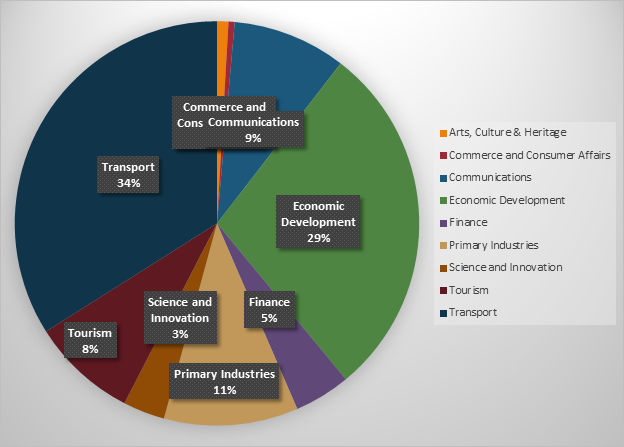
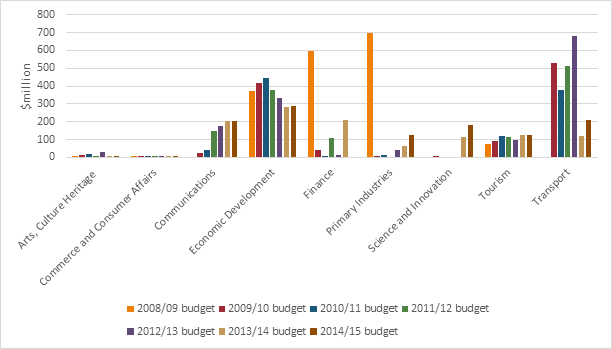
My report, which examines the cost of corporate welfare examines government spending since the 2007/2008 budget, shows:

  • Since National took office, corporate welfare has cost taxpayers $1-1.4 billion ($600 – $800 per household) per year
  • If corporate welfare was abolished, enough money would be saved to reduce the corporate tax rate from 28% to 22.5%
  • If applied to personal income tax rates, the saving would allow the 30% and 33% income tax rates to be lowered to 29%
Figure 2: Corporate welfare, Budgets 2008/09 to 2014/15 by Vote

image

Figure 3: Distribution of total corporate welfare across votes, 2008/09 to 2014/15

image

Development economics in a nutshell: Gordon Tullock developed his rent seeking insight when he was a diplomat in China

Image

IOC diva-like demands on Norway for its now scuttled Winter Olympics bid

  • They demand to meet the king prior to the opening ceremony. Afterwards, there shall be a cocktail reception. Drinks shall be paid for by the Royal Palace or the local organizing committee
  • Separate lanes should be created on all roads where IOC members will travel, which are not to be used by regular people or public transportation.
  • A welcome greeting from the local Olympic boss and the hotel manager should be presented in IOC members’ rooms, along with fruit and cakes of the season. (Seasonal fruit in Oslo in February is a challenge…)
  • The hotel bar at their hotel should extend its hours “extra late” and the minibars must stock Coke products.
  • The IOC president shall be welcomed ceremoniously on the runway when he arrives.
  • The IOC members should have separate entrances and exits to and from the airport.
  • During the opening and closing ceremonies a fully stocked bar shall be available. During competition days, wine and beer will do at the stadium lounge.
  • IOC members shall be greeted with a smile when arriving at their hotel.
  • Meeting rooms shall be kept at exactly 20 degrees Celsius at all times.
  • The hot food offered in the lounges at venues should be replaced at regular intervals, as IOC members might “risk” having to eat several meals at the same lounge during the Olympics.

The Economics of Europe’s Insane History of Putting Animals on Trial and Executing Them

jj

The fantastically creative and insightful Peter Leeson published an article in the Journal of Law and Economics in 2013 on the practice of putting animals on trial in the Medieval ages.

Abstract
For 250 years insects and rodents accused of committing property crimes were tried as legal persons in French, Italian, and Swiss ecclesiastic courts under the same laws and according to the same procedures used to try actual persons.

I argue that the Catholic Church used vermin trials to increase tithe revenues where tithe evasion threatened to erode them.

Vermin trials achieved this by bolstering citizens’ belief in the validity of Church punishments for tithe evasion: estrangement from God through sin, excommunication, and anathema.

Vermin trials permitted ecclesiastics to evidence their supernatural sanctions’ legitimacy by producing outcomes that supported those sanctions’ validity. These outcomes strengthened citizens’ belief that the Church’s imprecations were real, which allowed ecclesiastics to reclaim jeopardized tithe revenue

Leeson’s paper is also closely connected to Ekelund, Herbert, and Tollison’s (1989, 2002, 2006) and Ekelund et al.’s (1996) work. They study the medieval Catholic Church as a firm. They discuss how ecclesiastics used supernatural sanctions to protect the Church’s monopoly on spiritual services against heretical competition.

HT: Wired – fantastically-wrong-europes-insane-history-putting-animals-trial-executing/

Managerial Econ: Make the rules or your rivals will: use anti-growth activists to erect entry barriers

The courts have sanctioned the right to organize community opposition that urges government officials and agencies to deny land use permits to applicants, even when the underlying motive of the opposition is protecting market share and eliminating competition.

What’s more, the courts are protecting third-party funding sources, in many cases anonymous funding sources, which support the opposition efforts in order to block potential competition.

via Managerial Econ: Make the rules or your rivals will: use anti-growth activists to erect entry barriers.

Trigger warning: How attached are cats to their owners?

Infrastructure investment and economic development strategies in Shanghai and Rio de Janeiro

Image

The people designing your cities don’t care what you want. They’re planning for hipsters. – The Washington Post

HT: Michael Warby via The people designing your cities don’t care what you want. They’re planning for hipsters. – The Washington Post .

Fire of truth: subsidies and rent seeking

Image

The business community as an enemy of capitalism

alt


The sound and the fury

It is a general popular error to suppose the loudest complainers for the public to be the most anxious for its welfare.  - Edmund Burke

Image

Forget income inequality, lets go after zoning restrictions…


via Managerial Econ: Forget income inequality, lets go after zoning restrictions….

Image

Welfare economics of monopoly and rent seeking

Monopolisation has resulted in a higher price being paid (Pm not Pc) and the quantity bought (Qm not Qc) has been reduced. Part of the consumer surplus triangle has been shifted to producers as excess profits but part of it is totally lost to society as shown by the reduction in output from Qc to Qm.

The monopolised industry may result in more efficient production techniques and lowered costs. The net welfare gain or loss to the total economy is the difference between the red and blue areas.

Tullock’s (1967) argument is that if a successful monopolist can extort the excess profits from his customers such as through a government licence giving them a monopoly, such a large prize is worth the investment of up to an equivalent amount of resources  equal to the capitalised value of the future monopoly profits.

Rational entrepreneurs should be willing to invest resources in attempts to form a monopoly until the marginal cost equals the properly discounted marginal return. Under certain assumptions (see Posner 1975) the competitive outlays to establish a monopoly will exactly equal the present value of the profit rectangle.

Rent_seeking - Rent_seeking Picture Slideshow

The Tullock rectangle may have to be added to the Harberger triangle when calculating the potential loss of welfare associated with monopoly.

Paul Krugman on the nonsense thinking behind trade negotiations

HT: Alan Moran

Previous Older Entries Next Newer Entries

Bassett, Brash & Hide

Celebrating humanity's flourishing through the spread of capitalism and the rule of law

Truth on the Market

Scholarly commentary on law, economics, and more

The Undercover Historian

Beatrice Cherrier's blog

Matua Kahurangi

Celebrating humanity's flourishing through the spread of capitalism and the rule of law

Temple of Sociology

Celebrating humanity's flourishing through the spread of capitalism and the rule of law

Velvet Glove, Iron Fist

Celebrating humanity's flourishing through the spread of capitalism and the rule of law

Why Evolution Is True

Why Evolution is True is a blog written by Jerry Coyne, centered on evolution and biology but also dealing with diverse topics like politics, culture, and cats.

Down to Earth Kiwi

Celebrating humanity's flourishing through the spread of capitalism and the rule of law

NoTricksZone

Celebrating humanity's flourishing through the spread of capitalism and the rule of law

Homepaddock

A rural perspective with a blue tint by Ele Ludemann

Kiwiblog

DPF's Kiwiblog - Fomenting Happy Mischief since 2003

The Dangerous Economist

Celebrating humanity's flourishing through the spread of capitalism and the rule of law

Watts Up With That?

The world's most viewed site on global warming and climate change

The Logical Place

Tim Harding's writings on rationality, informal logic and skepticism

Doc's Books

A window into Doc Freiberger's library

The Risk-Monger

Let's examine hard decisions!

Uneasy Money

Commentary on monetary policy in the spirit of R. G. Hawtrey

Barrie Saunders

Thoughts on public policy and the media

Liberty Scott

Celebrating humanity's flourishing through the spread of capitalism and the rule of law

Point of Order

Politics and the economy

James Bowden's Blog

A blog (primarily) on Canadian and Commonwealth political history and institutions

Science Matters

Reading between the lines, and underneath the hype.

Peter Winsley

Economics, and such stuff as dreams are made on

A Venerable Puzzle

"The British constitution has always been puzzling, and always will be." --Queen Elizabeth II

The Antiplanner

Celebrating humanity's flourishing through the spread of capitalism and the rule of law

Bet On It

Celebrating humanity's flourishing through the spread of capitalism and the rule of law

History of Sorts

WORLD WAR II, MUSIC, HISTORY, HOLOCAUST

Roger Pielke Jr.

Undisciplined scholar, recovering academic

Offsetting Behaviour

Celebrating humanity's flourishing through the spread of capitalism and the rule of law

JONATHAN TURLEY

Res ipsa loquitur - The thing itself speaks

Conversable Economist

Celebrating humanity's flourishing through the spread of capitalism and the rule of law

The Victorian Commons

Researching the House of Commons, 1832-1868

The History of Parliament

Articles and research from the History of Parliament Trust

Books & Boots

Reflections on books and art

Legal History Miscellany

Posts on the History of Law, Crime, and Justice

Sex, Drugs and Economics

Celebrating humanity's flourishing through the spread of capitalism and the rule of law

European Royal History

Exploring the Monarchs of Europe

Tallbloke's Talkshop

Cutting edge science you can dice with

Marginal REVOLUTION

Small Steps Toward A Much Better World

NOT A LOT OF PEOPLE KNOW THAT

“We do not believe any group of men adequate enough or wise enough to operate without scrutiny or without criticism. We know that the only way to avoid error is to detect it, that the only way to detect it is to be free to inquire. We know that in secrecy error undetected will flourish and subvert”. - J Robert Oppenheimer.

STOP THESE THINGS

The truth about the great wind power fraud - we're not here to debate the wind industry, we're here to destroy it.

Lindsay Mitchell

Celebrating humanity's flourishing through the spread of capitalism and the rule of law

Alt-M

Celebrating humanity's flourishing through the spread of capitalism and the rule of law

croaking cassandra

Economics, public policy, monetary policy, financial regulation, with a New Zealand perspective

The Grumpy Economist

Celebrating humanity's flourishing through the spread of capitalism and the rule of law

International Liberty

Restraining Government in America and Around the World