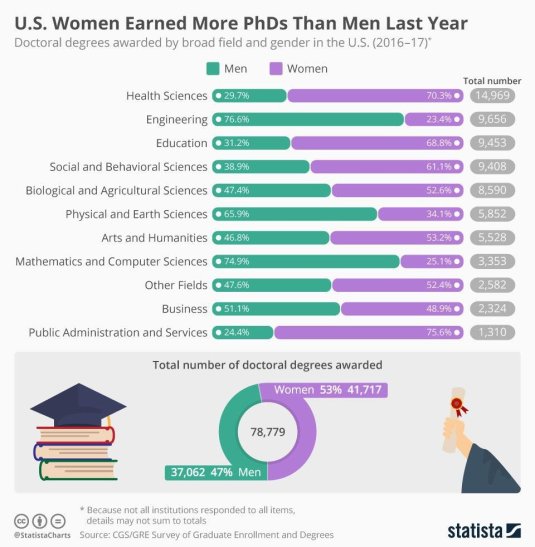
Women have achieved parity with men in biological and agricultural sciences PhDs and in business PhDs.
Cool!! pic.twitter.com/1yTau9ESne
— Noah Smith 🐇🇺🇸🇺🇦🇹🇼 (@Noahpinion) December 18, 2018
Celebrating humanity's flourishing through the spread of capitalism and the rule of law
28 Dec 2018 Leave a comment
in discrimination, economics of education, gender, human capital, James Buchanan, labour economics, labour supply, occupational choice, poverty and inequality Tags: reversing gender gap
10 Dec 2018 Leave a comment
in discrimination, economics of education, gender, human capital, labour economics, labour supply, occupational choice Tags: reversing gender gap
01 May 2017 1 Comment
in discrimination, economics of education, gender, human capital, labour economics, labour supply, occupational choice Tags: College premium, gender way, reversing gender gap
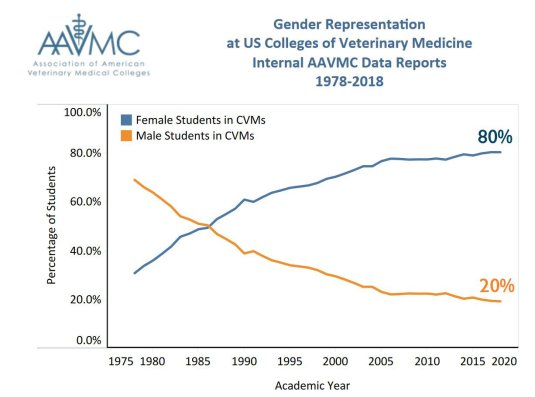
On the upside, Goldin (2006) showed that women adapted rapidly over the 20th century to changing returns to working and education as compared to options outside the market. Their labour force participation and occupational choices changed rapidly into long duration professional educations and more specialised training in the 1960s and 1970s as many more women worked and pursued careers. The large increase in tertiary education by New Zealand after 1990 and their move into many traditionally male occupations is another example.
The key is what drives the rapid changes in the labour force participation and occupational choices of women. Some of the factors are global technology trends such rising wages and the emergence of household technologies and safe contraception and antidiscrimination laws. All of these increased the returns to working and investing in specialised education and training.
Up until the mid-20th century, women invested in becoming a teacher, nurse, librarian or secretary because these skills were general and did not deprecate as much during breaks. When expectations among women of still working at the age of 35 doubled, there were massive increases in female labour force participation and female investments in higher education and specialised skills (Goldin and Katz 2006). These trends continue to today.
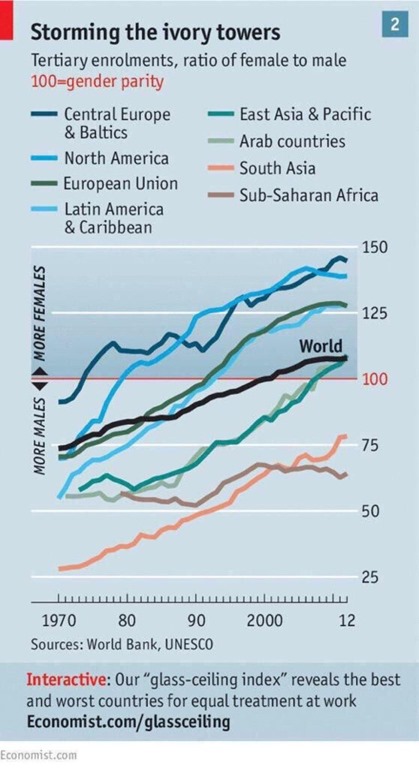 Women and in particular those women making education choices need good information on their prospects in different occupations. The evidence is they adapt rapidly to changing prospects (Goldin 2004, 2006). Goldin (2004, 2006) referred to a quiet revolution in women’s employment, earnings and education because the changes in female labour supply and occupational choices were abrupt and large.
Women adapted rapidly to changes in their expectations about their future working life, graduation rates, attainment of professional degrees, age of first marriage, and the timing and number of children. These expectations of women about their futures turned out the surprisingly accurate (Katz 2004, 2006). Young women are surprisingly good forecasters of their labour market involvement. Any gender policy options must be sensitive to the high level of responsiveness of women to changing educational opportunities and prospects and their precision to date as forecasters.
The complex decisions youth make about education and occupational choices is driven by many sources. Women are interested in issues that are of less importance to men such as work-life balance and the costs of career breaks to their earning power and human capital. Goldin (2004, 2006) argued that women who have a more accurate assessment of their future labour market involvement will invest more wisely in education and occupational choice.
The market process rewards the skills and commitment the men and women bring to the labour market. The differences in skills and commitment the men and women bring arise from a gendered division of labour and effort in the household and in raising families that appears to be open to only minor changes that are expensive in terms of growth and prosperity. This is because most gains in the status of women were the result of economic growth rather than legal interventions. Child care subsidies and parental leave arose after rising income made them and the modern welfare state fiscally affordable rather than the other way around.
28 Apr 2017 Leave a comment
in discrimination, economics of education, gender, human capital, labour economics, labour supply, occupational choice Tags: college major, College premium, gender wage gap, graduate premium, reversing gender gap
Rosen (2004) suggests that the engineering market responds strongly to economic forces. The demand for engineers responds to the price of engineering services and demand shocks such as recessions and defence cuts. Supply and enrolment decisions are remarkably sensitive to career prospects in engineering. Students also appear to use some forward-looking elements to forecast demand for engineers. Many students also change their majors in light on more information on whether the like their current choices and other news (Bettinger 2010).
This evidence of students use forward-looking elements to forecasting the occupational demand for human capital suggests that better information may improve these choices. The government has made a distributional judgment to expand the choices open to women. The growing evidence of relatively accurate forward looking decisions making by students suggests that they will respond to additional information on prospects in different careers.
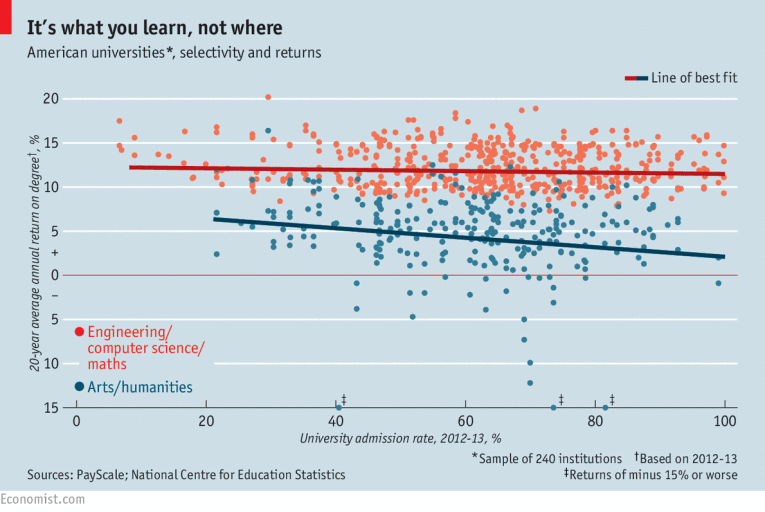
In addition, earnings from some occupations are also more uncertain than others. The STEM occupations are an example where shortages and, in particular, surpluses are more common because durable goods industries bear the bulk of business cycle risk. There is also the political unpredictability of defence and R&D spending. Women seem to prefer jobs that are more secure. Some occupations have higher risks of injury than others. Fewer parents, and both single fathers and single mothers, in particular, enter these more injury prone occupations.
These gender-based preferences about hazards and uncertainties will lead to fewer women entering occupations that are more injury prone or more at risk to recessions and industry-specific downturns. Occupational segregation will still persist in the labour market in the relative absence of either discrimination or a gendered division of labour and household effort.
26 Apr 2017 Leave a comment
in discrimination, economic history, economics of education, gender, human capital, labour economics, labour supply, occupational choice Tags: College premium, gender, reversing gender gap
There are important drivers of occupational segregation that are not related to either discrimination or a gendered division of labour. These newer drivers are strong enough to explain most of the gender differences in tertiary education attainment. These gender differences in tertiary attainment and the drivers behind them will be important determinates of the future occupational segregation and entry into male dominated professions.
An important driver of occupational segregation is modern technological trends ranging from ICT to the emergence of a larger service sectors that have worked to the comparative advantage of women. Many more service jobs and fewer jobs based on brawn have increased the returns to women of working more in the market. In addition, a range of personality traits and skills work to the advantage of women in some occupations more than others.
Another driver of occupational segregation is women have more occupation choices than men because of different personality traits and superior verbal and readings skills. The superior verbal and reading skills of teenage girls are the equivalent of ½ a year’s extra schooling (OECD 2012). Teenage girls also score higher on personality traits such as persistence. Teenage boys have many more behavioural problems. Boys do especially poorly in broken families (Bertrand and Pan 2013).
Jacob (2002) found that higher non-cognitive skills and larger college premiums for women accounted for 90 percent of the gender gap in higher education. Becker, Hubbard and Murphy (2010) found that differences in the costs of college for women and men are primarily due to differences in the distributions of non-cognitive skills and explain most of the world-wide overtaking of men by women in higher education.
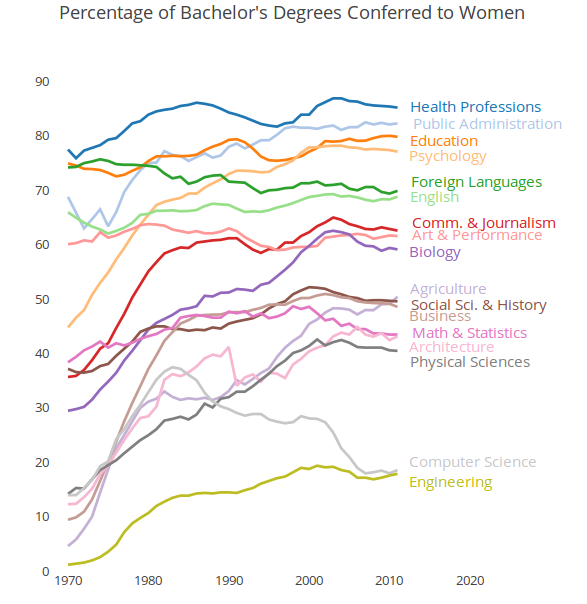
About 64% of recent New Zealand graduates were women but they have personality traits and verbal and reading skills that will be rewarded more in interactive professions and occupations. Women are pursuing these comparative advantages and maximising the rewards on their skills and natural talents. These differences in skills and talents will lead to different occupational and sub-occupational distributions and mixes as compared to men despite any differences arising from the gendered division of labour and effort and costs of care giving.
There are fewer women in STEM occupations because they have better options elsewhere to reward both their mathematical and scientific talents and their superior verbal and reading skills.
The wage premium for STEM occupations for women is much smaller because they have options elsewhere that reward all of their skills, not just their STEM related talents. Young women and well as young men do equally will in the STEM prerequisites. Women have more options is other higher power occupations that make full use of their more diverse talents.
Occupational segregation in the future in part will be driven the same factors behind much higher female tertiary educational attainment. Superior verbal and readings skills and greater persistence and self-organisation among women will make some occupations more rewarding for them as compared to males who have, on average, fewer of these innate talents.
11 Apr 2017 Leave a comment
in health economics Tags: Darwin awards, reversing gender gap
27 Mar 2017 Leave a comment
in discrimination, gender, labour economics, politics - New Zealand Tags: gender wage gap, reversing gender gap, unconscious bias
24 Mar 2017 Leave a comment
in discrimination, economics of education, gender, human capital, labour economics, labour supply, occupational choice, urban economics Tags: College premium, gender way, graduate premium, reversing gender gap, urban wage premium
09 Feb 2017 Leave a comment
in discrimination, economics of education, gender, human capital, labour economics Tags: behavioural genetics, educational psychology, gender gap, gender wage gap, reversing gender gap
06 Feb 2017 Leave a comment
in discrimination, economics of education, gender, labour economics, labour supply, occupational choice Tags: behavioural genetics, compensating differentials, educational psychology, gender gap, reversing gender gap
13 Jan 2017 Leave a comment
in discrimination, gender, human capital, labour economics, labour supply, occupational choice, poverty and inequality Tags: British economy, gender wage gap, reversing gender gap
08 Nov 2016 Leave a comment
in discrimination, economics of education, gender, human capital, labour economics, minimum wage, occupational choice Tags: gender wage gap, reversing gender gap
Rendall and Rendall (2016) found that women prefer occupations where their skills depreciate slowest when taking time out from motherhood. Verbal and reading skills depreciate at a far slower rate than mathematical and scientific skills so this gives women yet another strong reason to avoid science, technology, engineering and maths (STEM) careers.
we show that college educated women avoid occupations requiring significant math skills due to the costly skill atrophy experienced during a career break. In contrast, verbal skills are very robust to career interruptions.
The results support the broadly observed female preference for occupations primarily requiring verbal skills – even though these occupations exhibit lower average wages. Thus, skill-specific atrophy during employment leave and the speed of skill repair upon returning to the labour market are shown to be important factors underpinning women’s occupational outcomes.
Not only do women have vastly superior verbal and reading skills, worth somewhere near 6 to 12 months extra schooling, these skills do not depreciate much during career breaks. Indeed, reading and verbal skills tend to naturally increase with age until your late 60s.
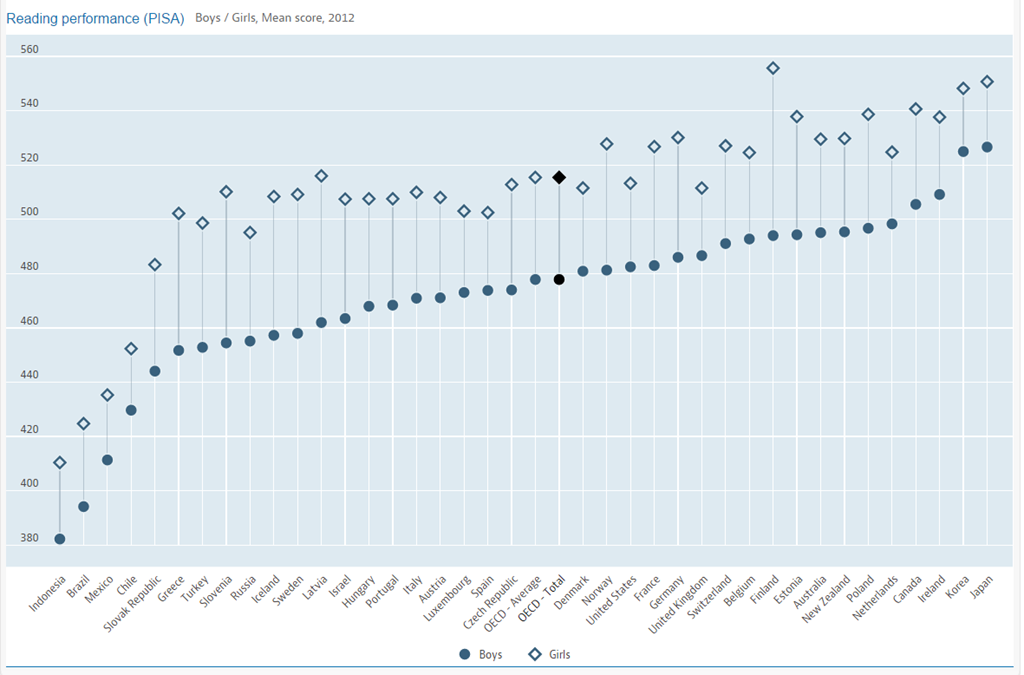
Source: Reading performance (PISA) – International student assessment (PISA) – OECD iLibrary.
Maths skills get rusty if not used while knowledge of computer languages and the like and of specific technologies can be quickly overtaken by events while on maternity leave. Rendall and Rendall (2016) again
… college educated females avoid math-heavy occupations, and pursue verbal-heavy occupations instead. This is due to the high skill atrophy associated with math skills, and the ability of verbal skills to act as “skill insurance” against gaps.
Additionally, for college educated individuals, math is the skill most vulnerable to loss during employment gaps, which also implies a slow rebuilding post-break. In contrast, non-college educated individuals experience a much smaller math skill loss.
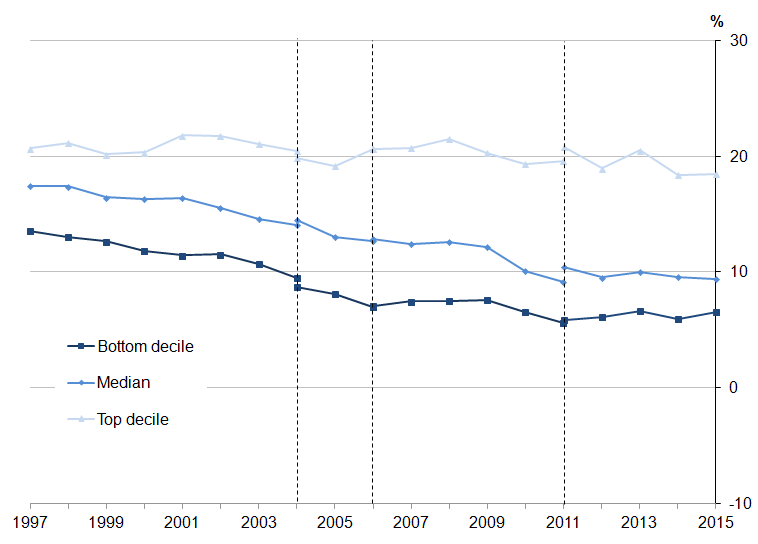
Rendall and Rendall’s point about college educated women avoiding maths heavy occupations even if it costs them wages so as to maximise the lifetime income may explain the larger gender wage gap at the top of the income distribution than at the bottom.
At the bottom of the income distribution, skill atrophy do not really matter much. At the top, it do. Women make occupational choices where annual income may be lower but lifetime income may be higher because of the lower rates of skill depreciation when they are out having children.
29 Aug 2016 Leave a comment
in economics of education, gender, human capital, labour economics Tags: gender gaps, reversing gender gap
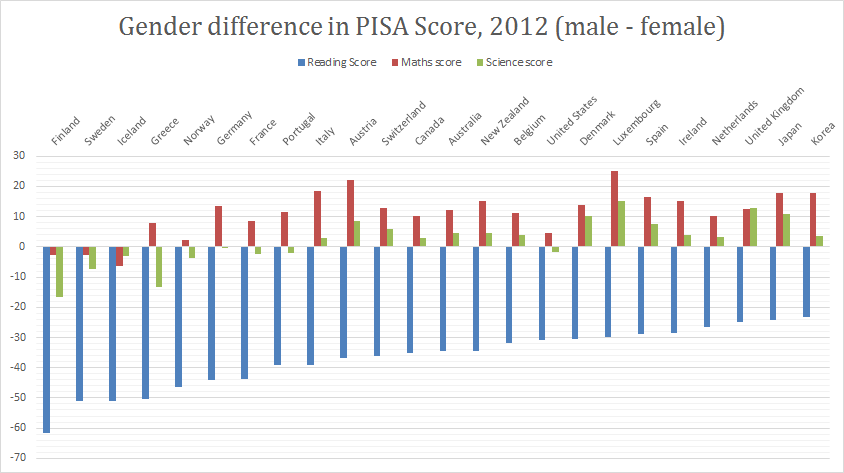
Source: OECD Programme for International Student Assessment (PISA) 2012.
23 May 2016 Leave a comment
in discrimination, economic history, economics of media and culture, gender, human capital, labour economics, labour supply, occupational choice, poverty and inequality Tags: gender wage gap, middle class stagnation, reversing gender gap, wage stagnation
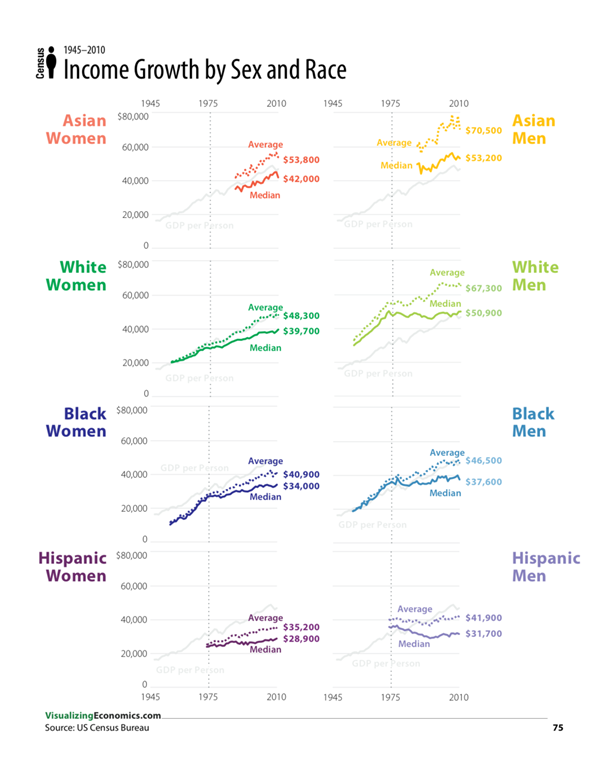
Source: Read Online — Visualizing Economics.
Celebrating humanity's flourishing through the spread of capitalism and the rule of law
Scholarly commentary on law, economics, and more
Beatrice Cherrier's blog
Celebrating humanity's flourishing through the spread of capitalism and the rule of law
Celebrating humanity's flourishing through the spread of capitalism and the rule of law
Celebrating humanity's flourishing through the spread of capitalism and the rule of law
Why Evolution is True is a blog written by Jerry Coyne, centered on evolution and biology but also dealing with diverse topics like politics, culture, and cats.
Celebrating humanity's flourishing through the spread of capitalism and the rule of law
Celebrating humanity's flourishing through the spread of capitalism and the rule of law
A rural perspective with a blue tint by Ele Ludemann
DPF's Kiwiblog - Fomenting Happy Mischief since 2003
Celebrating humanity's flourishing through the spread of capitalism and the rule of law
The world's most viewed site on global warming and climate change
Tim Harding's writings on rationality, informal logic and skepticism
A window into Doc Freiberger's library
Let's examine hard decisions!
Commentary on monetary policy in the spirit of R. G. Hawtrey
Thoughts on public policy and the media
Celebrating humanity's flourishing through the spread of capitalism and the rule of law
Politics and the economy
A blog (primarily) on Canadian and Commonwealth political history and institutions
Reading between the lines, and underneath the hype.
Economics, and such stuff as dreams are made on
"The British constitution has always been puzzling, and always will be." --Queen Elizabeth II
Celebrating humanity's flourishing through the spread of capitalism and the rule of law
Celebrating humanity's flourishing through the spread of capitalism and the rule of law
WORLD WAR II, MUSIC, HISTORY, HOLOCAUST
Undisciplined scholar, recovering academic
Celebrating humanity's flourishing through the spread of capitalism and the rule of law
Res ipsa loquitur - The thing itself speaks
Celebrating humanity's flourishing through the spread of capitalism and the rule of law
Researching the House of Commons, 1832-1868
Articles and research from the History of Parliament Trust
Reflections on books and art
Posts on the History of Law, Crime, and Justice
Celebrating humanity's flourishing through the spread of capitalism and the rule of law
Exploring the Monarchs of Europe
Cutting edge science you can dice with
Small Steps Toward A Much Better World
“We do not believe any group of men adequate enough or wise enough to operate without scrutiny or without criticism. We know that the only way to avoid error is to detect it, that the only way to detect it is to be free to inquire. We know that in secrecy error undetected will flourish and subvert”. - J Robert Oppenheimer.
The truth about the great wind power fraud - we're not here to debate the wind industry, we're here to destroy it.
Celebrating humanity's flourishing through the spread of capitalism and the rule of law
Celebrating humanity's flourishing through the spread of capitalism and the rule of law
Economics, public policy, monetary policy, financial regulation, with a New Zealand perspective
Celebrating humanity's flourishing through the spread of capitalism and the rule of law
Restraining Government in America and Around the World
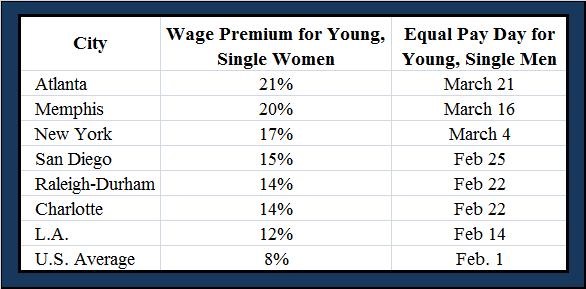

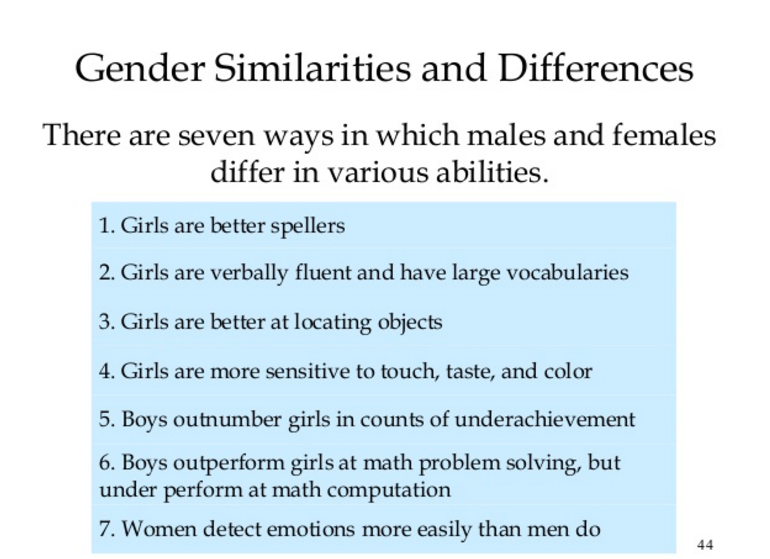
 Utopia, you are standing in it!
Recent Comments