CHART: Top Ten Most Dangerous Jobs and Percent Male, 2013
@chartoftheday http://t.co/5xfjvM8ll5—
Mark J. Perry (@Mark_J_Perry) May 14, 2015
The gender gap in occupational deaths and injuries
26 Jul 2015 Leave a comment
in discrimination, gender, health and safety, labour economics Tags: gender gap, reversing gender gap
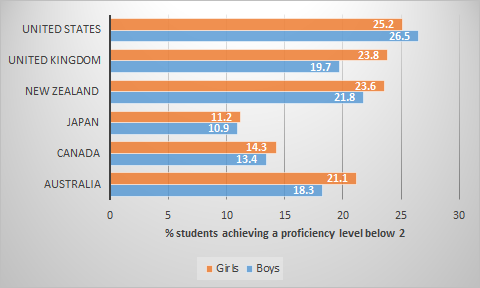
Low performers in maths by gender, USA, UK, Japan, Canada, Australia and New Zealand
17 Jul 2015 Leave a comment
in discrimination, economics of education, gender, human capital, labour economics Tags: cognitive psychology, educational psychology, lost boys, PISA, Psychology, reversing gender gap
Figure 1: % of students achieving a proficiency level below 2 in maths by gender, USA, UK, New Zealand, Japan, Canada and Australia, 2012
Source: OECD StatExtract.
Share of university degrees conferred to U.S. women since 1970
16 Jul 2015 Leave a comment
in economic history, economics of education, human capital, labour economics, occupational choice, politics - USA Tags: lost boys, reversing gender gap
Share of university degrees conferred to U.S. women since 1970 (via @MaxCRoser) http://t.co/FUGrM7WbJd—
Claire Lehmann (@clairlemon) July 09, 2015
Low performers in science by gender, USA, UK, Japan, Canada, Australia and New Zealand
16 Jul 2015 Leave a comment
in discrimination, economics of education, gender, labour economics, labour supply Tags: cognitive psychology, educational psychology, lost boys, PISA, Psychology, reversing gender gap
Figure 1: % of students achieving a proficiency level below 2 in science by gender, USA, UK, New Zealand, Japan, Canada and Australia, 2012

Source: OECD StatExtract.
Low performers in reading by gender, USA, UK, Japan, Canada, Australia and New Zealand
15 Jul 2015 1 Comment
in discrimination, economics of education, gender, human capital, labour economics Tags: cognitive psychology, education, lost boys, PISA, Psychology, reversing gender gap
Figure 1: % of students achieving a proficiency level below 2 in reading by gender, USA, UK, New Zealand, Japan, Canada and Australia, 2012

Source: OECD StatExtract.
Gender gaps and reversing gender gaps in education
15 Jul 2015 Leave a comment
in discrimination, economics of education, gender, human capital, international economics Tags: gender gap, reversing gender gap
Why gender analysis is essential to empirical labour economics
07 Jul 2015 Leave a comment
U.S. wage growth doesn't look as weak when you account for benefit costs covered by employers on.wsj.com/1JJ2EmV http://t.co/s0tJutTjBy—
Nick Timiraos (@NickTimiraos) July 06, 2015
Dual income nation
05 Jul 2015 Leave a comment
in economics of love and marriage, labour economics, labour supply, politics - USA, poverty and inequality Tags: asymmetric marriage premium, dual income couples, economics of families, reversing gender gap
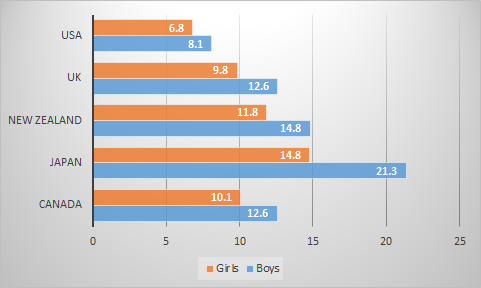
Top performers in science by gender, USA, UK, Japan, Canada, Australia and New Zealand
02 Jul 2015 Leave a comment
in discrimination, economics of education, gender, human capital, labour economics Tags: Australia, British economy, Canada, Japan, lost boys, reversing gender gap
Why are Japanese 15-year-old girls as good at science as teenagers anywhere else in the world?
Figure 1: Percentage achieving the proficiency level 5 or higher in sciences by gender, USA, UK, Japan, Canada, Australia, New Zealand, 2012
Source: OECD StatExtract.
Top performers in maths by gender, USA, UK, Japan, Canada, Australia and New Zealand
01 Jul 2015 5 Comments
in economics of education, gender, human capital, labour economics Tags: Australia, British economy, Canada, Japan, lost boys, reversing gender gap
Figure 1: Percentage achieving the proficiency level 5 or higher in mathematics by gender, USA, UK, Japan, Canada, Australia, New Zealand, 2012

Source: OECD StatExtract.
Top performers in reading by gender, USA, UK, Japan, Canada, Australia and New Zealand
30 Jun 2015 Leave a comment
in discrimination, economics of education, gender, human capital, labour economics Tags: Australia, British economy, Canada, Japan, lost boys, reversing gender gap
Figure 1: percentage achieving the proficiency level 5 or higher in reading by gender, USA, UK, Japan, Canada, Australia, New Zealand, 2012

Source: OECD StatExtract.
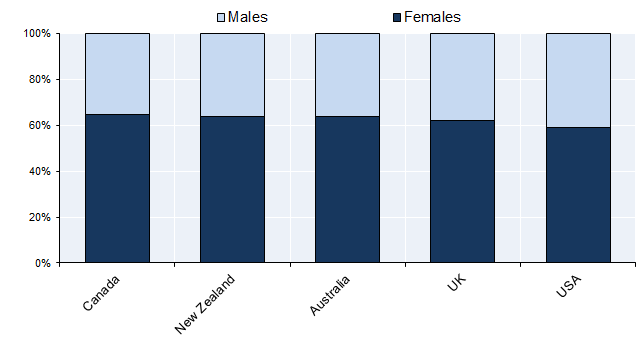
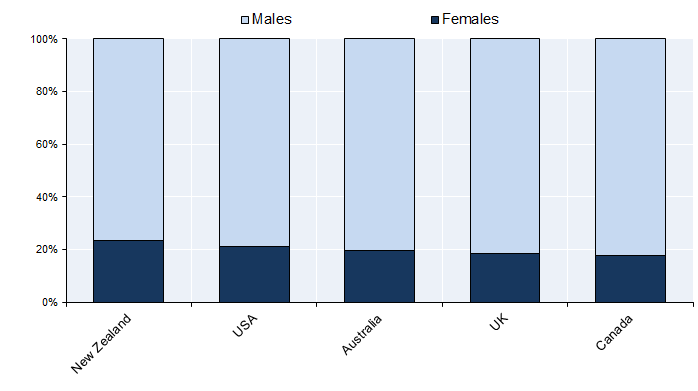
Humanities, arts, computing and engineering degrees awarded by gender, USA, UK, Canada, Australia and New Zealand
30 Jun 2015 Leave a comment
in discrimination, economics of education, gender, human capital, labour economics, occupational choice Tags: economics of personality traits, gender wage gap, reversing gender gap
Figure 1: Percentage of tertiary degrees awarded in humanities and arts qualifications by gender, 2012
Source: OECD Education Database.
Figure 2: percentage of tertiary degrees awarded in computing qualifications by gender, 2012
Source: OECD Education Database.
Figure 3: Percentage of tertiary degrees awarded in engineering, manufacturing and construction qualifications by gender, 2012
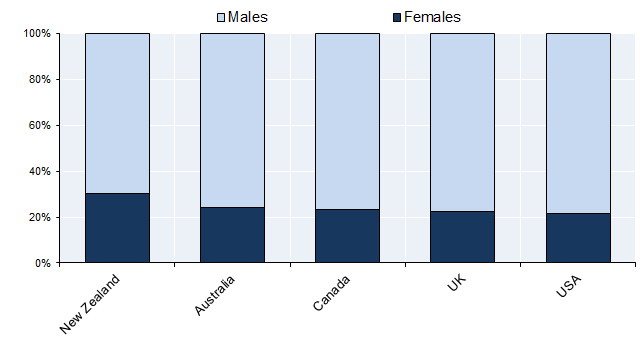
Source: OECD Education Database.
Gender differences in PISA scores, 2012, UK, USA, New Zealand and Australia
16 Jun 2015 Leave a comment
in economics of education, human capital, labour economics, occupational choice, politics - Australia, politics - New Zealand, politics - USA Tags: economics of personality traits, gender gap, PISA, reversing gender gap
Boys’ dominance just about endures in maths: at age 15 they are, on average, the equivalent of three months’ schooling ahead of girls. In science the results are fairly even.
But in reading, where girls have been ahead for some time, a gulf has appeared. In all 64 countries and economies in the study, girls outperform boys. The average gap is equivalent to an extra year of schooling.
Figure 1: : Gender differences (boys – girls) in student performance in reading, mathematics and science in PISA 2012

Source: OECD family database.
The reversing gender gap in one chart
11 Jun 2015 Leave a comment
in discrimination, economics of education, gender, human capital, labour economics, labour supply, occupational choice, poverty and inequality Tags: gender wage gap, lost boys, reversing gender gap
Gender gap in bachelor's is 6 percentage points. Men now where women were a decade ago.
nces.ed.gov/programs/diges… http://t.co/u9rAsIcfY0—
S Dynarski (@dynarski) June 01, 2015
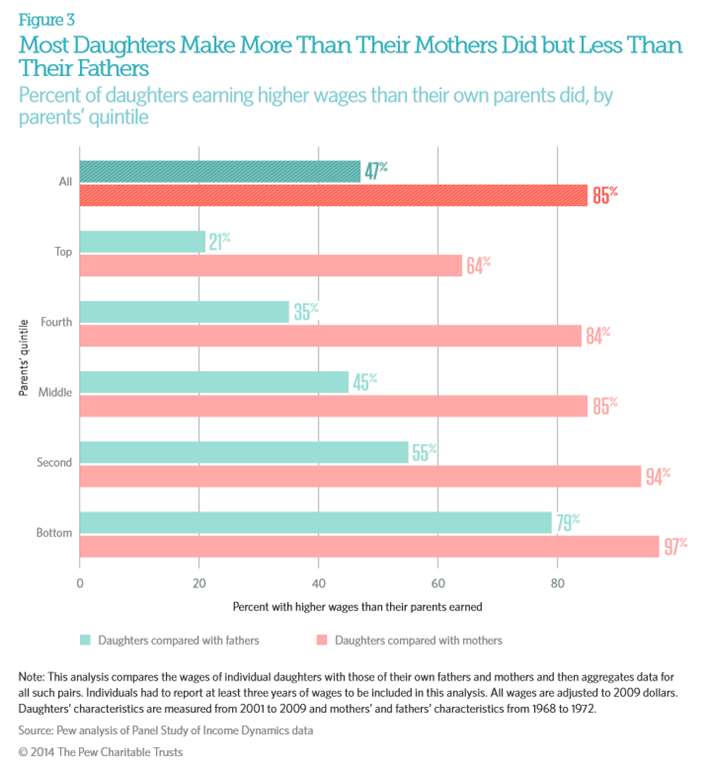
Almost 8 in 10 daughters raised by the lowest- earning men make more money per hour than their fathers did
08 Jun 2015 Leave a comment
in discrimination, economics of education, gender, human capital, labour economics, labour supply, occupational choice, poverty and inequality Tags: economic mobility, gender wage gap, reversing gender gap
 Utopia, you are standing in it!
Recent Comments