@metiria @NZGreens child poverty is driven by housing unaffordability – by Green opposition to RMA reform

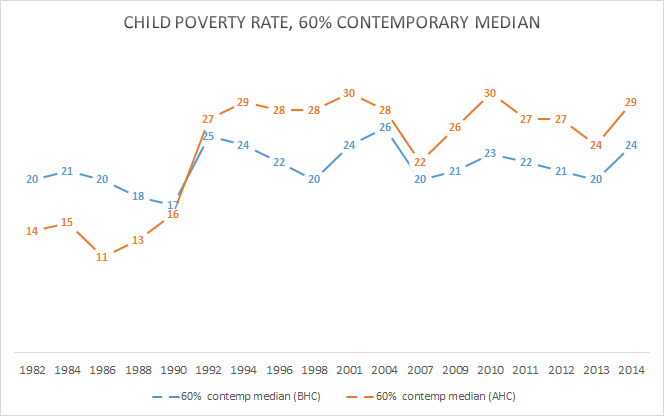
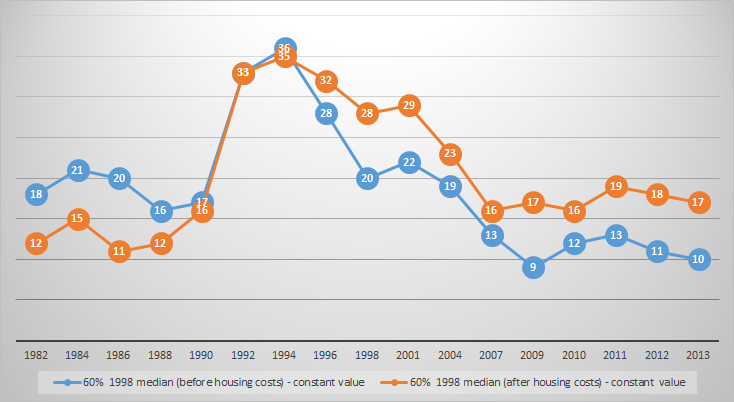
Nothing much has happening to child poverty before housing costs in New Zealand since the early 1980s. It is after housing costs poverty that is crucifying the children in New Zealand.

image

Source: Bryan Perry, Household Incomes in New Zealand: trends in indicators of inequality and hardship 1982 to 2014 – Ministry of Social Development, Wellington (August 2015), Table F6 and table F7.

From HES 2013 to HES 2014 median household income rose 5% in real terms (5% above the CPI inflation rate)…

On the AHC moving line measures, child poverty rates in HES 2014 are around the same as their peak after the GFC. A good amount of the rise from HES 2013 to HES 2014 is due to the large rise in the BHC median, as noted above, rather than a change in the numbers in low income per se.

Bryan Perry (2015, pp. 3, 7).

The parties that oppose measures to increase the supply of land and reduce the cost of housing through reform of the Resource Management Act and its many restraints on the supply of land are the New Zealand Labour Party and New Zealand Greens.

Has NZ child poverty doubled as @MaxRashbrooke said?

Lindsay Mitchell put me onto a quote by veteran grumbler Max Rashbrooke that the child poverty rate doubled in New Zealand:

In a system where income goes disproportionately to the already well-off, ordinary workers are missing out on the rewards of their efforts, to the tune of billions of dollars a year. Welfare benefits, cut by a quarter in 1991 and increased just 8 per cent in the last budget, are far too low to meet people’s basic needs.

The result is a doubling of child poverty and the return of childhood diseases unknown in most developed countries – a national embarrassment, as one researcher described it.

Poverty, income and inequality data is collected in loving detail by Brian Perry every year for the Ministry of Social Development.

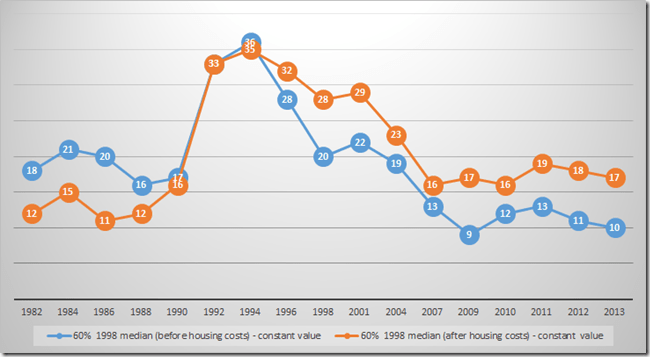
Figure 1: % child poverty in New Zealand (before and after housing costs), 60% 1998 median constant value, 1982 – 2013
image

Source: Bryan Perry, Household incomes in New Zealand: Trends in indicators of inequality and hardship 1982 to 2013. Ministry of Social Development (July 2014), Tables F.6 and F.7.

The only thing noticeable in the downward trend in child poverty in New Zealand since its doubling with the sharp recession in 1990 with double-digit unemployment rates is child poverty stop falling shortly after in-work family tax credits were introduced in the form of Working for Families in 2005.

There was a break in trend in the long decline in child poverty as soon as in-work family tax credits were introduced in New Zealand. I’m sure this is a coincidence because, as Brian Perry said when discussing the introduction of Working for Families in 2005:

The 2004 to 2007 period was the only one in the 25 years to 2007 in which the incomes of low- to middle-income households grew more quickly than those of households above the median.

The real killer in New Zealand in terms of poverty and inequality are housing costs. Housing costs are wholly under the control of government through its control of the supply of land, which is restricted at the behest of the parties of the left.

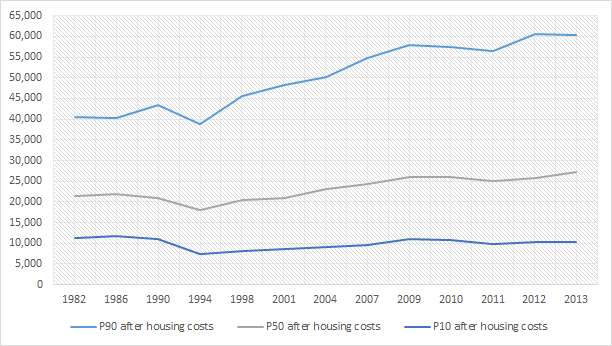
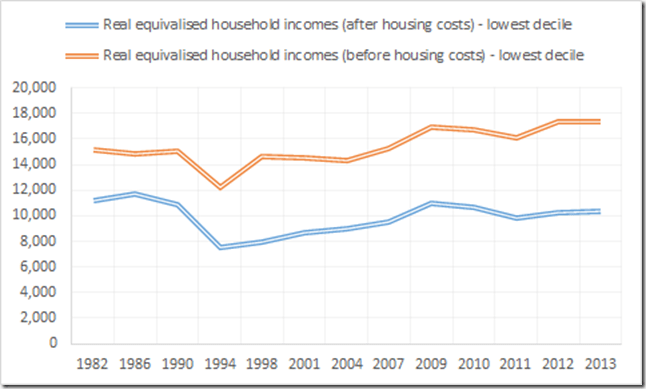
Figure 2: real equivalised household incomes (before and after housing costs): changes at the top of lowest income decile, New Zealand, 1982 to 2013
image

Source: Bryan Perry, Household incomes in New Zealand: Trends in indicators of inequality and hardship 1982 to 2013. Ministry of Social Development (July 2014), tables D.2 and D.4.

Figure 2 shows that real equivalised household income after housing costs has not grown and in fact has fallen for the bottom 10% of the income distribution in New Zealand.

It is the left-wing parties who oppose measures to reduce housing costs and and increase the supply of land through reforms to the Resource Management Act and the relaxation of the Auckland metropolitan urban limit.

Labour and the Greens are in effect keeping the poor poor to win middle-class votes.

Figure 3: real equivalised household incomes (before and after housing costs): changes at the top of the top, middle and lowest lowest income deciles, New Zealand, 1982 to 2013

image

Source: Bryan Perry, Household incomes in New Zealand: Trends in indicators of inequality and hardship 1982 to 2013. Ministry of Social Development (July 2014), tables D.2 in D.4.

Figure 3 shows that those in the middle and higher deciles, a political territory rich in swinging voters, are still doing well after housing costs. The parties of the left are collaborating with a middle-class home owning voter while betraying the working class and its aspirations from home ownership and quite simply affordable housing costs when they rent.

The increases for all groups may be understated by the inability of living standards measures to adequately account for new goods, product upgrades and rising life expectancies.
Auckland housing is more expensive than many big US cities

What will Labour do about the supply of land in Auckland?

This Eco-Friendly Capsule Home Would Let You Live Off The Grid Anywhere In The World?

I doubt that it would get planning permission in either Auckland and Christchurch?

It is hard to get local government land use permission to build new granny flats and other small and temporary accommodation units in Auckland and Christchurch.

Auckland has rapidly increasing housing prices. Christchurch is still rebuilding after an earthquake so both housing prices and rents in particular are skyrocketing. The local councils in both cities are strict regulations restricting or prohibiting high-density housing.

via This Eco-Friendly Capsule Home Would Let You Live Off The Grid Anywhere In The World | IFLScience.

Housing affordability breakthrough! The capital gains tax has been given its chance to fail

This week, the New Zealand government announced a special capital gains tax for investments in housing. Specifically, if a buyer sells the house within two years of buying it, and this house is not their home, the investor will be liable to income tax on any profit.

This solution also has been put forward by the left-wing political parties in New Zealand as their solution to the problem of restricted land supply in Auckland and other cities in New Zealand.

The introduction of a capital gains tax is a breakthrough for housing affordability. This solution of using a capital gains tax to dampen demand has been given its chance and it will fail.

Once a capital gains tax fails to make housing more affordable, political parties on the left and on the right can no longer put off confronting real solutions such as major reforms to the Resource Management Act (RMA) to loosen restrictions on the supply of land in the big cities in New Zealand and in particular in Auckland.

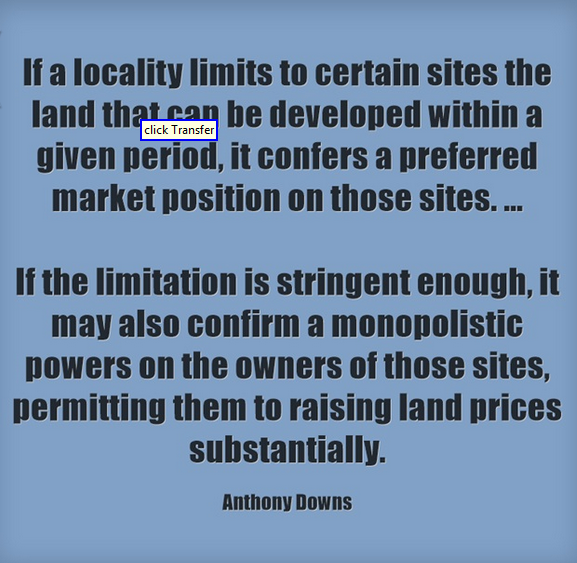
The principle of competitive land supply – Anthony Downs

image

via Florida Repeals Smart Growth Law | Newgeography.com.

Urban planners are confident souls

image

from The transformation of cities: A suburban world | The Economist via demographia.com

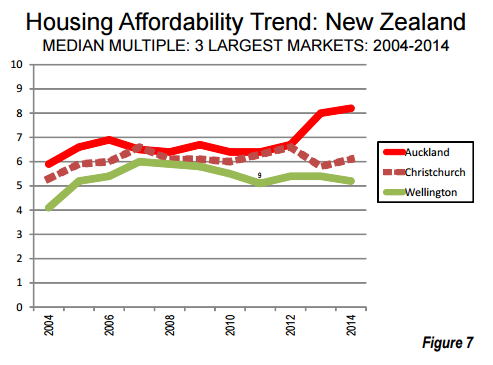
Housing affordability trends in New Zealand and the case for a capital gains tax

If the affordability crisis in New Zealand is demand side driven requiring capital gains tax to temper that demand, why is the affordability crisis so marked in one city? Does that make a case for a capital gains tax only on Auckland or suggest the capital gains tax is trying to solve the wrong problem.

image

via demographia.com

The economic forces underpinning the housing affordability crisis

The key point is that increases (declines) in demand can bring sharply rising (falling) house prices when supply is constrained. However, when land supply is not regulated, it adjusts to demand and house price volatility is reduced.

As long as commentators focus primarily on the demand side of the housing market, whilst ignoring supply-side constraints, they will never fully understand the drivers of housing bubbles and busts. The resulting incorrect diagnosis will inevitably lead to poor policy prescriptions and outcomes.

via The Truth About the U.S. Housing Market | Seeking Alpha

Housing affordability and land regulation around the globe

Auckland is up with London and New York in terms of housing unaffordability relative to median incomes. US cities with responsive land regulation don’t experience housing bubbles.

Glaeser and Gyourko summarised the findings of a number of studies  on land supply and housing prices:

Recent research also indicates that house prices are more volatile, not just higher, in tightly regulated markets …. price bubbles are more likely to form in tightly regulated places, because the inelastic supply conditions that are created in part from strict local land-use regulation are an important factor in supporting ever larger price increases whenever demand is increasing.

…. It is more difficult for house prices to become too disconnected from their fundamental production costs in lightly regulated markets because significant new supply quickly dampens prices, thereby busting any illusions market participants might have about the potential for ever larger price increases.

Via The Truth About the U.S. Housing Market | Seeking Alpha.

Land use regulation knocks 10 points of US GDP!

Bloomberg Business highlighted a great new study by Enrico Moretti on power of the regulatory restrictions on land supply to destroy wealth.

Moretti focused on the impact that restrictions on land supply have on the ability of workers to move to higher productivity cities. Moretti is the second best urban economist working at the moment. The best is Ed Glaeser. Moretti concluded that

A limited number of American workers can have access to these very high-productivity cities

He concluded that a more efficient distribution would be “a general benefit for the entire economy.”

The secret of his analysis was to look at how different US cities, the high productivity cities, contributed to national economic growth. He then explore the implications of fewer and fewer workers been able to move to these cities to take advantage of the great productive potential. The barrier to them moving was high housing prices and high rents.

For example, labour productivity grew quickly in San Francisco, New York and San Jose overt 45-years. All of these cities are famous for their human capital-intensive industries including technology and finance. These cities weren’t America’s growth engine:

The reason is that the main effect of the fast productivity growth in New York, San Francisco, and San Jose was an increase in local housing prices and local wages, not in employment.

Despite the large difference in local GDP growth between New York, San Jose, and San Francisco and the Rust Belt cities, both groups of cities had roughly the same contribution to aggregate output growth.

The drivers of US growth between 1964 and 2009 were southern U.S. cities and 19 other large cities. These cities attracted many residents because of good weather and abundant supply of cheap housing.

The lesson both the US and for New Zealand, and Auckland in particular, is this reallocation of population away from the expensive cities with restricted land supply reduced national output because these population movements bring workers to cities "where the marginal product of labour is low."

In a technology boom town such as San Francisco, it is now what like New Zealand will be as Generation Rent runs its course – 65% of residents are renters:

Over the past year, the City and County of San Francisco boasted the second strongest labour market in the nation, adding 25,000 new jobs. Yet only 2,548 new housing units were permitted and even fewer were built.

Just think: 25,000 new workers and their families have been knocking on San Francisco doors, but there are new units for less than 10 percent of them. It is not surprising that apartment prices get bid up.

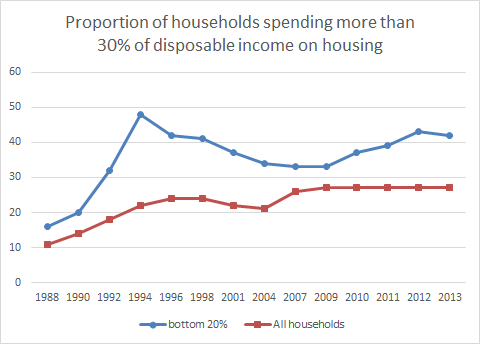
Housing unaffordability in New Zealand, 1988–2013

There has been a steady decline in housing affordability in New Zealand. The position is critical of the bottom 20% of the income ladder with now four in 10 of them spending more than 30% of their disposable income on housing costs in relatively good economic times.

image

via Statistics New Zealand, New Zealand Social Indicators, Housing affordability.

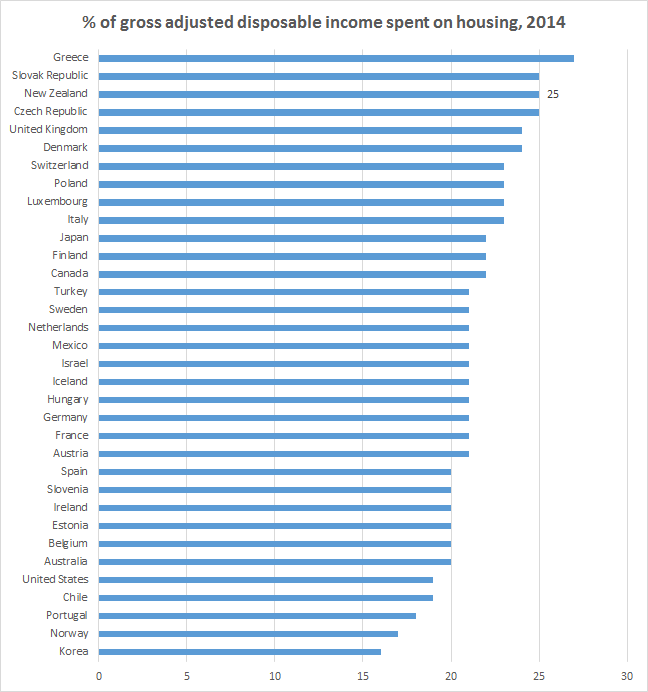
% spent on housing as a share of disposable income, OECD members, 2014

New Zealand is pretty much on top of the world as to the amount of income that households must spend keep a roof. That success is a product of local council restrictions on the supply of land and national and local regulations such as under the Resource Management Act (RMA) that increase the costs of bringing lands in the market.

image

Source: OECD Better Life Index.

Note: Household net adjusted disposable income is  the maximum amount that a household can afford to consume without having to reduce its assets or to increase its liabilities. It’s obtained, as defined by the System of National Accounts – SNA, adding to people’s gross income (earnings, self-employment and capital income, as well as current monetary transfers received from other sectors) the social transfers in-kind that households receive from governments (such as education and health care services), and then subtracting the taxes on income and wealth, the social security contributions paid by households as well as the depreciation of capital goods consumed by households.

@NZNationalParty housing policy defies the laws of supply and demand for land

If homebuyers access additional lines of funding because they can tap into their KiwiSaver retirement savings, they will use this to bid up the price of housing and land.

If the supply of land is fixed or otherwise constrained from expanding much, such as by the Resource Management Act and the metropolitan urban limit in Auckland, the only thing that will happen is that the price will go up with more money chasing the same amount of land and housing.

The price of land and housing must go up in the absence of some reforms that increase the supply of land. Rather than increase access to housing among those with don’t own a house, allowing homebuyers to access their KiwiSaver retirement savings entrenches the prospects of Generation Rent.

Previous Older Entries Next Newer Entries

Bassett, Brash & Hide

Celebrating humanity's flourishing through the spread of capitalism and the rule of law

Truth on the Market

Scholarly commentary on law, economics, and more

The Undercover Historian

Beatrice Cherrier's blog

Matua Kahurangi

Celebrating humanity's flourishing through the spread of capitalism and the rule of law

Temple of Sociology

Celebrating humanity's flourishing through the spread of capitalism and the rule of law

Velvet Glove, Iron Fist

Celebrating humanity's flourishing through the spread of capitalism and the rule of law

Why Evolution Is True

Why Evolution is True is a blog written by Jerry Coyne, centered on evolution and biology but also dealing with diverse topics like politics, culture, and cats.

Down to Earth Kiwi

Celebrating humanity's flourishing through the spread of capitalism and the rule of law

NoTricksZone

Celebrating humanity's flourishing through the spread of capitalism and the rule of law

Homepaddock

A rural perspective with a blue tint by Ele Ludemann

Kiwiblog

DPF's Kiwiblog - Fomenting Happy Mischief since 2003

The Dangerous Economist

Celebrating humanity's flourishing through the spread of capitalism and the rule of law

Watts Up With That?

The world's most viewed site on global warming and climate change

The Logical Place

Tim Harding's writings on rationality, informal logic and skepticism

Doc's Books

A window into Doc Freiberger's library

The Risk-Monger

Let's examine hard decisions!

Uneasy Money

Commentary on monetary policy in the spirit of R. G. Hawtrey

Barrie Saunders

Thoughts on public policy and the media

Liberty Scott

Celebrating humanity's flourishing through the spread of capitalism and the rule of law

Point of Order

Politics and the economy

James Bowden's Blog

A blog (primarily) on Canadian and Commonwealth political history and institutions

Science Matters

Reading between the lines, and underneath the hype.

Peter Winsley

Economics, and such stuff as dreams are made on

A Venerable Puzzle

"The British constitution has always been puzzling, and always will be." --Queen Elizabeth II

The Antiplanner

Celebrating humanity's flourishing through the spread of capitalism and the rule of law

Bet On It

Celebrating humanity's flourishing through the spread of capitalism and the rule of law

History of Sorts

WORLD WAR II, MUSIC, HISTORY, HOLOCAUST

Roger Pielke Jr.

Undisciplined scholar, recovering academic

Offsetting Behaviour

Celebrating humanity's flourishing through the spread of capitalism and the rule of law

JONATHAN TURLEY

Res ipsa loquitur - The thing itself speaks

Conversable Economist

Celebrating humanity's flourishing through the spread of capitalism and the rule of law

The Victorian Commons

Researching the House of Commons, 1832-1868

The History of Parliament

Articles and research from the History of Parliament Trust

Books & Boots

Reflections on books and art

Legal History Miscellany

Posts on the History of Law, Crime, and Justice

Sex, Drugs and Economics

Celebrating humanity's flourishing through the spread of capitalism and the rule of law

European Royal History

Exploring the Monarchs of Europe

Tallbloke's Talkshop

Cutting edge science you can dice with

Marginal REVOLUTION

Small Steps Toward A Much Better World

NOT A LOT OF PEOPLE KNOW THAT

“We do not believe any group of men adequate enough or wise enough to operate without scrutiny or without criticism. We know that the only way to avoid error is to detect it, that the only way to detect it is to be free to inquire. We know that in secrecy error undetected will flourish and subvert”. - J Robert Oppenheimer.

STOP THESE THINGS

The truth about the great wind power fraud - we're not here to debate the wind industry, we're here to destroy it.

Lindsay Mitchell

Celebrating humanity's flourishing through the spread of capitalism and the rule of law

Alt-M

Celebrating humanity's flourishing through the spread of capitalism and the rule of law

croaking cassandra

Economics, public policy, monetary policy, financial regulation, with a New Zealand perspective

The Grumpy Economist

Celebrating humanity's flourishing through the spread of capitalism and the rule of law

International Liberty

Restraining Government in America and Around the World