— EPI Chart Bot (@epichartbot) December 26, 2015
More evidence from the @economicpolicy institute of the great success of the 1996 US federal welfare reforms
17 Jan 2016 Leave a comment
in economic history, gender, labour economics, labour supply, politics - USA, welfare reform Tags: child poverty, family poverty, single mothers, single parents, US welfare reforms
1996 US welfare reforms & single mother employment rates @garethmorgannz @geoffsimmonz
13 Jan 2016 Leave a comment
in gender, labour economics, labour supply, politics - New Zealand, politics - USA, poverty and inequality, welfare reform Tags: 1996 US welfare reforms, female labour force participation, maternal labour force participation, single mothers, single parents, social insurance, welfare state
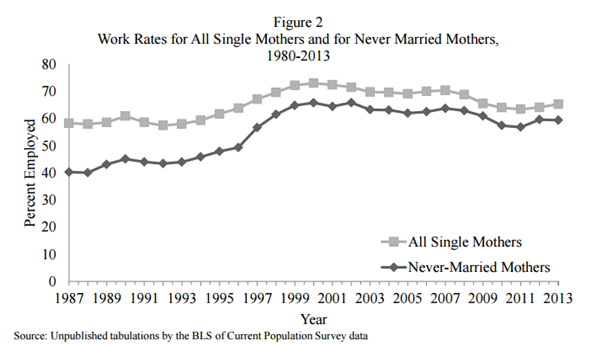
Source: Ron Haskins (2015).
Poverty Rates by Mothers’ Marital Status, 1987 to 2013
13 Jan 2016 Leave a comment
in applied welfare economics, economic history, labour economics, labour supply, politics - USA, poverty and inequality, welfare reform Tags: child poverty, family poverty, single mothers, single parents, social insurance, welfare state
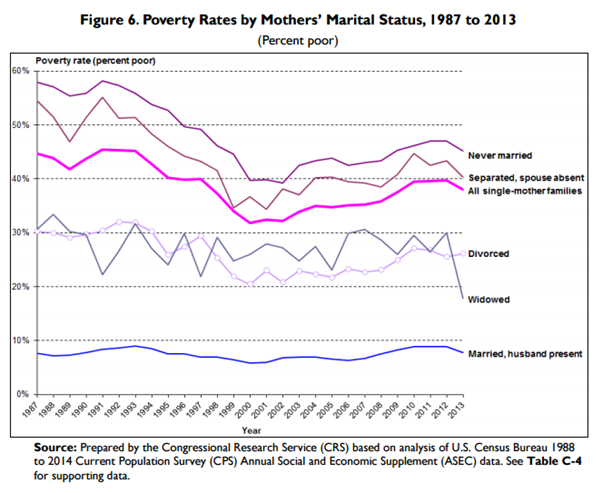
Source: Congressional Research Service.https://www.fas.org/sgp/crs/misc/R41917.pdf
What is the success sequence?
08 Jan 2016 Leave a comment
in economics of education, labour economics, labour supply, occupational choice, politics - USA, poverty and inequality, welfare reform Tags: child poverty, family poverty, high school dropouts, marriage and divorce, single parents, success sequence
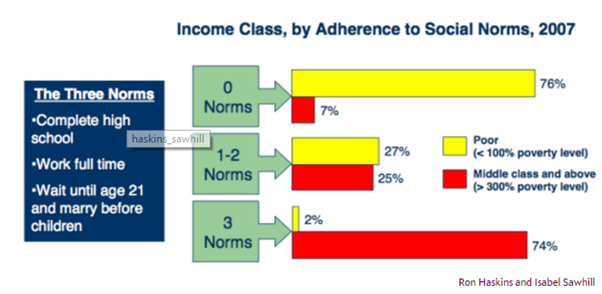
Source: The success sequence: Conservatives think they have a formula for raising people out of poverty.
.
Teen smoking rates in one and two parent households in USA, UK, Canada, Germany, France, Italy and Scandinavia
23 Dec 2015 Leave a comment
in health economics Tags: economics of smoking, single mothers, single parents
Not only do smoking rates differ greatly across the Atlantic and the English Channel, the influence of a single parent household seems to be large in the Anglo-Saxon countries but much less important elsewhere.
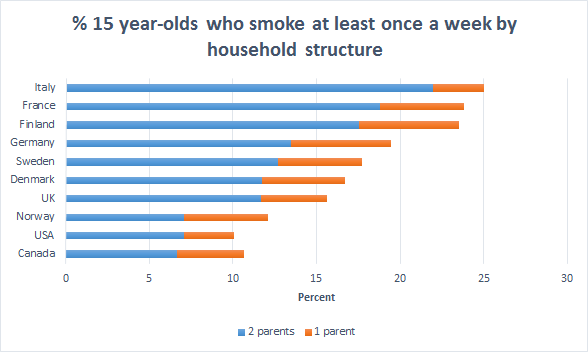
Source: OECD Family Database.
#itsnotchoice @povertymonitor @PlunketNZ % Australian, NZ and US sole parents who do not work
13 Dec 2015 Leave a comment
in gender, labour economics, labour supply, politics - Australia, politics - New Zealand, politics - USA, welfare reform Tags: 1996 U.S. welfare reforms, child poverty, single parents, sole parents
The only major success in reducing sole parent beneficiary numbers anywhere has been time limits introduced as part of the 1996 US federal welfare reforms. Time limits on welfare for single parents reduced caseloads by two thirds, 90% in some states.
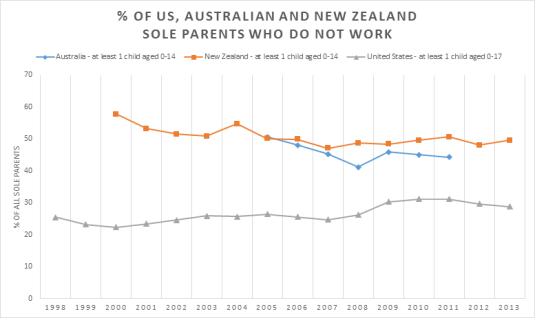
Source and Notes: OECD Family Database; Australian data are available only from 2005.
The subsequent declines in welfare participation rates and gains in employment were largest among the single mothers previously thought to be most disadvantaged: young (ages 18-29), mothers with children aged under seven, high school drop-outs, and black and Hispanic mothers. These low-skilled single mothers were thought to face the greatest barriers to employment. Blank (2002) found that
nobody of any political persuasion predicted or would have believed possible the magnitude of change that occurred in the behaviour of low-income single-parent families.
With the enactment of welfare reform in 1996, black child poverty fell by more than a quarter to 30% in 2001. Over a six-year period after welfare reform, 1.2 million black children were lifted out of poverty. In 2001, despite a recession, the poverty rate for black children was at the lowest point in national history. Employment are never married mothers increased by 50% after the US reforms; employment a single mothers with less than a high school education increased by two thirds; employment of single mothers aged of 18 in 24 approximately doubled.
This great success of US welfare reforms was that after decades of no progress in their war on poverty, poverty among both single mothers and black children declined dramatically.
Employment status of sole parents in UK, USA, France, Italy, Australia, Ireland and New Zealand
13 Nov 2015 Leave a comment
in economics of love and marriage, labour supply, politics - Australia, politics - New Zealand, politics - USA Tags: Australia, British economy, France, Ireland, Italy, maternal labour supply, single parents, sole parents, welfare state
Despite supposedly having stingy welfare states, both New Zealand and Australia have a lot of sole parents who do not work at all. There is no separate breakdown of full-time and part-time work status in the USA. About 72% of sole parents in the USA either work full-time or part-time.
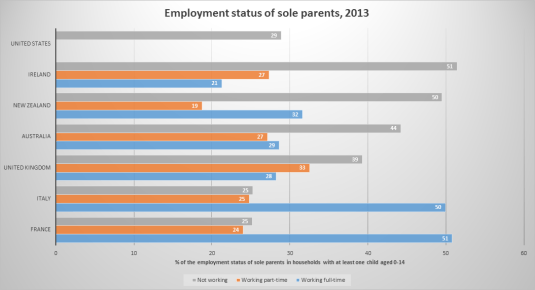
Source: OECD Family Database.
@Greencatherine 1996 US welfare reforms and the employment of single mums who were high school dropouts
31 Oct 2015 Leave a comment
in labour economics, labour supply, politics - USA, poverty and inequality, welfare reform Tags: 1996 US welfare reforms, paternal labour supply, single mothers, single parents, social insurance, welfare state
https://twitter.com/hamiltonproj/status/659776768094547968
There was a step increase in the employment rate of single parents and in particular high school dropouts straight after the implementation of the 1996 US federal welfare reforms.
These single mothers who dropped out of high school were thought to be least employable and most at risk to the 1996 US welfare reform. There was a large increase in their employment and this massive improvement in their rates of employment is enduring to this day.

Who is married with children in USA, UK, Canada, Germany and France?
25 Oct 2015 Leave a comment
in economics of love and marriage, population economics Tags: economics of fertility, marriage and divorce, search and matching, single parents, soul parents
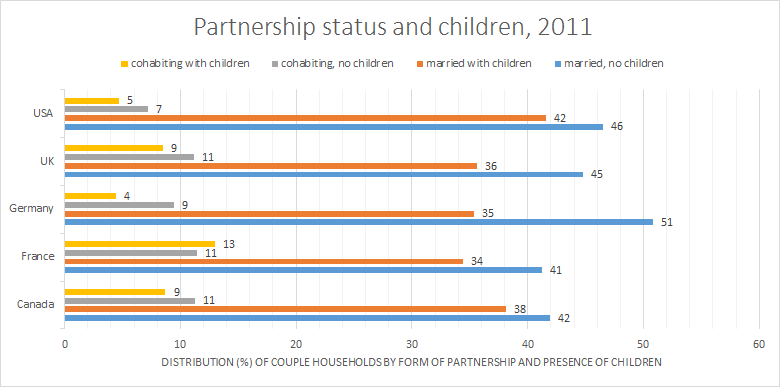
Source: OECD Family Database – OECD.
The impact of household composition on income inequality
30 Sep 2015 1 Comment
in labour economics, population economics, poverty and inequality Tags: asymmetric marriage premium, labour demographics, marriage and divorce, Population demographics, single mothers, single parents
The Moynihan Report revisited
22 Sep 2015 Leave a comment
in economic history, labour economics, politics - USA Tags: economics of families, marriage and divorce, Moynihan report, single mothers, single parents
Why did married couples get a pass on the great wage stagnation and the ravages of the top 1%?
20 Sep 2015 Leave a comment
in economics of love and marriage, labour economics, law and economics, poverty and inequality Tags: asymmetric marriage premium, economics of fertility, female labour force participation, male labour force participation, marriage and divorce, maternal labour force participation, single mothers, single parents
Marriage used to be a pairing of opposites: Men would work for pay and women would work at home. But in the second half of the 20th century, women flooded the labour force, raising their participation rate from 32 percent, in 1950, to nearly 60 percent in the last decade. As women closed the education gap, the very nature of marriage has changed. It has slowly become an arrangement pairing similarly rich and educated people. Ambitious workaholics used to seek partners who were happy to take care of the house. Today, they’re more likely to seek another ambitious workaholic.


The rich and educated are more likely to marry, to marry each other, and to produce rich and educated children. But this virtual cycle turns vicious for the poor.
Source: How America’s Marriage Crisis Makes Income Inequality So Much Worse – The Atlantic
James Heckman on improving schools @greencatherine @dbseymour @ThomasHaig @PPTAWeb
17 Sep 2015 Leave a comment
in economics of crime, economics of education, human capital, labour supply, occupational choice, poverty and inequality Tags: behavioural genetics, crime and punishment, criminal deterrence, economics of early childhood education, economics of families, economics of fertility, economics of personality traits, marriage and divorce, single parents


 Utopia, you are standing in it!
Recent Comments