The Left and Right approaches to poverty
01 Feb 2015 Leave a comment
in applied price theory, applied welfare economics, comparative institutional analysis, liberalism, poverty and inequality, welfare reform Tags: capitalism and freedom, Leftover Left, poverty and inequality, The Great Enrichment
The Upside of Income Inequality » Gary Becker and Kevin Murphy
01 Feb 2015 Leave a comment
in economics of education, human capital, labour economics, liberalism, occupational choice, poverty and inequality Tags: education premium, educational attainment, graduate premium, The Great Enrichment


The average American household was poorer in 2013 than it was in 1983 – Vox
31 Jan 2015 1 Comment
in applied welfare economics, population economics, poverty and inequality, technological progress Tags: Brad De Long, The Great Enrichment, The Great Escape, The Great Fact, time machines
/cdn0.vox-cdn.com/uploads/chorus_asset/file/3351202/vox-chart_net-worth-change-v2_1024.0.png)
US net worth rose considerably over that period, which is what you would expect to see.
Technology has improved and productivity increased, so society has a greater capacity for wealth building. America was also quite a bit older on average in 2013 than it was in 1983, so average wealth should have gone up.
But all of these gains went to the top 20 percent of the population. It’s worse than that, actually.
Over 100 percent of the gains went to the top 20 percent, because the bottom 60 percent of the population got poorer.
What does this claim by Matthew Yglesias exactly mean? He writes frequently on economics, so his editor must think he knows something about it.
http://t.co/0hEAL8X1kS—
EPI Chart Bot (@epichartbot) July 04, 2015
If 60% of the population got poorer as compared to 1983, they would be better off stepping into a time machine to go back to 1983. That is the only logical interpretation of this claim about 60% of the population. I owe this time machine thought experiment to Brad De Long.

Of course, going back to 1983, would involve giving up all products and services invented since then, and all product upgrades since then.
https://twitter.com/classicepics/status/561432237976322048
More importantly, for a good proportion of the population, they have become very sick or die immediately when they stepped out side of the Time Machine. This is because of shorter life expectancies in 1983 and the unavailability of a whole range of lifesaving medicines.

Am I just pedantic because I want access to crucial diabetic and other medications unavailable 30 years ago? No Internet, no cable, no international travel and no mobile phones.

In his original thought experiment, De Long asks how much you would want in additional income to agree to go back in time to a specific year. De Long was an economic historian examining the differences in living standards as compared to 1890 and 1990 and how that gap is greatly underestimated in economic statistics. De Long would have refused to go into the time machine to return to 1890 unless he could pack a very large bag to take with him:
I would want, first, health insurance: the ability to go to the doctor and be treated with late-twentieth-century medicines.
Franklin Delano Roosevelt was crippled by polio. Without antibiotic and adrenaline shots I would now be dead of childhood pneumonia.
The second thing I would want would be utility hookups–electricity and gas, central heating, and consumer appliances.
The third thing I want to buy is access to information–audio and video broadcasts, recorded music, computing power, and access to databases.
None of these were available at any price back in 1890.
The first fridge for a family and whole village
31 Jan 2015 Leave a comment
in development economics, growth disasters, growth miracles Tags: capitalism and freedom, global poverty, India, The Great Enrichment, The Great Fact
19th century Internet
31 Jan 2015 Leave a comment
The world’s poverty – in 50 seconds from BBC
30 Jan 2015 Leave a comment
in development economics, growth disasters, growth miracles Tags: capitalism and freedom, global poverty, The Great Enrichment, The Great Fact
Victorian era exercise machine
26 Jan 2015 Leave a comment

Global Warming Was Worth It
22 Jan 2015 Leave a comment
in applied welfare economics, climate change, development economics, growth disasters, growth miracles, liberalism Tags: modernity, The Great Enrichment, The Great Fact

- Higher incomes that allow people to make livings that afford them more than merely survival or avoiding starvation.
- A low poverty rate.
- High quality and diversity of employment opportunities. Rather than the choice of being a farmer or being a blacksmith, the average citizen should have an array of careers to choose from, and the ability to be industrious and take risks for profit.
- The availability of housing. On an average night in the United States, a country with a population of somewhere around 350 million, fewer than one million people are homeless.
- Consistent GDP growth.
- Access to quality health care.
- The availability of quality education. (I suppose we could quibble over the word “quality,” but certainly there is widespread free education availability.)
- High life expectancy. Worldwide life expectancy has more than doubled from 1750 to 2007.
- Low frequency of deadly disease.
- Affordable goods and services.
- Infrastructure that bolsters economic growth.
- Political stability.
- Air conditioning.
- Freedom from slavery, torture and discrimination.
- Freedom of movement, religion and thought.
- The presumption of innocence under the law.
- Equality under the law regardless of gender or race.
- The right to have a family – as large as one can support. Maybe even larger.
- The right to enjoy the fruits of labor without government – or anyone else – stealing it.
My childhood TV wasn’t much smaller than a 1954 TV
21 Jan 2015 1 Comment
in economics of media and culture, technological progress Tags: The Great Enrichment
The Great Fact in one chart
21 Jan 2015 Leave a comment
in development economics, growth disasters, growth miracles, liberalism Tags: The Great Enrichment, The Great Fact
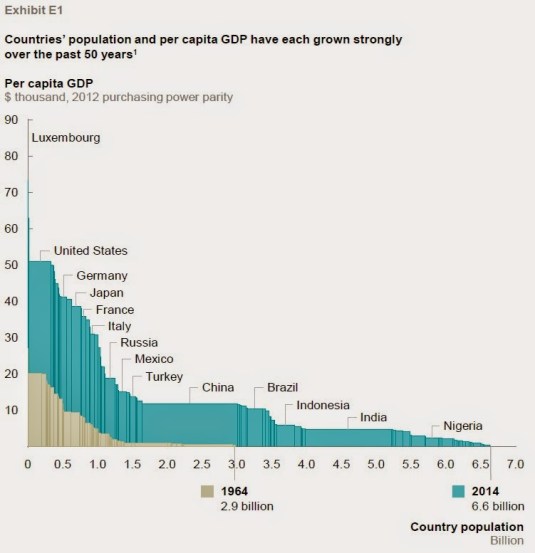
GDP at PPP by population shares
20 Jan 2015 Leave a comment
 Utopia, you are standing in it!
Recent Comments