
via DNA Sequencing Costs.
Celebrating humanity's flourishing through the spread of capitalism and the rule of law
14 Mar 2015 Leave a comment
in entrepreneurship, health economics Tags: creative destruction, innovation, Moore's law, The Great Enrichment, The Great Escape
via DNA Sequencing Costs.
09 Mar 2015 Leave a comment
in economic history, technological progress Tags: The Great Enrichment
The difference between 2000 and 2015 in one image. http://t.co/FJKP6XylLA—
Benedict Evans (@BenedictEvans) March 05, 2015
08 Mar 2015 Leave a comment
in politics - USA, poverty and inequality Tags: Euroland, living standards, The Great Enrichment
07 Mar 2015 Leave a comment
06 Mar 2015 Leave a comment
in population economics, technological progress, transport economics Tags: the good old days, The Great Enrichment
22 Feb 2015 Leave a comment
in economic growth, economic history, liberalism Tags: capitalism and freedom, The Great Enrichment, The Great Fact
Figure 1: Growth in real average income for the bottom 90%

Source: voxeu.org
By the way, in the countries where growth in real average incomes appears to have flattened out, is it seriously suggested that middle-class families cannot buy a basket of goods of superior quality and quantity than they could 30 or 40 years ago?
22 Feb 2015 Leave a comment
in income redistribution, politics - USA, poverty and inequality, welfare reform Tags: capitalism and freedom, poverty and inequality, The Great Enrichment, top 1%

Over the past one-, two-, and three-decade periods, both middle class and poor households have experienced noticeable gains in living standards. Their gains are slower than those experienced by middle-income families in the earlier post-war era, but the gains are well above zero.

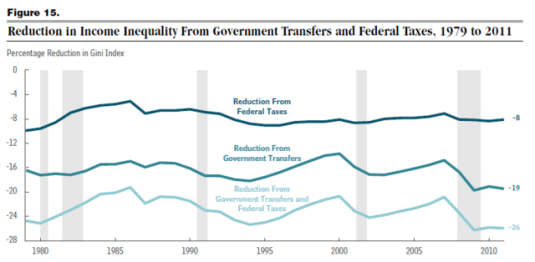
In 1980, in-kind benefits and employer and government spending on health insurance accounted for just 6% of the after-tax incomes of households in the middle one-fifth of the distribution. By 2010 these in-kind income sources represented 17% of middle class households’ after-tax income
…The broadest and most accurate measures of household income are published by the CBO. CBO’s newest estimates confirm the long-term trend toward greater inequality, driven mainly by turbo-charged gains in market income at the very top of the distribution. The market incomes of the top 1% are extraordinarily cyclical, however. They soar in economic expansions and plunge in recessions. Income changes since 2007 fit this pattern.
What many observers miss, however, is the success of the nation’s tax and transfer systems in protecting low- and middle-income Americans against the full effects of a depressed economy.
via Gary Burtless
19 Feb 2015 Leave a comment
in income redistribution, labour economics, poverty and inequality Tags: The Great Enrichment, top 1%
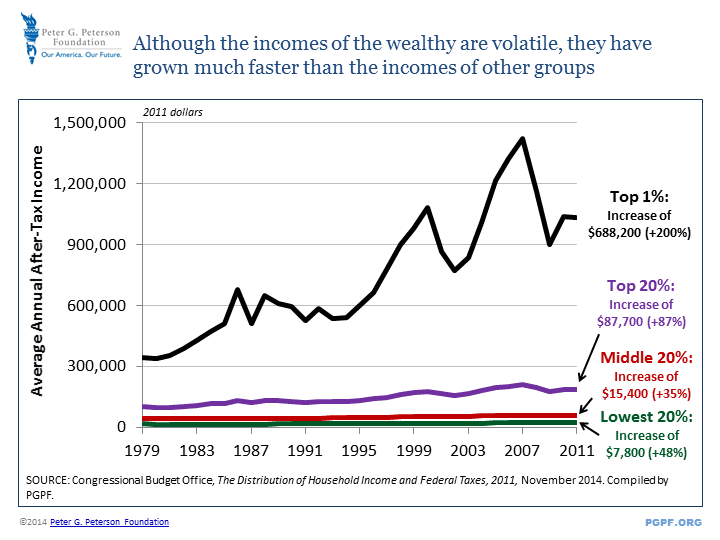
Everyone is 30-50% richer.

![Microsoft PowerPoint - Group C Federal Budget (KF).pptx [Read-Only]](https://utopiayouarestandinginit.com/wp-content/uploads/2015/02/0014_taxes-income-full.gif "Microsoft PowerPoint - Group C Federal Budget (KF).pptx [Read-Only]")
Ordinary Americans do not pay much in taxes.

Low income Americans receive large amounts of government transfers and increases their income by at least 50%

The middle-class is getting seriously smaller because more of them are getting richer
Celebrating humanity's flourishing through the spread of capitalism and the rule of law
Celebrating humanity's flourishing through the spread of capitalism and the rule of law
Celebrating humanity's flourishing through the spread of capitalism and the rule of law
Celebrating humanity's flourishing through the spread of capitalism and the rule of law
Celebrating humanity's flourishing through the spread of capitalism and the rule of law
Celebrating humanity's flourishing through the spread of capitalism and the rule of law
Celebrating humanity's flourishing through the spread of capitalism and the rule of law
A History of the Alt-Right
Econ Prof at George Mason University, Economic Historian, Québécois
Celebrating humanity's flourishing through the spread of capitalism and the rule of law
Scholarly commentary on law, economics, and more
Beatrice Cherrier's blog
Celebrating humanity's flourishing through the spread of capitalism and the rule of law
Celebrating humanity's flourishing through the spread of capitalism and the rule of law
Celebrating humanity's flourishing through the spread of capitalism and the rule of law
Why Evolution is True is a blog written by Jerry Coyne, centered on evolution and biology but also dealing with diverse topics like politics, culture, and cats.
Celebrating humanity's flourishing through the spread of capitalism and the rule of law
A rural perspective with a blue tint by Ele Ludemann
DPF's Kiwiblog - Fomenting Happy Mischief since 2003
Celebrating humanity's flourishing through the spread of capitalism and the rule of law
The world's most viewed site on global warming and climate change
Tim Harding's writings on rationality, informal logic and skepticism
A window into Doc Freiberger's library
Let's examine hard decisions!
Commentary on monetary policy in the spirit of R. G. Hawtrey
Thoughts on public policy and the media
Celebrating humanity's flourishing through the spread of capitalism and the rule of law
Politics and the economy
A blog (primarily) on Canadian and Commonwealth political history and institutions
Reading between the lines, and underneath the hype.
Economics, and such stuff as dreams are made on
"The British constitution has always been puzzling, and always will be." --Queen Elizabeth II
Celebrating humanity's flourishing through the spread of capitalism and the rule of law
Celebrating humanity's flourishing through the spread of capitalism and the rule of law
WORLD WAR II, MUSIC, HISTORY, HOLOCAUST
Undisciplined scholar, recovering academic
Celebrating humanity's flourishing through the spread of capitalism and the rule of law
Res ipsa loquitur - The thing itself speaks
In Hume’s spirit, I will attempt to serve as an ambassador from my world of economics, and help in “finding topics of conversation fit for the entertainment of rational creatures.”
Researching the House of Commons, 1832-1868
Articles and research from the History of Parliament Trust
Reflections on books and art
Posts on the History of Law, Crime, and Justice
Celebrating humanity's flourishing through the spread of capitalism and the rule of law
Exploring the Monarchs of Europe
Cutting edge science you can dice with


Recent Comments