
The 1972 Limits To Growth book predicted that industrialization would increase air pollution until civilization collapsed and a few other things
12 Jun 2014 Leave a comment
in environmental economics, environmentalism, health economics Tags: Bjørn Lomborg, pollution, The Club of Rome, The Great Escape, The Great Fact, The Limits of Growth


Paul Ehrlich in 1970 predicted a USA decimated by hunger in the year 2000: just 23 million inhabitants living on less calories than the average African gets today
10 Jun 2014 Leave a comment
in environmental economics, environmentalism Tags: Bjørn Lomborg, Paul Ehrlich, The Great Escape, The Great Fact
HT: Cool It
The great enrichment – Deirdre McCloskey’s 2013 John Bonython lecture on ABC Radio
06 Jun 2014 1 Comment
in development economics, economic history, growth miracles, history of economic thought Tags: Deirdre McCloskey, The Great Enrichment, The Great Escape, The Great Fact, The Industrial Revolution
Capitalism has raised living standards worldwide by a thousand fold. Societies that respect innovation and entrepreneurship can expect more of the same.
In the space of just a couple of hundred years real incomes and living standards have risen dramatically. From peasantry to prosperity – how did it happen ?
According to McCloskey in her 2013 John Bonython lecture presented by the Centre for Independent Studies, it was ideological change, rather than saving or exploitation, that created this prosperous modern world.
McCloskey proclaims “it’s OK to be in business” and asks those critical of capitalism to re-think their opposition.
Business and enterprise, she suggests, is altruistic, cooperative and the best way to lift living standards in developing and emerging economies.
In a marvellous speech in India on the origins of economic freedom (and its subsequent fruits), Deirdre McCloskey aptly crystallizes the deeper implications of her work on bourgeois virtues and bourgeois dignity:
The leading Bollywood films changed their heroes from the 1950s to the 1980s from bureaucrats to businesspeople, and their villains from factory owners to policemen, in parallel with a similar shift in the ratio of praise for market-tested improvement and supply in the editorial pages of The Times of India…
Did the change from hatred to admiration of market-tested improvement and supply make possible the Singh Reforms after 1991?
Without some change in ideology Singh would not in a democracy have been able to liberalize the Indian economy…
…After 1991 and Singh much of the culture didn’t change, and probably won’t change much in future.
Economic growth does not need to make people European.
Unlike the British, Indians in 2030 will probably still give offerings to Lakshmi and the son of Gauri, as they did in 1947 and 1991.
Unlike the Germans, they will still play cricket, rather well.
So it’s not deep “culture.” It’s sociology, rhetoric, ethics, how people talk about each other.
Robert Lucas on the role of income redistribution in economic development
30 May 2014 Leave a comment
in development economics, growth miracles, Robert E. Lucas Tags: income redistribution, The Great Escape, The Great Fact

|
Of the tendencies that are harmful to sound economics, the most seductive, and in my opinion the most poisonous, is to focus on questions of distribution.
In this very minute, a child is being born to an American family and another child, equally valued by God, is being born to a family in India. The resources of all kinds that will be at the disposal of this new American will be on the order of 15 times the resources available to his Indian brother. This seems to us a terrible wrong, justifying direct corrective action, and perhaps some actions of this kind can and should be taken. But of the vast increase in the well-being of hundreds of millions of people that has occurred in the 200-year course of the industrial revolution to date, virtually none of it can be attributed to the direct redistribution of resources from rich to poor. The potential for improving the lives of poor people by finding different ways of distributing current production is nothing compared to the apparently limitless potential of increasing production. |
via The Industrial Revolution: Past and Future 2003 Annual Report Essay by Robert E. Lucas, Jr
Deirdre McCloskey on why poverty matters more than inequality (BBC Radio interview)
30 May 2014 2 Comments
in applied price theory, applied welfare economics, development economics, growth miracles Tags: Deirdre McCloskey, Piketty, The Great Enrichment, The Great Escape, The Great Fact
In place of capitalism, she talks of a system of ‘market-tested innovation and supply’:
You have to ask what the source of the inequality is.
If the source is stealing from poor people, I’m against it.
But if the source is, you got there first with an innovation that everyone wants to buy, so you get paid some crazy sum, you ought to be paid so much, don’t you think?
There is noting to be gained by focusing on inequality.

McCloskey’s characteristically extravagant self-description:
She asks that compared to all the envy driven policies, what has helped the poor more than increasing the size of pie?
McCloskey argued that:
- Equality is not an ethically sensible purpose.
- Changes in inequality was made an issue by the intellectuals, not by the working class.
- Absolute poverty is what matters and can be solved.
- Inequality is a fool’s errand.
- Who are you going to trust to fix a problem is the key?
- You must look at the actual ability of government to do various things.
- predicting the future of human affairs is a deeply foolish project.
Make Bono history | The Economist
29 May 2014 Leave a comment
in development economics, growth miracles Tags: The Great Escape, The Great Fact

Presidents and prime ministers in the West have made grandiloquent speeches about making poverty history for fifty years.
In 2000 the United Nations announced a series of eight Millenium Development Goals to reduce poverty, improve health and so on. The impact of such initiatives has been marginal at best.
Almost all of the fall in the poverty rate should be attributed to economic growth.
Fast-growing economies in the developing world have done most of the work.
Between 1981 and 2001 China lifted 680m people out of poverty.
Since 2000, the acceleration of growth in developing countries has cut the numbers in extreme poverty outside China by 280m
Between 1981 and 2010, China lifted a 680 million people out poverty—more than the entire population of Latin America. This cut the poverty rate in China from 84% in 1980 to about 10% in 2010.
The record of poverty reduction has profound implications for aid.
One of the main purposes of setting development goals was to give donors a wish list and persuade them to put more resources into the items on the list.
This may have helped in some areas but it is hard to argue that aid had much to do with halving poverty.
via Poverty: Not always with us | The Economist and The Economist
How We Used to Die
28 May 2014 Leave a comment
in technological progress Tags: The Great Escape, The Great Fact
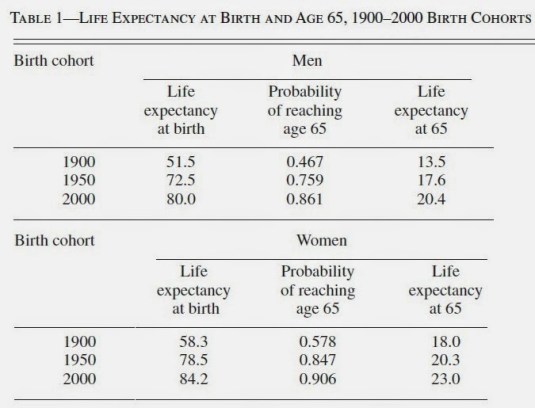
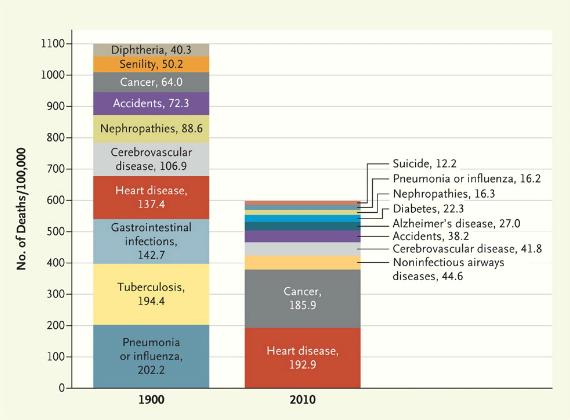
aside from a halving in the chances of dying in an accident, Pneumonia/influenza, tuberculosis, and gastrointestinal infections each claimed more lives per 100,000 people than did heart disease in 1900. The major causes of death 100 years ago are now historic curios rather than current threats.
via priceonomics.com
Why Life Expectancy Is Misleading
25 May 2014 Leave a comment
in technological progress Tags: life expectancy, The Great Escape, The Great Fact
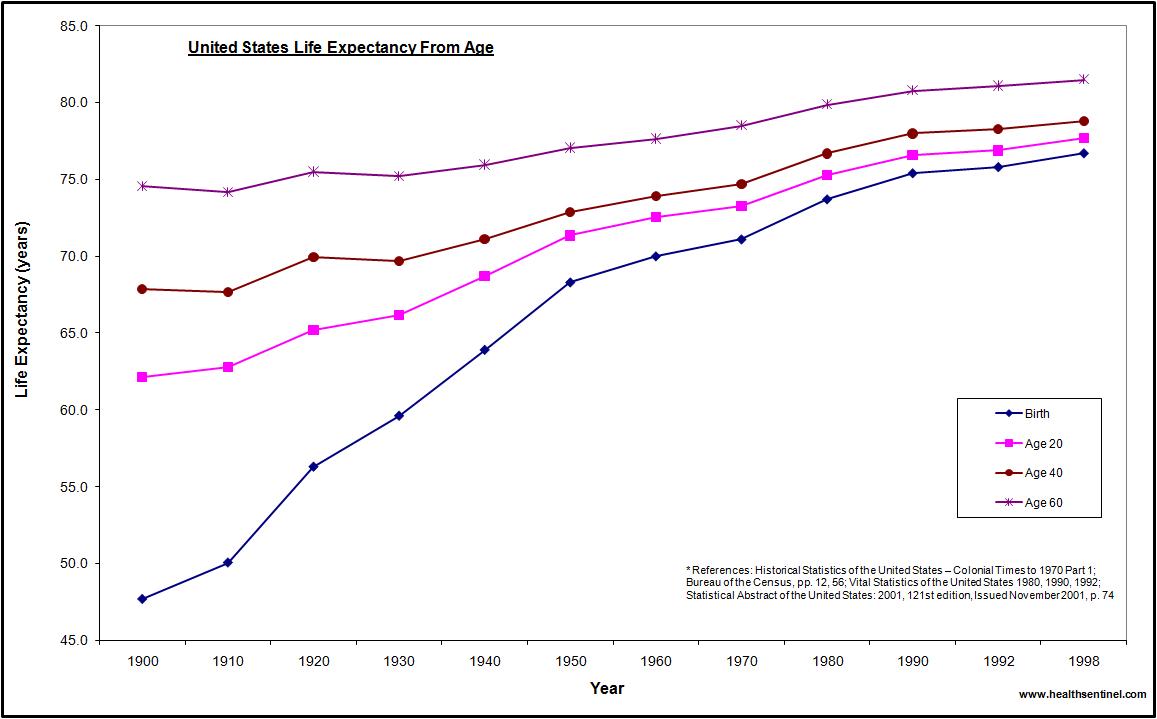
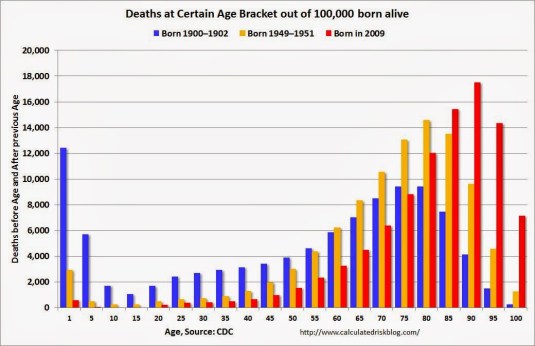
From 1900 to 1998, life expectancy from birth for Americans rose from 47 to 75, an increase of 28 years.
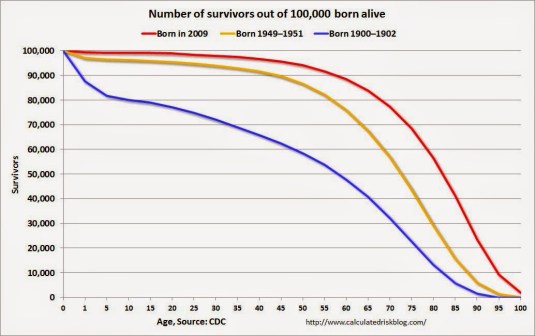
A good deal of that increase in life span had to do with increases in the chances of surviving birth and childhood.
via priceonomics
 Utopia, you are standing in it!
Recent Comments