"Today, children in sub-Saharan Africa are more likely…"—Prof. Angus Deaton, @Princeton
Data: buff.ly/1K2tELk http://t.co/lrTdiLi3F7—
HumanProgress.org (@humanprogress) July 12, 2015
A stunning aspect of The Great Escape since my parents were born
13 Jul 2015 Leave a comment
in applied welfare economics, development economics, economic history, growth disasters, growth miracles, health economics Tags: Africa, British economy, British history, child mortality, child poverty, infant mortality, life expectancies, The Great Enrichment, The Great Escape, The Great Fact
We now know that extreme poverty can be eradicated within one more generation
13 Jul 2015 Leave a comment
in development economics, economic history, growth disasters, growth miracles Tags: capitalism and freedom, extreme poverty, global poverty, The Great Escape, The Great Fact
"We now know that extreme poverty can be eradicated within one more generation." — UN Secretary-General Ban Ki-moon http://t.co/hMjKtYlh5h—
RFE/RL (@RFERL) July 07, 2015
The Great Escape in China, India and Indonesia
12 Jul 2015 Leave a comment
in applied welfare economics, development economics, economic history, growth disasters, growth miracles, health economics Tags: China, India, Indonesia, life expectancies, The Great Escape, The Great Fact
These 4 nations are 50% of mankind. That's 3.5 billion people who are living longer. buff.ly/1Kle6mU #health http://t.co/949oqisMsL—
HumanProgress.org (@humanprogress) June 30, 2015
Naomi Klein versus The Great Fact
12 Jul 2015 Leave a comment
in comparative institutional analysis, development economics, economic history, growth disasters, growth miracles Tags: activists, do gooders, evidence-based policy, extreme poverty, global poverty, Naomi Klein, The Great Enrichment, The Great Fact
71% of the world live on less than $10 per day buff.ly/1D5kA3c http://t.co/GLCifBBOGP—
Business Insider (@businessinsider) July 11, 2015
Extreme poverty declined > 50% from 1.9 bil in '90 to 836 mil today: on.undp.org/Ppj00 #WPD2015 #MDGs http://t.co/vUDO5AYd4H—
UN Development (@UNDP) July 12, 2015
The number of ‘low-income’ countries halved since 1994
12 Jul 2015 Leave a comment
MAP showing location of 31 low-income countries, fewest since 1994; only 4 are outside Africa gu.com/p/4abxb/stw http://t.co/R0rzLzP6cc—
Mark Anderson (@MarkC_Anderson) July 10, 2015
The Great Escape: infant mortality since 1990
10 Jul 2015 Leave a comment
in development economics, growth disasters, growth miracles, health economics Tags: child poverty, extreme poverty, global poverty, infant mortality, life expectancies, The Great Enrichment, The Great Escape, The Great Fact
Child mortality declined in all world regions.
Here is by how much: http://t.co/06lS3ZELKr—
Max Roser (@MaxCRoser) June 26, 2015
The Great Fact: the rise of the middle class in developing countries
09 Jul 2015 Leave a comment
China pulled 203m into the middle class from 2001-11; more than half the global gain of 385m pewrsr.ch/1LSs6Wz http://t.co/DiskvneykJ—
Rakesh Kochhar (@RakeshKochhar) July 08, 2015
Why does 1% of history have 99% of the wealth?
07 Jul 2015 Leave a comment
in applied price theory, applied welfare economics, comparative institutional analysis, economic growth, economic history, liberalism Tags: Deidre McCloskey, The Great Enrichment, The Great Escape, The Great Fact
Matt Ridley on the Pope and The Great Fact
06 Jul 2015 Leave a comment
in applied price theory, applied welfare economics, development economics, economic history, economics of regulation, energy economics, entrepreneurship, environmental economics, financial economics, growth disasters, growth miracles, health economics, history of economic thought, human capital, industrial organisation, labour economics, liberalism, survivor principle Tags: doomsday prophecies, Matt Ridley doomsday prophets, Papal economics, The Great Enrichment, The Great Escape, The Great Fact
See which way the data points for yourself, like @mattwridley. buff.ly/1HsZxgx #health #progress http://t.co/B3KbUJOn05—
HumanProgress.org (@humanprogress) June 30, 2015
The Great Fact in Sudan
06 Jul 2015 Leave a comment
in development economics, growth disasters, growth miracles Tags: Sudan, The Great Escape, The Great Fact
Access to education and to the Internet are expanding and helping to improve lives: buff.ly/1NzHbKP #progress http://t.co/45AISWVKHQ—
HumanProgress.org (@humanprogress) July 02, 2015
Moving Brad DeLong’s Time Machine behind John Rawls’ veil of ignorance
06 Jul 2015 Leave a comment
in applied welfare economics, constitutional political economy, economic history, Rawls and Nozick Tags: Brad Delong, Elizabeth Warren, good old days, John Rawls, The Great Enrichment, The Great Escape, The Great Fact, time machine, Twitter left
Brad DeLong set up a thought experiment to work out if we were better off than in the good old days. He asked how much money would you want to take with you if you had to step into a time machine to go back to some specific point in time and not be worse off for the trip in living standards and life expectancy. He was writing in 1995, talking about going back to 1895.

John Rawls asks a similar question by saying what type of society would you to agree to in a social contract if you’re behind a veil of ignorance. You didn’t know where you were going to be in society behind the veil of ignorance.

All you know you is you will be some random member of that society, at the top, bottom or somewhere in between.
…no one knows his place in society, his class position or social status; nor does he know his fortune in the distribution of natural assets and abilities, his intelligence and strength, and the like.
What social institutions would you agree in that society given you don’t know where you will be in it?
John Rawls also said that the society was fair if you didn’t mind showing up somewhere in it as a random member.

Let’s suppose a thought experiment which combines a time machine with a veil of ignorance:
- Alien proctologists from outer space take time off from kidnapping rednecks at closing time at pubs to kidnap you instead;
- After probing your nether regions, but before flying off to light years away where they came from without any further earthly contact they offer you the option of beaming back to where you came from but with a twist in time;
- You can beam back to be a random member of your current society or a random member of a society in the past of your choice; but
- Random reassignment to either the present or a past of your choosing are your only options as the alien kidnap victim.
Behind that inter-temporal veil of ignorance, would you choose to be a random member of your own society or prefer to beam back in time to before the ravages of neoliberalism destroyed the good old days?
Apparently, we not a cent better off compared to the 70s because all the income gains, every single cent, went into the pockets of the top 10%, if Senator Warren is to be believed in her recent Washington post op-ed:
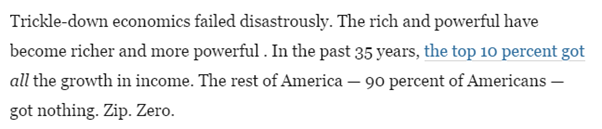
When you line up by Senator Warren to go into the time machine, remember to leave your iPhones and air points at the door.
Innovation is letting us accomplish more with less. Learn more: buff.ly/1LmtAZD #tech #progress http://t.co/e2kQlGu3NA—
HumanProgress.org (@humanprogress) June 22, 2015
@MaxCRoser only one line in this chart about India matters
05 Jul 2015 Leave a comment
in comparative institutional analysis, constitutional political economy, development economics, economic history, growth disasters, growth miracles, poverty and inequality, Public Choice Tags: capitalism and freedom, extreme poverty, global poverty, India, Leftover Left, The Great Escape, The Great Fact, top 1%
In #India poverty is falling very, very rapidly – while inequality is rising.
More at: bit.ly/1KLT8Lh http://t.co/xTxlW1i06o—
Max Roser (@MaxCRoser) June 29, 2015
Only one line in this chart matters
04 Jul 2015 Leave a comment
in applied welfare economics, development economics, economic history, growth disasters, growth miracles Tags: capitalism and freedom, child poverty, extreme poverty, global poverty, Malaysia, The Great Escape, The Great Fact
In #Malaysia inequality and poverty are falling.
More at: bit.ly/1KLUA02 http://t.co/aXEmuA0bnb—
Max Roser (@MaxCRoser) July 02, 2015
The rise of the South
03 Jul 2015 Leave a comment
in development economics, growth disasters, growth miracles Tags: China, India, The Great Fact, undeveloped countries
The GDP of the South doubled to 40% by 2012, w/ China —12% of global GDP: wrld.bg/N9CYe #RisingoftheSouth http://t.co/Yt2LiF9srr—
World Bank Pubs (@WBPubs) May 20, 2015
 Utopia, you are standing in it!
Recent Comments