
In 2015, the top 1% paid almost as much in federal income taxes ($568B and 39% of taxes paid) as the entire bottom 95% ($588B and 40.4% of taxes paid). pic.twitter.com/wJJWV7OpAF
— Mark J. Perry (@Mark_J_Perry) November 28, 2017
Celebrating humanity's flourishing through the spread of capitalism and the rule of law
14 Dec 2017 Leave a comment
in economic history, politics - USA, public economics Tags: top 1%
09 Dec 2017 Leave a comment
in applied price theory, economic history, labour economics, sports economics Tags: superstars, top 1%
10 Nov 2017 Leave a comment
in politics - USA, public economics Tags: top 1%
31 May 2017 Leave a comment
in financial economics, human capital, labour economics, labour supply, occupational choice Tags: superstars, top 1%
11 May 2017 Leave a comment
in fiscal policy, macroeconomics, politics - USA, Public Choice, public economics, sports economics Tags: taxation and labour supply, top 1%
07 Apr 2017 Leave a comment
in economic history, politics - New Zealand, poverty and inequality Tags: superstar wages, superstars, top 1%
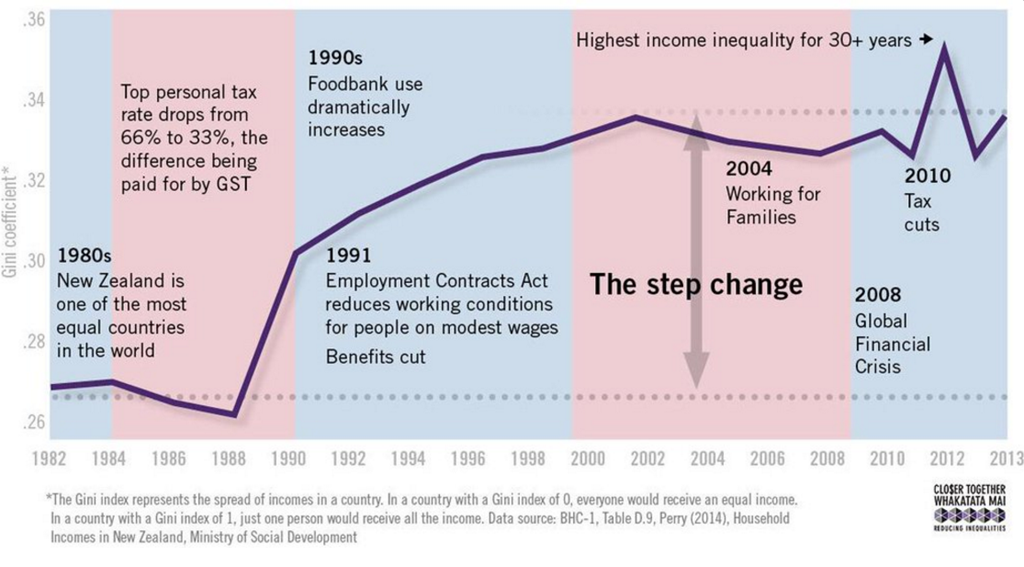
It has become an urban legend in New Zealand that inequality is getting worse and worse.
Brian Easton adjusted the top income share database for New Zealand for the introduction of dividend imputation. This encouraged companies to distribute more dividends.
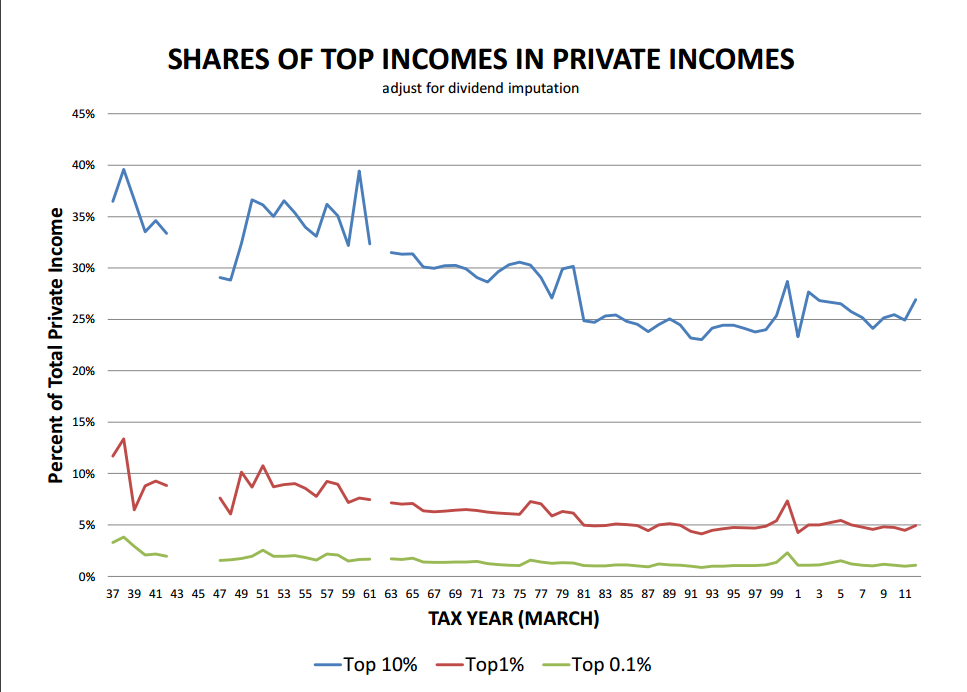
Once this measurement error was corrected by Easton, there has been no increase in top income shares in New Zealand since the 1950s. It has been a slow taper at best or a flat line.
There is a wages boom from the early 1990s after 20 years of wage stagnation, a period which some people regard as the good old days.
The return of real wages growth, and strong employment growth to boot, came straight after the Ruth Richardson horror budget and the passage of the Employment Contracts Act.
Every ethnic group experienced strong income growth as well as the graphic below shows. The rich got richer and the poor got richer too.
30 Mar 2017 Leave a comment
in applied price theory, development economics, economic history Tags: top 1%
27 Mar 2017 1 Comment
in applied price theory, applied welfare economics, development economics, economic history, growth miracles, politics - USA Tags: anti-market bias, Leftover Left, pessimism bias, The Great Enrichment, top 1%
18.1% of all children born on this planet in 1960 died before they had their fifth birthday ourworldindata.org/data/populatio… https://t.co/1FcIzAk88b—
Ninja Economics (@NinjaEconomics) December 28, 2015
A Graph for Pope Francis: If You Want to Help the Poor, You Should Embrace Capitalism. Exhibit A: See Chart http://t.co/yG1ixKZxrJ—
Mark J. Perry (@Mark_J_Perry) September 21, 2015
Celebrating humanity's flourishing through the spread of capitalism and the rule of law
Celebrating humanity's flourishing through the spread of capitalism and the rule of law
Celebrating humanity's flourishing through the spread of capitalism and the rule of law
Celebrating humanity's flourishing through the spread of capitalism and the rule of law
Celebrating humanity's flourishing through the spread of capitalism and the rule of law
Celebrating humanity's flourishing through the spread of capitalism and the rule of law
Celebrating humanity's flourishing through the spread of capitalism and the rule of law
A History of the Alt-Right
Econ Prof at George Mason University, Economic Historian, Québécois
Celebrating humanity's flourishing through the spread of capitalism and the rule of law
Scholarly commentary on law, economics, and more
Beatrice Cherrier's blog
Celebrating humanity's flourishing through the spread of capitalism and the rule of law
Celebrating humanity's flourishing through the spread of capitalism and the rule of law
Celebrating humanity's flourishing through the spread of capitalism and the rule of law
Why Evolution is True is a blog written by Jerry Coyne, centered on evolution and biology but also dealing with diverse topics like politics, culture, and cats.
Celebrating humanity's flourishing through the spread of capitalism and the rule of law
A rural perspective with a blue tint by Ele Ludemann
DPF's Kiwiblog - Fomenting Happy Mischief since 2003
Celebrating humanity's flourishing through the spread of capitalism and the rule of law
The world's most viewed site on global warming and climate change
Tim Harding's writings on rationality, informal logic and skepticism
A window into Doc Freiberger's library
Let's examine hard decisions!
Commentary on monetary policy in the spirit of R. G. Hawtrey
Thoughts on public policy and the media
Celebrating humanity's flourishing through the spread of capitalism and the rule of law
Politics and the economy
A blog (primarily) on Canadian and Commonwealth political history and institutions
Reading between the lines, and underneath the hype.
Economics, and such stuff as dreams are made on
"The British constitution has always been puzzling, and always will be." --Queen Elizabeth II
Celebrating humanity's flourishing through the spread of capitalism and the rule of law
Celebrating humanity's flourishing through the spread of capitalism and the rule of law
WORLD WAR II, MUSIC, HISTORY, HOLOCAUST
Undisciplined scholar, recovering academic
Celebrating humanity's flourishing through the spread of capitalism and the rule of law
Res ipsa loquitur - The thing itself speaks
In Hume’s spirit, I will attempt to serve as an ambassador from my world of economics, and help in “finding topics of conversation fit for the entertainment of rational creatures.”
Researching the House of Commons, 1832-1868
Articles and research from the History of Parliament Trust
Reflections on books and art
Posts on the History of Law, Crime, and Justice
Celebrating humanity's flourishing through the spread of capitalism and the rule of law
Exploring the Monarchs of Europe
Cutting edge science you can dice with





Recent Comments